

What Disqualifies You From Disability Coverage?

What Disqualifies You From Disability Coverage? What Conditions or Situations Make You Ineligible
Getting turned down for disability can feel like a door slamming shut. You are sick or hurt. You can’t work like you used to. And then a letter tells you “no.”
I wrote this guide because the rules are confusing, and most denials happen for a short list of reasons. If you know those reasons ahead of time, you can avoid a lot of them.
In this article, I’ll walk you through what disqualifies you from disability coverage in plain words. I’ll cover the two big Social Security programs, SSDI and SSI. I’ll also cover private and work-based disability insurance, since those have their own rules.
Here’s a quick note on the names:
- SSDI (Social Security Disability Insurance) is for people who worked and paid Social Security taxes.
- SSI (Supplemental Security Income) is for people with very little income and very few assets.
- Private or employer disability insurance is a policy you buy or get through your job.
All the dollar amounts below are the 2026 numbers. They usually change every January, so check the latest figures before you apply.
The Quick Answer: 10 Things That Can Disqualify You
If you only have a minute, here’s the short list. I’ll explain each one in more detail below.
- You earn too much money from work. In 2026, that usually means more than $1,690 a month.
- You don’t have enough work credits. This one only applies to SSDI.
- Your condition isn’t severe enough. Social Security has to believe you can’t do any steady job, not just your old one.
- Your condition won’t last long enough. It must last at least 12 months or be expected to end in death.
- You don’t follow your doctor’s treatment plan without a good reason.
- Drugs or alcohol are the main cause of your disability.
- You are in jail or prison, or you have certain open warrants.
- You lie or hide facts on your application.
- You’ve reached full retirement age. At that point, retirement benefits take over.
- You have too much income or too many assets for SSI. For SSI, the asset limit is $2,000 for one person.
Private disability policies add their own rules, like pre-existing condition limits. I’ll cover those near the end.
1. Earning Too Much Money From Work
This is the first thing Social Security checks. If you work and earn too much, they stop right there. They won’t even look at your medical records.
The official name for this limit is substantial gainful activity, or SGA. It sounds fancy, but it just means “real work that pays enough to live on.”
Here are the 2026 SGA limits from the Social Security Red Book:
| Who you are | Monthly earnings limit (2026) |
|---|---|
| Most people with a disability | $1,690 |
| People who are legally blind | $2,830 |
So if you earn $1,800 a month at a part-time job, you will most likely be denied. That’s true even if your health problem is very serious.
Q: Can I work at all and still get disability?
A: Yes, a little. You can earn under the SGA limit. Social Security can also subtract some disability-related costs you pay, like special equipment or a ride to work. That can lower the earnings they count.
Q: What if I’m already getting SSDI and want to try working?
A: SSDI has a trial work period. You can test going back to work for 9 months without losing your check. In 2026, any month you earn more than $1,210 counts as one of those 9 trial months.
My tip: If you are still working full time, it’s usually better to wait until you stop or cut way back before you apply. Applying while earning over the limit almost always leads to a fast “no.”
2. Not Having Enough Work Credits (SSDI Only)
SSDI works a lot like insurance. You “pay in” through the Social Security taxes taken out of your paycheck. If you haven’t paid in enough, you can’t collect.
You pay in by earning work credits. In 2026, you get one credit for every $1,890 you earn. You can earn up to 4 credits a year. So once you earn $7,560 in a year, you’ve maxed out your credits for that year, according to Social Security.
How many credits do I need?
Most people need to pass the 20/40 rule:
- You need 40 credits in total.
- At least 20 of them must come from the last 10 years before your disability began.
Younger workers can qualify with fewer credits. That’s because they haven’t had as many years to work.
The “recent work” trap
This is the part that catches a lot of people. Say you worked for 25 years, then stayed home for 6 years before getting sick. You may have plenty of credits overall. But you might not have 20 credits from the last 10 years. That can disqualify you from SSDI.
My tip: Create a free My Social Security account at ssa.gov. It shows your work history and how many credits you have. Check it before you apply. If you don’t have enough credits, you may still qualify for SSI, which doesn’t use work credits.
3. Your Condition Isn’t Severe Enough or Won’t Last Long Enough
This is the biggest reason people get denied. Social Security uses a very strict definition of “disabled.”
They only pay for total disability. They do not pay for partial disability or short-term disability. Your condition has to meet all three of these tests:
- It stops you from working at the SGA level. (That’s the $1,690-a-month line we talked about.)
- You can’t do your old job, and you can’t switch to other work.
- It has lasted, or will last, at least 12 months in a row, or it is expected to end in death.
Why “any other work” matters so much
I think this rule surprises people the most. It’s not enough that you can’t do your job.
Let’s say you were a roofer and hurt your back. You can’t climb ladders anymore. But Social Security might decide you could do a desk job, like answering phones. If they think that, they can deny you.
They look at your age, schooling, work history, and job skills when they decide this. Being older usually helps. It’s harder to start a brand-new kind of work at 58 than at 30.
What about short-term problems?
A broken leg that heals in 6 months won’t qualify. Neither will surgery with a short recovery. Social Security expects people to use savings, sick leave, or short-term insurance for those.
The good news for very serious illnesses
Some conditions are so serious that Social Security fast-tracks them. This is called Compassionate Allowances. Examples include ALS and pancreatic cancer.
My tip: Your medical records are your proof. Go to your appointments. Tell your doctor exactly what you can’t do, like “I can’t sit for more than 20 minutes.” Those details matter more than the name of your illness.
4. Not Following Your Doctor’s Treatment Plan
If a treatment would let you go back to work, Social Security expects you to try it. If you skip it for no good reason, they can deny or stop your benefits.
This could mean:
- Not taking medicine your doctor prescribed
- Skipping physical therapy
- Refusing a surgery that is likely to help
- Missing lots of appointments
Q: What counts as a “good reason” to skip treatment?
A: Social Security does accept some reasons. Here are common ones:
- You can’t afford it, and you’ve tried to find free or low-cost care.
- Your religion doesn’t allow that kind of treatment.
- The treatment is very risky, like a major surgery with a high chance of failure.
- Your mental illness makes it hard for you to understand or stick with treatment.
- A different doctor told you not to do it.
My tip: If you stop a treatment, write down why. Tell your doctor so it goes in your records. A clear reason on paper can save your claim.
5. Drugs or Alcohol Are the Main Cause
Since 1996, Social Security can’t pay disability benefits when drug or alcohol addiction is the main reason you can’t work.
Here’s how they check. They ask one big question: “If this person stopped using drugs or alcohol, would they still be disabled?”
- If the answer is yes, you can still qualify. For example, say you have liver damage from years of drinking, and the damage won’t heal even if you quit. That damage can count.
- If the answer is no, you’ll be denied. For example, say your only problem is that you can’t hold a job while you’re drinking. That won’t qualify.
Q: Will having an addiction in my records automatically get me denied?
A: No. Many people with a history of substance use get approved. What matters is whether your other health problems would still stop you from working if you were sober.
My tip: If you are in recovery, make sure your records show it. Treatment programs, meetings, and clean test results all help prove that your disability isn’t just caused by drinking or drug use.
6. Jail, Warrants, and Fraud
These three can stop or pause your benefits, even if you are truly disabled.
Being in jail or prison
- SSDI: Your checks stop if you are convicted of a crime and locked up for more than 30 days in a row.
- SSI: Your checks stop if you spend a full calendar month in a jail, prison, or other public institution.
The good news is that benefits can often start again after you are released. You’ll need to contact Social Security to restart them.
Having certain open warrants
You may not get benefits if you have an open warrant for running from the law, escaping custody, or violating probation or parole. Clearing up the warrant is usually the first step to getting paid.
Lying or hiding facts
This one is simple: don’t do it. If you lie on your application or hide income, Social Security can:
- Deny your claim
- Stop your benefits for months at a time as a penalty
- Make you pay back money you got
- Send your case for a criminal charge
My tip: Be honest, even if a fact feels like it might hurt you. A small truth is much easier to explain than a lie that gets caught later.
7. Reaching Full Retirement Age
SSDI is meant for people who become disabled before retirement age. Once you reach full retirement age, you can’t start SSDI. For anyone born in 1960 or later, that age is 67.
If you’re already on SSDI when you hit that age, don’t worry. Your disability check turns into a retirement check, and the amount stays the same, according to Social Security.
8. Too Much Income or Too Many Assets (SSI Only)
SSI is for people with very little money. So it has strict limits on what you own and what you earn.
The asset limit
The SSI resource limit is:
| Who | Limit on countable assets |
|---|---|
| One person | $2,000 |
| A married couple | $3,000 |
That includes cash, bank accounts, stocks, and land other than your home. If you’re over the limit at the start of a month, you can’t get SSI that month.
Luckily, a lot of things don’t count:
- The home you live in
- One car used for getting around
- Household goods and wedding rings
- Burial plots and small burial funds up to $1,500
- Up to $100,000 in an ABLE account, a special savings account for people with disabilities
The income limit
In 2026, the most SSI pays one person is $994 a month. If your countable income is too high, your SSI drops to zero. Income from a spouse or parents can count against you too.
Watch out: Giving away money or selling things for cheap to get under the limit can backfire. Social Security can make you wait up to 36 months for SSI if you do that.
9. Private and Employer Disability Insurance Exclusions
You may have disability insurance through your job, or you may have bought a policy yourself. These plans follow the rules written in your policy, not Social Security’s rules. Every policy is a little different, so read yours closely.
Here are the most common things that can disqualify you:
- Pre-existing conditions. Many policies won’t cover a health problem you were treated for shortly before the coverage started. This often applies to claims in your first year.
- The waiting period. Most plans make you wait a set time, like 90 days, before payments start. If you get better before then, you get nothing.
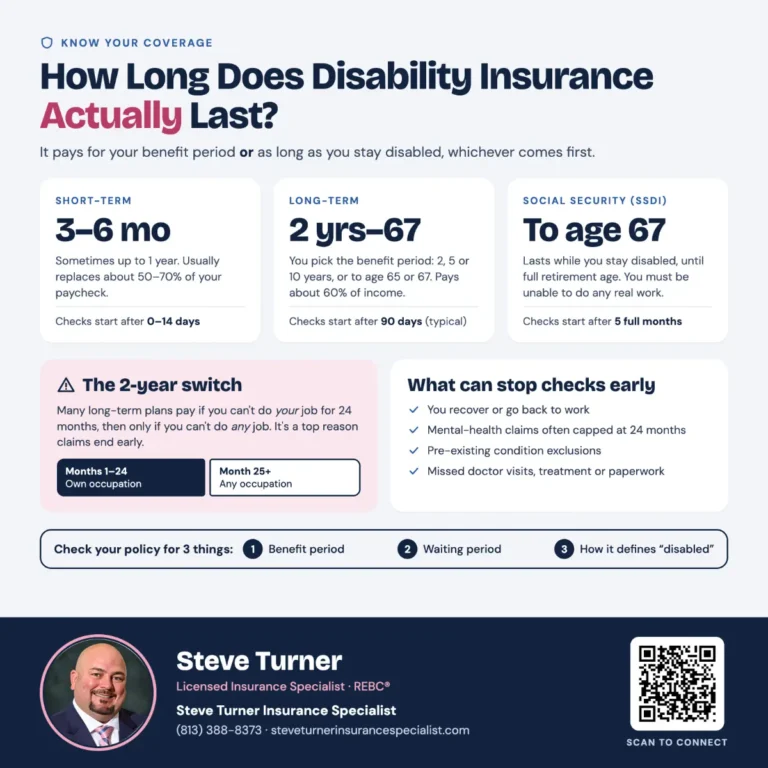
- “Own job” vs. “any job.” Some plans pay if you can’t do your job. Others switch after about 2 years and only pay if you can’t do any job.
- Mental health limits. Many plans cap payments for mental health conditions, often at 24 months.
- Self-inflicted injuries. Injuries you cause on purpose are usually not covered.
- Injuries while committing a crime. Getting hurt while breaking the law is a common exclusion.
- War or military action. Many policies exclude injuries from war.
- Not seeing a doctor. Most plans require you to stay under a doctor’s regular care.
- Missed premium payments. If your policy lapses, your coverage is gone.
- Leaving your job. Work-based coverage often ends when your job does.
My tip: Ask your HR department or insurance company for the full policy, not just the summary. The exclusions are usually listed in a section called “Exclusions and Limitations.” Also, many work plans will reduce your payment by the amount you get from SSDI.
Frequently Asked Questions
Does having savings disqualify me from SSDI?
No. SSDI has no limit on savings or property. You could have money in the bank and a paid-off house and still qualify. Asset limits apply only to SSI.
Can my spouse’s income disqualify me?
For SSDI, no. Your spouse can earn any amount. For SSI, yes. Social Security counts part of your spouse’s income and assets as yours.
Can I get disability if I’m self-employed?
Yes. If you paid self-employment taxes, you earned work credits just like an employee. Social Security will look at your net earnings, not just what came into the business.
If I get denied once, am I disqualified forever?
Not at all. Many people are approved on appeal. You usually have 60 days from the date on your denial letter to ask for an appeal. Asking for a new look is often better than starting over with a new application.
Can I get SSDI and SSI at the same time?
Yes, in some cases. If your SSDI check is very small and you have few assets, you may get SSI to fill the gap.
Can I lose my benefits after I’m approved?
Yes. Social Security checks in from time to time to see if you are still disabled. These are called continuing disability reviews. Earning over the SGA limit after your trial work period can also end your benefits.
Does workers’ comp or VA disability disqualify me?
No, they don’t disqualify you. But workers’ compensation and some other public disability payments can lower your SSDI check. VA disability pay does not lower SSDI.
What I’d Do If I Were Denied
A denial letter is not the end of the road. Here’s the plan I’d follow:
- Read the letter carefully. It tells you why you were denied. That reason tells you what to fix.
- Mark the deadline. You usually have 60 days to appeal. Don’t let it slip by.
- Gather more proof. Ask your doctors for updated records and a letter about what you can’t do.
- File your appeal. You can do it online at ssa.gov, by phone, or at your local office.
- Get help if you need it. Disability lawyers and advocates usually only get paid if you win. Their fee is capped by law.
The Bottom Line
Most people who get disqualified from disability coverage fall into a few simple groups. They earn too much, don’t have enough work credits, or can’t prove their condition is severe and long-lasting. Others run into rules about treatment, drugs or alcohol, jail, or SSI’s money limits.
The best thing I can tell you is this: learn the rules before you apply. Check your work credits. Keep your earnings under the limit. Go to every doctor’s visit. And be completely honest.
Disability rules change every year, so check ssa.gov for the newest numbers before you file. SSA usually announces the 2027 amounts in mid-October, and they take effect in January.
This article is for general information only. It isn’t legal advice. For help with your own case, talk to Social Security or a disability attorney.
Why choose Steve Turner Insurance Specialist?
Because I’m an “Insurance Specialist.” An “insurance specialist” is a broad term that includes insurance agents and insurance brokers, but the key difference is who the agent represents versus who the broker represents.
An “insurance agent” works directly for an insurance company and sells its specific policies to clients.
An “insurance broker” acts as an independent intermediary, comparing policies from multiple companies to find the best fit for their client’s needs, essentially representing the client rather than the insurance company.
I am both a licensed Insurance Agent and a licensed Insurance Broker.
My number one goal in life is to help people and ensure, without a shadow of a doubt, that you and your family are secure and protected. I will always be by your side, helping you mitigate risk by providing the industry’s best and most affordable insurance solutions.
I will find insurance plans for the entire family to help cover whatever life throws at you. I can help you save on severe medical emergencies, find a health insurance plan with low- or no-cost doctor visits and affordable prescription medications, and protect your family in the event of an unexpected accident or illness.
Best of all, it doesn’t cost you anything extra to use an experienced Insurance Agent and Broker like me to help you find the Insurance Plans that fit your individual, family, or business needs.
The companies that sell the insurance plans “you choose“ pay me – you don’t pay me. Calling any big insurance company directly won’t get you a lower price, as they will forward your call to the next available insurance agent on their list. You won’t have had any opportunity to learn about the insurance agent you’re speaking with in advance, understand their qualifications or experience level, or make an informed choice about who you want to work with.
Tap the Contact Me text or icon and get in touch by phone or email, or schedule a “No Obligation” chat through my calendar. I look forward to speaking with you!
OUR CLIENT REVIEWS


CONTACT STEVE TURNER INSURANCE AGENT & BROKER
I’m here to take your calls and emails and answer your questions 7 Days a week from 7:00 a.m. to 8:00 p.m., excluding posted holidays.
Steve Turner is a licensed agent and broker and a long-standing member of the National Association of Benefits and Insurance Professionals®. Steve holds the prestigious Registered Employee Benefits Consultant® designation. NABIP® is the preeminent organization for health insurance and employee benefits professionals and works diligently to ensure all Americans have access to high-quality, affordable healthcare and related services.
Steve Turner is a licensed agent appointed by Florida Blue.
Richard Steven Turner’s official Florida state insurance license number (operating as Steve Turner Insurance Specialist) is W333468
EMAIL ME: 24×7
OFFICE LOCATION
Website: steveturnerinsurancespecialist.com
Email: [email protected]
Phone and Text: +1-813-388-8373
Business Hours:
Monday: 7:00 a.m. – 8:00 p.m.
Tuesday: 7:00 a.m. – 8:00 p.m.
Wednesday: 7:00 a.m. – 8:00 p.m.
Thursday: 7:00 a.m. – 8:00 p.m.
Friday: 7:00 a.m. – 8:00 p.m.
Saturday: 7:00 a.m. – 8:00 p.m.
Sunday: 7:00 a.m. – 8:00 p.m.
DISABILITY INSURANCE POSTS
INSURANCE OFFERINGS
What Disqualifies You From Disability Coverage?
HEALTH INSURANCE

MEDICARE ADVANTAGE

MEDICARE SUPPLEMENT

PRESCRIPTION DRUGS

LIFE INSURANCE

DISABILITY INSURANCE
DENTAL INSURANCE

GROUP HEALTH INSURANCE

ACCIDENT INSURANCE

LONG TERM CARE INSURANCE

MEDICAID INSURANCE

MEDICARE INSURANCE

MEDICARE PART A INSURANCE

MEDICARE PART B INSURANCE

MEDICARE PART C INSURANCE

MEDICARE PART D INSURANCE

MEDICARE PLAN G INSURANCE

MEDICARE PLAN N INSURANCE

SERVICE AREA
MEDICARE STATEMENT
We do not offer every plan available in your area. Currently, we represent 7 organizations that offer 70 products in your area. Please contact Medicare.gov or 1-800-MEDICARE for information on all your options.
Steve Turner is a licensed insurance agent and is not connected with or endorsed by the United States Government or the Federal Medicare Program. The Medicare Annual Enrollment Period is October 15 to December 7.
There’s no one-size-fits-all answer. Carefully consider your health status, expected medical needs, prescription drugs, budget, preferred doctors and hospitals, and how comfortable you are with network rules. During the Annual Enrollment Period, you can research the plans available in your Florida county using the Medicare Plan Finder at Medicare.gov, compare costs and benefits, and get free, unbiased counseling from Florida’s SHINE (Serving Health Insurance Needs of Elders) program at floridashine.org or 1-800-963-5337. You can also call 1-800-MEDICARE (1-800-633-4227; TTY 1-877-486-2048), 24 hours a day, 7 days a week.