

Should I Get Disability Insurance If I Have FMLA?

Should I Get Disability Insurance If I Have FMLA? How Do These Programs Work Together
A few years ago, I had a scary moment. My doctor told me I needed surgery, and I would be out of work for about eight weeks. My first thought was, “Good thing I have FMLA.” My second thought, a few seconds later, was, “Wait. Does FMLA pay me?”
It doesn’t. And that’s the big thing I want you to understand before you read anything else.
So, should you get disability insurance if you have FMLA? For most people, my answer is yes. FMLA keeps your job safe while you’re gone. Disability insurance is what keeps money coming in. They do two very different jobs, and most of us need both.
In this article, I’ll explain:
- What FMLA really does (and doesn’t do)
- What disability insurance is
- How the two work together
- Who needs disability insurance the most
- How to get it without overpaying
I’ll keep it simple. No legal jargon, I promise.
What Is FMLA? (The Short Version)
FMLA stands for the Family and Medical Leave Act. It’s a federal law from 1993. It lets some workers take time off for big life events without losing their job.
Here’s what FMLA gives you:
- Up to 12 weeks off in 12 months
- Your job back (or one just like it) when you return
- Your health insurance stays on, just like before
And here’s what FMLA does not give you:
- A paycheck. FMLA leave is unpaid.
That last part surprises a lot of people. FMLA promises your boss won’t fire you for being gone. It is not a promise that you’ll get paid while you’re gone.
Who qualifies for FMLA?
Not everyone gets FMLA. You usually need to check all of these boxes:
- Your employer has 50 or more workers within 75 miles of where you work (or you work for a government agency or a school).
- You’ve worked there for at least 12 months.
- You’ve worked at least 1,250 hours in the past year. That’s about 24 hours a week.
If you work at a small business, or you just started a new job, you may not have FMLA at all. That’s another reason disability insurance matters.
What can I use FMLA for?
You can use FMLA to:
- Recover from your own serious health problem
- Have a baby, or bond with a new baby, adopted child, or foster child
- Care for a sick spouse, child, or parent
- Handle certain needs when a family member is in the military
What Is Disability Insurance?
Disability insurance pays you part of your paycheck when you can’t work because you’re sick or hurt. Think of it as “paycheck insurance.” You pay a small amount now, and if something happens later, it sends you money.
There are two main kinds.
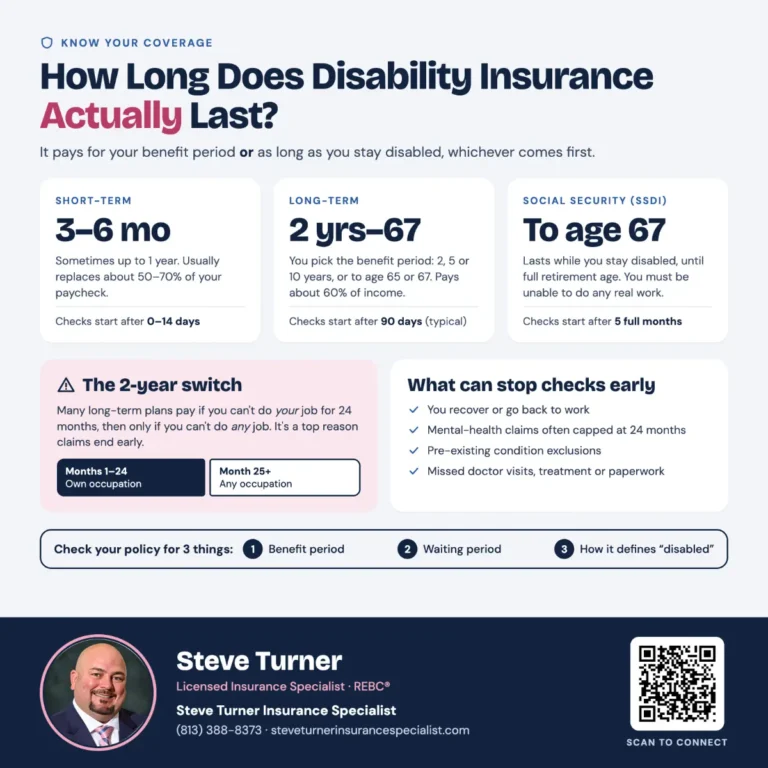
Short-term disability insurance
- How long it pays: Usually 3 to 6 months, sometimes up to a year
- How much it pays: Often 50% to 70% of your pay
- When it starts: After a short wait, often 7 to 14 days
- Good for: Surgery, a broken bone, pregnancy and childbirth, a bad illness
Long-term disability insurance
- How long it pays: A few years, or even until age 65 or 67
- How much it pays: Often 50% to 60% of your pay
- When it starts: After a longer wait, often 90 days
- Good for: Cancer, a heart attack, a serious back injury, or any problem that keeps you out of work for a long time
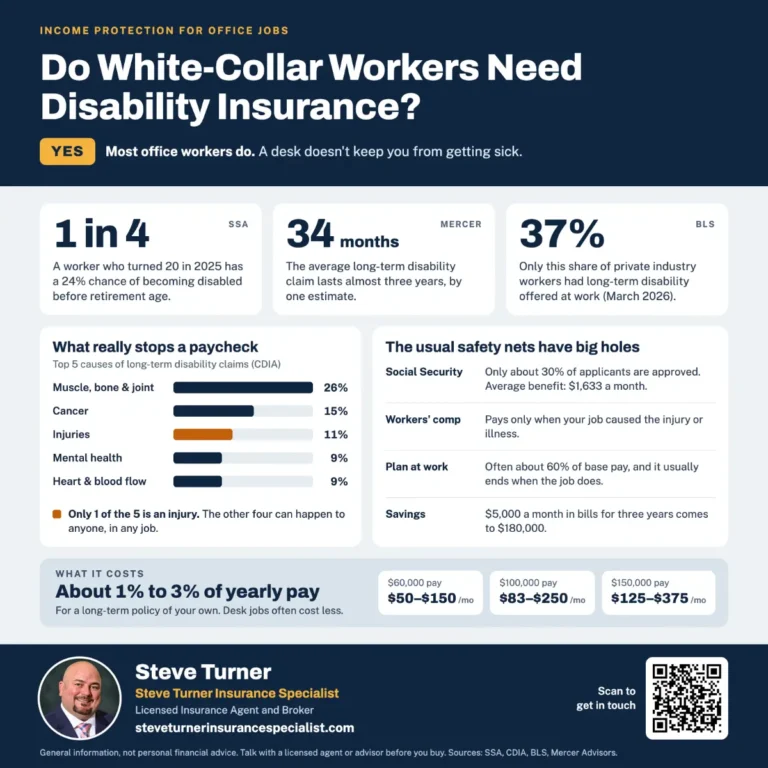
A lot of people picture disability as a big car crash. But most long-term claims come from everyday health problems, like back and joint issues, cancer, and heart disease. That’s what made me take it seriously. I don’t do risky things, but I do have a body that can break down like anyone else’s.
Where do people get it?
- Through work. Many employers offer it as a benefit. Sometimes it’s free. Sometimes you pay for it through payroll.
- On your own. You can buy an individual policy from an insurance company.
- From your state. A few states run their own programs. I’ll cover those below.
The Big Difference: FMLA Protects Your Job, Disability Insurance Pays Your Bills
If you remember just one thing from this article, make it this:
FMLA = job protection. Disability insurance = money.
I like to think of it like a house. FMLA is the lock on the front door. It keeps someone from taking your spot while you’re away. Disability insurance is the food in the fridge. It keeps you going while you’re stuck at home.
A lock doesn’t feed you. And food doesn’t lock the door. You want both.
Here’s what can happen if you only have one:
- FMLA only: Your job is safe, but you might go 12 weeks with no paycheck. Rent, car payments, and groceries don’t stop.
- Disability insurance only: You get checks, but your boss may be allowed to fill your job while you’re out. You could get better and have nothing to come back to.
- Both: Your job is waiting for you, and money keeps coming in. This is the goal.
When I sat down and did the math on my own eight weeks out, the number scared me. Two months of bills with no pay would have wiped out most of my savings. That’s when I stopped thinking of disability insurance as a “nice extra.”
FMLA vs. Disability Insurance: Side by Side
Here’s a quick chart to show the difference at a glance.
| Question | FMLA | Short-term disability | Long-term disability |
|---|---|---|---|
| Does it pay me? | No | Yes, about 50% to 70% of pay | Yes, about 50% to 60% of pay |
| Does it protect my job? | Yes | No | No |
| How long does it last? | Up to 12 weeks a year | About 3 to 6 months | Years, sometimes to age 65 or 67 |
| Can I use it to care for family? | Yes | No, only for your own health | No, only for your own health |
| Can I use it for a new baby? | Yes, for birth and bonding | Yes, for recovery after birth | Rarely |
| Who provides it? | The law (your employer must follow it) | Employer, insurer, or some states | Employer or insurer |
| Does everyone get it? | No, you must qualify | Only if you have a policy or live in a state with a program | Only if you have a policy |
One thing jumps out to me in this chart. FMLA covers caring for family, but disability insurance doesn’t. Disability insurance only pays when you are the one who’s sick or hurt.
How FMLA and Disability Insurance Work Together
The good news is that you don’t have to pick one. FMLA and disability insurance usually run at the same time. Your FMLA clock and your disability checks start ticking together.
Let me show you with a simple example.
Example: Maria’s knee surgery
Maria makes $1,000 a week. She needs knee surgery and will be out for 10 weeks. She qualifies for FMLA, and she has short-term disability through work that pays 60% after a 7-day wait.
- Week 1: Maria starts FMLA. Her disability policy has a 7-day waiting period, so she uses a week of paid sick time.
- Weeks 2 to 10: Her disability insurance pays her $600 a week. FMLA keeps her job safe.
- Week 11: Maria goes back to the same job, with the same pay.
Without disability insurance, Maria would have lost about $9,000 in pay. With it, she got about $5,400 of that back. That’s a big difference for most families.
What if I’m out longer than 12 weeks?
This is where it gets tricky. Once you use up your 12 weeks of FMLA, your job is no longer protected by FMLA. But if you have long-term disability insurance, the checks can keep coming.
So in a long illness:
- FMLA covers your job for the first 12 weeks.
- Short-term disability covers your income for the first few months.
- Long-term disability picks up after that and can last for years.
That chain is what keeps a health problem from turning into a money disaster.
A few things to watch for
- Your boss may require you to use paid time off during FMLA. Check your company’s rules.
- Your policy may have a waiting period. Keep some savings or sick days to cover that gap.
- Disability checks may be taxed. If your employer paid the premium, the money is usually taxable. If you paid with after-tax dollars, it’s usually tax-free.
Does My State Already Give Me Paid Leave?
It might. Where you live makes a big difference.
As of fall 2026, 14 states and Washington, D.C. have required paid family and medical leave programs. These programs pay you part of your wages while you’re out for your own health, a new baby, or caring for family. The states include California, Colorado, Connecticut, Delaware, Maine, Massachusetts, Minnesota, New Jersey, New York, Oregon, Rhode Island, and Washington. Delaware, Minnesota, and Maine started paying benefits in 2026.
A few more are coming. Maryland has pushed back the start of its program. Virginia passed a law in April 2026, but its benefits won’t begin until December 2028.
Some states also run their own short-term disability programs. These include California, Hawaii, New Jersey, New York, and Rhode Island.
So do I still need my own coverage if my state has a program?
Maybe not for short-term needs. But here’s what I’d keep in mind:
- State benefits often have a weekly cap. If you earn a good salary, the cap may cover only a small slice of your pay.
- State programs are short—most last a few months. None of them replace long-term disability insurance.
- Rules change. Check your state’s official website for the latest numbers.
What if my state has nothing?
Then you’re in the same boat as most Americans. Many states, including big ones like Florida and Texas, have no state-paid leave or state disability program. In those states, short-term disability insurance is often the only way to get paid while you recover from surgery or childbirth. If that’s you, I’d treat disability insurance as a must-have, not a maybe.
7 People Who Really Need Disability Insurance (Even With FMLA)
I think almost every worker should at least look at disability insurance. But some people need it more than others. Here’s my list.
- People who live paycheck to paycheck. If missing two checks would put you behind on rent, FMLA alone won’t save you. Disability insurance fills that gap.
- The main earner in the family. If your family depends on your paycheck, protecting your income comes first.
- People planning to have a baby. In many states, short-term disability is the main way to get paid while you recover from childbirth. Just know that most policies won’t cover a pregnancy that started before you signed up. Get it early.
- Workers at small businesses. If your company has fewer than 50 workers, you probably don’t get FMLA. Disability insurance may be your only safety net.
- New hires. You need 12 months on the job to qualify for FMLA. If you just started, disability insurance can cover you in the meantime.
- People with physical jobs. Nurses, builders, mechanics, and warehouse workers are more likely to get hurt in a way that keeps them home.
- Self-employed people and gig workers. FMLA doesn’t cover you at all. If you don’t work, you don’t get paid. Period.
Who might be able to skip it?
Some people may not need much extra coverage:
- People with 6 or more months of savings set aside
- People whose spouse earns enough to cover all the bills
- People in a state with a strong paid leave program who only worry about short absences
Even then, I’d still think hard about long-term disability. Savings can cover a few months. They usually can’t cover a few years.
How to Get Disability Insurance (Without Overpaying)
Here’s the step-by-step process I’d follow.
- Check what you already have. Look in your benefits portal or ask HR. You might already have free short-term or long-term disability through work.
- Check your state. See if your state has a paid leave or disability program. That can shrink how much extra coverage you need.
- Do the math. Add up your monthly bills. Then figure out how much a policy would pay each month. Is there a gap?
- Sign up at open enrollment. Work plans are often cheapest and easiest to get during open enrollment. You may not need a health exam.
- Think about a personal policy. If your work plan is small, or you might change jobs, an individual policy goes with you.
- Compare a few quotes. Prices can vary a lot. An independent agent can shop several companies at once.
What to look for in a policy
When I compare policies, these are the things I check:
- Benefit amount: What percent of my pay will it replace? Is there a monthly cap?
- Waiting period: How long until the checks start? A longer wait usually means a lower price.
- Benefit period: How long will the checks last?
- Definition of disability: “Own occupation” pays if you can’t do your job. “Any occupation” only pays if you can’t do any job. Own occupation is better, but it costs more.
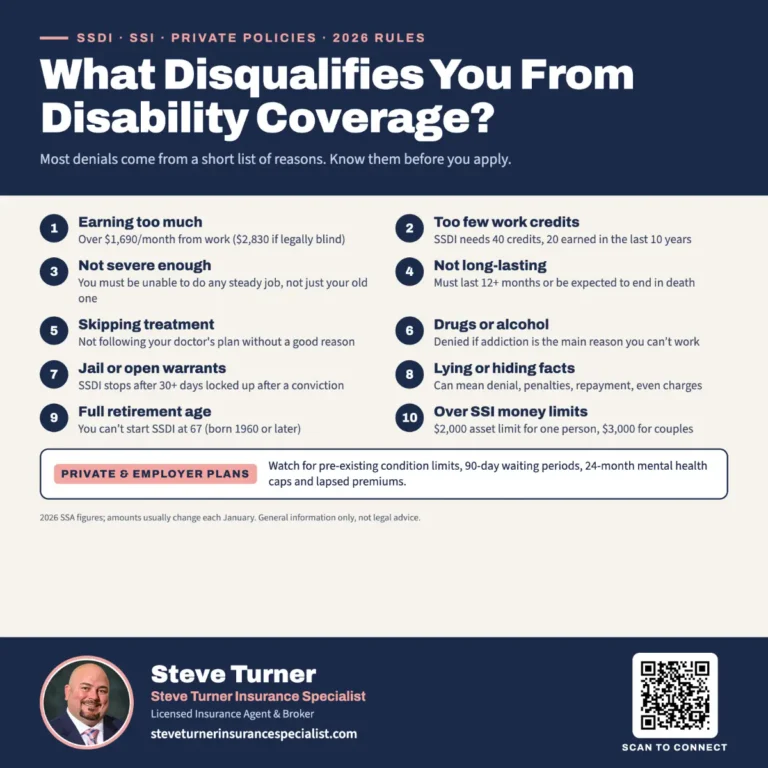
- Pre-existing conditions: Does the policy exclude health problems you already have?
- Portability: Can I keep it if I leave my job?
How much does it cost?
It depends on your age, health, job, and income. As a rough rule, many people pay about 1% to 3% of their yearly income for an individual long-term policy. Group plans through work are often cheaper. Always get real quotes, since your price could be higher or lower.
FAQ: Disability Insurance and FMLA
Does FMLA pay you?
No. FMLA is unpaid leave. It protects your job and your health insurance, but it does not pay your wages. You may be able to use paid sick days or vacation days at the same time.
Can I use FMLA and short-term disability at the same time?
Yes, and most people do. They usually run together. FMLA protects your job, and short-term disability pays part of your wages during the same weeks.
Do I have to apply for them separately?
Usually, yes. Ask your employer or HR about FMLA. You file a disability claim with the insurance company or your state program. Both will likely need paperwork from your doctor.
Can I get fired while on short-term disability?
If you’re also on FMLA, your employer generally can’t fire you just for taking that leave. But disability insurance by itself doesn’t protect your job. Once your FMLA runs out, your job protection may end too. Some workers also have rights under the Americans with Disabilities Act (ADA), so ask HR or an employment lawyer if you’re worried.
Does disability insurance cover pregnancy?
Short-term disability often covers recovery after childbirth, usually about 6 weeks for a normal delivery and 8 weeks for a C-section. But many policies won’t cover a pregnancy that began before your coverage started. Sign up before you plan to get pregnant.
Does disability insurance cover caring for a sick family member?
No. Disability insurance only pays when you can’t work. For caring for family, look at FMLA (for job protection) and your state’s paid family leave program, if you have one.
What happens when my 12 weeks of FMLA run out?
Your FMLA job protection ends. If you still can’t work, long-term disability insurance can keep paying you. Talk to your employer early about your options, like extra unpaid leave or a slower return to work.
Is employer disability insurance enough?
Sometimes. But many work plans cap your benefit, cover only part of your pay, and end when you leave the job. If your plan is small, a personal policy can fill in the gap.
My Bottom Line: Should You Get Disability Insurance If You Have FMLA?
For most people, yes. Here’s why I believe that:
- FMLA keeps your job, but it doesn’t pay you. Bills don’t pause just because you’re out sick.
- Not everyone even gets FMLA. Small-business workers, new hires, and self-employed people may have no protection.
- FMLA stops after 12 weeks. Long-term disability can keep paying long after that.
- Most states have no paid leave program. In those states, disability insurance may be your only way to get paid during a long recovery.
When I faced my own surgery, the job protection from FMLA gave me peace of mind. But disability checks let me rest instead of worrying about my bank account. That combo is what I’d want for you, too.
Here’s my simple action plan:
- Check your work benefits for disability coverage
- Look up your state’s paid leave or disability program
- Figure out how many months you could live on your savings
- Get a few quotes if you find a gap
It takes about an hour. It could save you a lot of stress later.
This article is for general education only. It isn’t legal, tax, or financial advice. Rules and benefits change, so check with HR, your state agency, or a licensed professional about your own situation.
Why choose Steve Turner Insurance Specialist?
Because I’m an “Insurance Specialist.” An “insurance specialist” is a broad term that includes insurance agents and insurance brokers, but the key difference is who the agent represents versus who the broker represents.
An “insurance agent” works directly for an insurance company and sells its specific policies to clients.
An “insurance broker” acts as an independent intermediary, comparing policies from multiple companies to find the best fit for their client’s needs, essentially representing the client rather than the insurance company.
I am both a licensed Insurance Agent and a licensed Insurance Broker.
My number one goal in life is to help people and ensure, without a shadow of a doubt, that you and your family are secure and protected. I will always be by your side, helping you mitigate risk by providing the industry’s best and most affordable insurance solutions.
I will find insurance plans for the entire family to help cover whatever life throws at you. I can help you save on severe medical emergencies, find a health insurance plan with low- or no-cost doctor visits and affordable prescription medications, and protect your family in the event of an unexpected accident or illness.
Best of all, it doesn’t cost you anything extra to use an experienced Insurance Agent and Broker like me to help you find the Insurance Plans that fit your individual, family, or business needs.
The companies that sell the insurance plans “you choose“ pay me – you don’t pay me. Calling any big insurance company directly won’t get you a lower price, as they will forward your call to the next available insurance agent on their list. You won’t have had any opportunity to learn about the insurance agent you’re speaking with in advance, understand their qualifications or experience level, or make an informed choice about who you want to work with.
Tap the Contact Me text or icon and get in touch by phone or email, or schedule a “No Obligation” chat through my calendar. I look forward to speaking with you!
OUR CLIENT REVIEWS


CONTACT STEVE TURNER INSURANCE AGENT & BROKER
I’m here to take your calls and emails and answer your questions 7 Days a week from 7:00 a.m. to 8:00 p.m., excluding posted holidays.
Steve Turner is a licensed agent and broker and a long-standing member of the National Association of Benefits and Insurance Professionals®. Steve holds the prestigious Registered Employee Benefits Consultant® designation. NABIP® is the preeminent organization for health insurance and employee benefits professionals and works diligently to ensure all Americans have access to high-quality, affordable healthcare and related services.
Steve Turner is a licensed agent appointed by Florida Blue.
Richard Steven Turner’s official Florida state insurance license number (operating as Steve Turner Insurance Specialist) is W333468
EMAIL ME: 24×7
OFFICE LOCATION
Website: steveturnerinsurancespecialist.com
Email: [email protected]
Phone and Text: +1-813-388-8373
Business Hours:
Monday: 7:00 a.m. – 8:00 p.m.
Tuesday: 7:00 a.m. – 8:00 p.m.
Wednesday: 7:00 a.m. – 8:00 p.m.
Thursday: 7:00 a.m. – 8:00 p.m.
Friday: 7:00 a.m. – 8:00 p.m.
Saturday: 7:00 a.m. – 8:00 p.m.
Sunday: 7:00 a.m. – 8:00 p.m.
DISABILITY INSURANCE POSTS
INSURANCE OFFERINGS
Should I Get Disability Insurance If I Have FMLA?
HEALTH INSURANCE
MEDICARE ADVANTAGE

MEDICARE SUPPLEMENT

PRESCRIPTION DRUGS
LIFE INSURANCE

DISABILITY INSURANCE
DENTAL INSURANCE

GROUP HEALTH INSURANCE

ACCIDENT INSURANCE
LONG TERM CARE INSURANCE
MEDICAID INSURANCE

MEDICARE INSURANCE

MEDICARE PART A INSURANCE

MEDICARE PART B INSURANCE

MEDICARE PART C INSURANCE

MEDICARE PART D INSURANCE

MEDICARE PLAN G INSURANCE

MEDICARE PLAN N INSURANCE

SERVICE AREA
MEDICARE STATEMENT
We do not offer every plan available in your area. Currently, we represent 7 organizations that offer 70 products in your area. Please contact Medicare.gov or 1-800-MEDICARE for information on all your options.
Steve Turner is a licensed insurance agent and is not connected with or endorsed by the United States Government or the Federal Medicare Program. The Medicare Annual Enrollment Period is October 15 to December 7.
There’s no one-size-fits-all answer. Carefully consider your health status, expected medical needs, prescription drugs, budget, preferred doctors and hospitals, and how comfortable you are with network rules. During the Annual Enrollment Period, you can research the plans available in your Florida county using the Medicare Plan Finder at Medicare.gov, compare costs and benefits, and get free, unbiased counseling from Florida’s SHINE (Serving Health Insurance Needs of Elders) program at floridashine.org or 1-800-963-5337. You can also call 1-800-MEDICARE (1-800-633-4227; TTY 1-877-486-2048), 24 hours a day, 7 days a week.