

Tap the button below to get your FREE Medicare Advantage & Medicare Supplement Quote from Steve Turner.
Medicare Plan L Insurance

Medicare Plan L Insurance
Medicare Plan L: Lower Premiums, a Yearly Cap, and Free Help Choosing
Looking Into Medicare Plan L? I Can Help You Decide
Hi, I’m Steve Turner, a licensed Medicare insurance agent with Steve Turner Insurance Specialist. If you’re reading this, you’ve probably heard about Medicare Plan L. Now you want to know if it’s a good fit for you. You’re in the right place.
I help people compare Medicare Supplement plans every week. Plan L is one of the most overlooked plans. It often costs less each month than the most popular plans. And it has something almost no other plan has: a yearly cap on what you pay.
On this page, I’ll walk you through Plan L in plain English. Here’s what you’ll learn:
- What Medicare Plan L is and how it works
- What it pays for, and what it doesn’t
- The 2026 and 2027 out-of-pocket limits
- How Plan L compares to Plans K, G, and N
- When to sign up so you get the best price
- How I can help you, at no cost to you
Want to skip the reading? Tap to call me at +1 (813) 388-8373 or tap to book a FREE Call. I’ll check Plan L prices in your ZIP code and show you how they compare. No pressure, ever.
What Is Medicare Plan L?
Medicare Plan L is a Medicare Supplement insurance plan. You may also hear it called Medigap Plan L. Private insurance companies sell it, not the government.
Here’s the simple version. Original Medicare (Part A and Part B) pays a big part of your health care bills. But it doesn’t pay all of it. You still owe deductibles, coinsurance, and copays. Those are the “gaps.” A Medigap plan helps fill them.
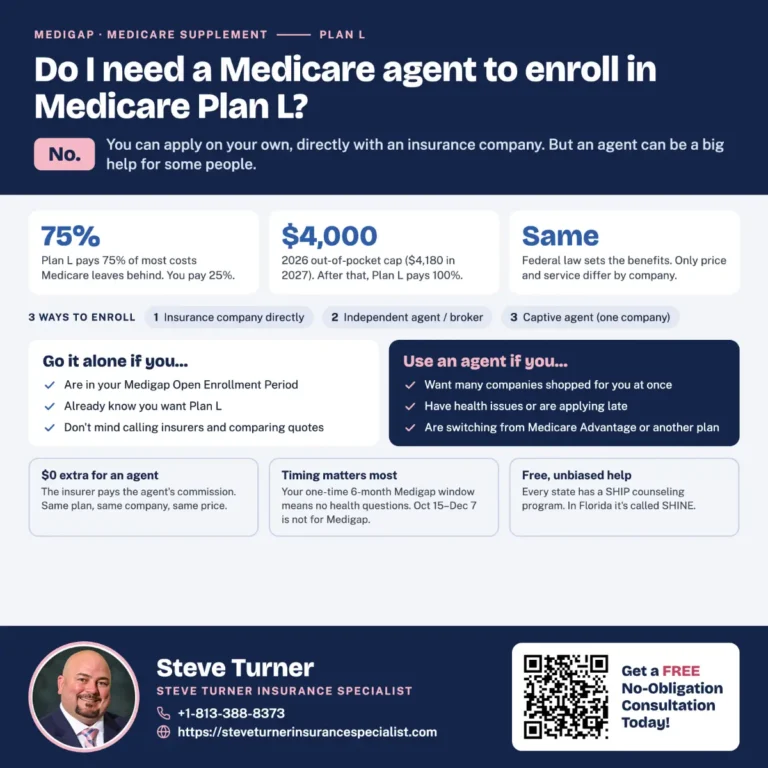
Plan L fills most of those gaps at 75%. You pay the other 25%. Once your share for the year hits a set limit, Plan L pays 100% of covered costs for the rest of the year.
Q: Is Plan L the same as “Medicare Part L”?
No. Medicare has Parts A, B, C, and D. Plan L is a supplement plan named with a letter. It’s an easy mix-up, and I hear it all the time.
Here are five more things I want you to know about Plan L:
- It only works with Original Medicare. You can’t use it with a Medicare Advantage plan.
- The benefits are set by law. A Plan L from one company covers the same things as a Plan L from another company. Only the price and service are different. (Massachusetts, Minnesota, and Wisconsin use their own plan setup.)
- You pick your doctors. You can see any doctor or hospital in the U.S. that takes Medicare. No networks and no referrals.
- It covers one person. If you’re married, you and your spouse each need your own plan.
- It doesn’t cover prescriptions. You’ll want a separate Part D drug plan.
What Does Medicare Plan L Cover?
Plan L pays its share after Original Medicare pays first. Here’s what it covers, using 2026 Medicare costs:
| Benefit | What Plan L pays |
|---|---|
| Part A hospital coinsurance, plus 365 extra hospital days after Medicare runs out | 100% |
| Part A hospital deductible ($1,736 in 2026) | 75% |
| Part B coinsurance or copays (doctor visits, outpatient care, tests) | 75% |
| Part B preventive care coinsurance | 100% |
| Skilled nursing facility coinsurance ($217 a day for days 21 to 100 in 2026) | 75% |
| Hospice care coinsurance or copays | 75% |
| First 3 pints of blood | 75% |
| Yearly out-of-pocket limit | $4,000 in 2026 |
Let me show you what 75% looks like in real life. Say your doctor’s office sends a $100 coinsurance bill. Plan L pays $75. You pay $25. That’s it.
The hospital part is where Plan L really shines. If you’re admitted, you pay 25% of the Part A deductible. In 2026, that’s $434, not $1,736. After that, Plan L pays 100% of your hospital coinsurance. It even covers up to 365 more days after your Medicare hospital days run out.
Most people fear one thing more than anything: a long hospital stay that drains their savings. Plan L takes much of that fear away.
What Medicare Plan L Does Not Cover
I always tell my clients about the gaps up front. I don’t want you surprised by a bill later. Here’s what Plan L won’t pay for:
- The Part B deductible. You pay this yourself. It’s $283 in 2026. The good news? It counts toward your yearly limit.
- Part B excess charges. Some doctors don’t accept Medicare’s approved amount as full payment. They can bill you up to 15% more. Plan L doesn’t cover that. My tip: ask your doctor if they “accept assignment.” Most do.
- Emergency care outside the U.S. If you travel abroad a lot, you’ll want travel insurance or a different plan.
- Prescription drugs. You’ll need a Part D plan for these.
- Dental, vision, and hearing aids. No Medigap plan covers routine care for these.
- Long-term care. This means help with daily living in a nursing home or at home.
- Your monthly premiums. These also don’t count toward your yearly limit.
None of these are deal-breakers for most people. But you should know them before you buy. When we talk, I’ll help you plan for each one.
The Plan L Out-of-Pocket Limit for 2026 and 2027
This is my favorite part of Plan L. Your share of costs has a ceiling. In 2026, the Plan L out-of-pocket limit is $4,000. For 2027, Medicare has set it at $4,180.
Plans K and L are the only Medigap plans with a limit like this. Plan K’s limit is twice as high: $8,000 in 2026 and $8,360 in 2027.
Here’s how the limit works, step by step:
- You pay the Part B deductible ($283 in 2026).
- You pay 25% of most covered costs.
- Those amounts add up over the year.
- Once you reach the limit, Plan L pays 100% of covered costs for the rest of the year.
- On January 1, the count starts over.
A Real-World Example
Let’s say Pat has Plan L. In 2026, Pat needs cancer treatment. The outpatient care adds up to $80,000 in Medicare-approved costs. Here’s what Pat pays:
| Cost | Original Medicare only | With Plan L |
|---|---|---|
| Part B deductible | $283 | $283 |
| Coinsurance on the other $79,717 | $15,943.40 (20%) | $3,985.85 (25% of the 20%) |
| Total before the cap | $16,226.40 | $4,268.85 |
| What Pat actually pays | $16,226.40 | $4,000 |
With Plan L, Pat saves more than $12,000 in one year. Original Medicare alone has no yearly limit at all. The bills could keep going up.
That’s why I call Plan L a “safety net” plan. You know your worst-case number before the year even starts. (Remember: premiums and excess charges don’t count toward the limit.)
How Much Does Medicare Plan L Cost?
Plan L usually costs less each month than full-coverage plans like Plan G. That’s because you share some costs when you get care. Lower monthly bills, with a cap on the bad years. That’s the trade.
I can’t give you one price for everyone, though. Your Plan L premium depends on:
- Your age. Younger buyers often pay less.
- Your ZIP code. Prices vary by state and even county.
- Gender and tobacco use. Most states allow companies to price on these.
- The insurance company. Two companies can charge very different prices for the same Plan L.
- How the company sets prices. Some charge everyone the same (community-rated). Some base it on your age when you buy (issue-age). Others raise prices as you get older (attained-age).
- Discounts. Some companies offer household or pay-yearly discounts.
You’ll still pay your Part B premium. The standard amount is $202.90 a month in 2026. People with higher incomes pay more.
Here’s the thing most people miss. Since Plan L benefits are the same at every company, price and service are the only differences. Shopping around can save you real money. That’s exactly what I do for you.
One more thing: not every company sells Plan L. In some areas, only a few do. I’ll tell you which companies offer it in your area.
Is Medicare Plan L Right for You?
Plan L isn’t for everyone. But for the right person, it’s a great value. Here’s how I help people figure it out.
Plan L may be a great fit if you:
- Are fairly healthy and see the doctor a few times a year
- Want a lower monthly premium than Plan G
- Want a firm cap on your costs if something big happens
- Live on a fixed income and want to know your worst-case number
- Don’t mind paying a small share when you get care
- See doctors who accept Medicare assignment
- Rarely travel outside the U.S.
Plan L may not be the best fit if you:
- See specialists often or have ongoing treatment, like dialysis
- Want to pay almost nothing when you get care
- Travel abroad often
- Use doctors who charge Part B excess charges
Q: How do I know if the savings are worth it?
Good question. I look at two numbers with you. First, how much less Plan L costs each year compared to Plan G. Second, how much more you could pay out of pocket in a bad year. If you’re healthy, the premium savings often win. If you need lots of care, a fuller plan may cost less overall. I’ll run these numbers for you using real prices in your area.
Medicare Plan L vs. Plan K, Plan G, and Plan N
Most people I talk to compare Plan L with three other plans. Here’s how they line up:
| Benefit | Plan L | Plan K | Plan G | Plan N |
|---|---|---|---|---|
| Part A hospital deductible | 75% | 50% | 100% | 100% |
| Part B coinsurance | 75% | 50% | 100% | 100% (up to $20 office and $50 ER copays) |
| Skilled nursing and hospice | 75% | 50% | 100% | 100% |
| Part B deductible | No | No | No | No |
| Part B excess charges | No | No | 100% | No |
| Foreign travel emergencies | No | No | 80% | 80% |
| 2026 out-of-pocket limit | $4,000 | $8,000 | None | None |
Plan L vs. Plan K: These are sister plans. Plan K pays 50% of most costs. Plan L pays 75%. Plan K usually has a lower premium, but its cap is twice as high. If you want stronger protection, Plan L wins.
Plan L vs. Plan G: Plan G covers almost everything except the Part B deductible. It doesn’t need a cap because you pay very little after that. But Plan G usually costs more each month. Plan L makes sense when the premium savings outweigh the extra costs you expect.
Plan L vs. Plan N: Plan N is very popular. It pays 100% of most costs but has small copays for office and ER visits. It also has no official yearly cap. Plan L gives you a hard ceiling on the bad years.
Q: What about Medicare Advantage?
Medicare Advantage is a whole different path. Those plans often have networks and need referrals. They also have their own yearly limits, which are often much higher. Plan L lets you see any doctor in the country who takes Medicare. I can explain both paths if you’re torn.
When Should You Sign Up for Medicare Plan L?
Timing matters a lot with Medigap. The best time to buy Plan L is during your Medigap Open Enrollment Period. Here’s how it works:
- It starts the first month you’re 65 or older and enrolled in Part B.
- It lasts six months.
- During this time, companies can’t turn you down because of your health.
- They also can’t charge you more for health problems you already have.
If you miss this window, things get harder. In most states, companies can ask health questions. They can charge you more or say no.
There are some exceptions. These are called guaranteed issue rights. You may have one if you lose job-based coverage or your Medicare Advantage plan leaves your area. Some states also have extra rules that make switching easier. I’ll check your state’s rules for you.
Q: Can I sign up for Plan L during fall Open Enrollment (October 15 to December 7)?
That fall window is for Medicare Advantage and Part D drug plans. Medigap doesn’t have a yearly open enrollment like that in most states. You can apply for Plan L any time of year. But outside your Medigap Open Enrollment Period, you may have to answer health questions. Fall is still a great time to review your Part D plan and consider Plan L.
Q: Can I get Plan L if I’m under 65?
It depends on your state. Federal law doesn’t require companies to sell Medigap to people under 65. Some states do require it. I’ll tell you what’s available.
How I Help You Choose the Right Medicare Plan
Picking a Medicare plan can feel like reading a foreign language. My job is to make it simple. Here’s what working with me looks like:
- We start with a free call. It takes about 15-20 minutes. We talk about your health, your doctors, your budget, and how often you travel.
- I check real prices. I compare Plan L with plans from companies in your area. I line it up next to Plans K, G, and N.
- I show you the math. You’ll see your yearly premium and your worst-case costs for each plan. No guessing.
- You make the choice. If Plan L wins, I’ll help you apply. If it’s not, I’ll tell you straight.
- I stay with you. Questions about a bill? A rate increase? A yearly check-up on your plan? Just call me.
Why people choose to work with me:
- My help costs you nothing. Insurance companies pay me. Your premium is the same whether you use me or go direct.
- I’m not tied to one company. I compare plans from several insurers, so you see real choices.
- I speak plain English. No jargon. No fine print games.
- There’s zero pressure. Some people learn Plan L isn’t for them, and that’s okay.
- I’m here after you sign up. Many agents disappear. I don’t.
[Add a short client testimonial here, plus your license number and the states you serve.]
Ready to See Medicare Plan L Prices in Your Area?
You’ve done your homework. Now let’s find out what Plan L would really cost you.
When you reach out, here’s what you get:
- Plan L prices from the companies in your ZIP code
- A side-by-side look at Plans L, K, G, and N
- Your best-case and worst-case yearly costs for each plan
- Honest advice, even if Plan L isn’t your best fit
- Help applying, plus support for as long as you have your plan
It’s free, and there’s no pressure to buy. If you’re close to 65, don’t wait. Your best prices and easiest approval come during your Medigap Open Enrollment Period.
Medicare PLAN L INSURANCE AGENT AND BROKER
As your Insurance Agent and Broker serving you, my goal is to “help you” and ensure, without a shadow of a doubt, that you and your family are secure and protected from risk. As a licensed Medicare Advantage and Medicare Supplement agent, I take the burden off your shoulders by conducting a thorough needs analysis and researching the benefits that best suit you.
I can help you save on severe medical emergencies and find a plan that offers low- to no-cost doctor visits, prescription medication, and extra benefits such as dental, vision, and hearing, gym membership, and over-the-counter items. I will show you plans where your doctors are in-network and provide a side-by-side comparison of your prescription costs across plans.
Medicare is constantly changing, and I work tirelessly to stay informed about the latest market developments. Every year brings new government regulations, new or modified coverages, and new techniques for controlling benefit costs. To best serve their clients, professionals must understand each benefit or program’s provisions, advantages, and limitations to support economic security.
I am a long-standing member of the National Association of Benefits and Insurance Professionals® (NABIP.ORG) and hold the Registered Employee Benefits Consultant® designation (https://nabip.org/professional-development/rebc-designation). I can provide information on your market’s availability and any expected changes.
After you choose your Medicare Insurance plan, I provide ongoing support year-round; you won’t have to call an (800) number anymore.
If you have questions, issues, or concerns about your plan’s benefits, you can contact me by phone, text, or through my simple-to-use email contact form using the buttons below.
Steve Turner, your Helpful Licensed Agent and Broker
Medicare Plan L Insurance FAQ
OUR CLIENT REVIEWS


CONTACT STEVE TURNER, LICENSED INSURANCE AGENT & BROKER
Questions? Call, text, or book a time below; I answer calls and emails 7 Days a week from 7:00 a.m. to 8:00 p.m., excluding posted holidays.
EMAIL ME: 24×7
OFFICE LOCATION
Address: 14502 N Dale Mabry Hwy, Suite 200, Tampa, FL 33618
Website: steveturnerinsurancespecialist.com
Email: [email protected]
Phone and Text: +1-813-388-8373
Business Hours:
Monday: 7:00 a.m. / 8:00 p.m.
Tuesday: 7:00 a.m. / 8:00 p.m.
Wednesday: 7:00 a.m. / 8:00 p.m.
Thursday: 7:00 a.m. / 8:00 p.m.
Friday: 7:00 a.m. / 8:00 p.m.
Saturday: 7:00 a.m. / 8:00 p.m.
Sunday: 7:00 a.m. / 8:00 p.m.
SERVICE AREA FACTS UNITED STATES
The United States: Facts and Top Visitor Sites
The United States of America is a vast, diverse country with a wide array of cultures, landscapes, and iconic landmarks. Here are some key facts and top attractions:
Facts about the USA
The United States is a vast, diverse country with a rich tapestry of culture, history, and natural beauty. Here is a comprehensive overview of key statistics and top visitor attractions across the nation.
Key U.S. Statistics and Economic Overview
The United States is a global leader in population, economy, and innovation, attracting people from all over the world.
- Population and Demographics: As of 2025, the U.S. population is projected to exceed 343 million, making it the world’s third-most populous country. The population is diverse, with a significant Hispanic and Latino population that accounts for much of the recent growth. The median age is around 39 years, and a growing segment of the population is over 65, reflecting an aging nation.
- Geography: Third largest country by land area, behind Russia and Canada. It spans 3.8 million square miles and has 4 million miles of roads.
- National Parks: 63 national parks nationwide.
- Government-owned Land: The government owns 37% of the land (federal, state, and local).
- Diversity: The U.S. is a diverse country, with a growing non-white population. Non-Hispanic white people currently make up the largest ethnic group, but their share of the population has decreased over time. The Hispanic population has grown the most, increasing by 23% between 2010 and 2020.
- Languages: While English is the primary language, Spanish is the most common non-English language spoken at home, followed by Chinese and Tagalog.
- Aging Population: Americans are living longer, and the 65-and-older population is increasing significantly.
- Economy & Key Industries: The U.S. economy is the largest in the world by nominal GDP. Its economic strength is built on several key industries:
- Financial Services: This sector is a global powerhouse, centered in cities like New York, with major hubs for banking, insurance, and investment.
- Technology and Information Technology (IT): The U.S. leads the world in technology, with major tech hubs in Silicon Valley, Austin, and Seattle driving innovation in software, hardware, and digital services.
- Healthcare and Social Assistance: As the country’s largest private employment sector, healthcare is a massive industry with high demand for skilled workers and ongoing innovation.
- Manufacturing: The U.S. manufacturing sector is a backbone of the economy, producing everything from automobiles and aerospace components to medical equipment and consumer goods.
- Work-from-Home Trends: More Americans work remotely than before the pandemic. In 2022, 15% of Americans worked from home, up from 6% in 2019.
Top Places for Visitors to Explore in the USA
The United States offers an incredible variety of destinations, from iconic cities to breathtaking national parks.
- New York City, New York: A global icon, New York City is famous for its vibrant culture, world-class museums, and iconic landmarks. Visitors can explore Times Square, see a Broadway show, visit the Statue of Liberty, and walk through Central Park. The city offers an endless array of dining and shopping experiences.
- The Grand Canyon, Arizona: A breathtaking natural wonder carved by the Colorado River, the Grand Canyon National Park is a must-see. Visitors can take in panoramic views from the South Rim, hike into the canyon, or take a helicopter tour for a unique perspective.
- Las Vegas, Nevada: Known as “The Entertainment Capital of the World,” Las Vegas is famous for its casinos, luxury hotels, and spectacular live shows. The Las Vegas Strip is a bustling boulevard with unique attractions and a vibrant nightlife.
- Orlando, Florida: The “Theme Park Capital of the World,” Orlando is home to some of the world’s most famous attractions, including Walt Disney World Resort and Universal Orlando Resort. It is a top destination for families and anyone seeking a thrilling, magical vacation.
- Washington, D.C.: The nation’s capital is a city of history and monuments. Visitors can explore the National Mall, which connects the Lincoln Memorial, Washington Monument, and the U.S. Capitol. It’s also home to the Smithsonian Institution’s world-class museums.
- Yellowstone National Park, Wyoming: As the first national park in the U.S., Yellowstone National Park is a marvel of geothermal activity and wildlife. It is home to the famous Old Faithful geyser, the Grand Prismatic Spring, and a wide variety of animals, including bison, bears, and wolves.
- San Francisco, California: This iconic West Coast city is famous for the Golden Gate Bridge, its historic cable cars, and diverse neighborhoods. Visitors can explore Fisherman’s Wharf, Alcatraz Island, and the beautiful Golden Gate Park.
- Hawaii: An archipelago in the Pacific Ocean known for its stunning natural beauty, volcanic landscapes, and rich Polynesian culture. Visitors can relax on beautiful beaches, hike through lush rainforests, and explore the Hawaii Volcanoes National Park on the Big Island.
- Great Smoky Mountains National Park, North Carolina/Tennessee: The Great Smoky Mountains National Park is the most visited national park in the U.S. and is known for its beautiful mountains, diverse plant and animal life, and rich Appalachian culture.
- New Orleans, Louisiana: This historic city on the Mississippi River is famous for its unique blend of cultures, live music, and vibrant festivals. The French Quarter is a lively neighborhood with historic architecture, delicious Creole cuisine, and jazz clubs.
MEDICare PLAN L INSURANCE POSTS
SERVICE AREA
Medicare plan availability differs by state and county. Steve Turner is licensed in AL, CO, FL, GA, NC, SC, TN, and TX.
Steve Turner is a licensed insurance agent and is not connected with or endorsed by the United States Government or the Federal Medicare Program. The Medicare Annual Enrollment Period is October 15 to December 7.
MEDICARE DISCLAIMER
We do not offer every plan available in your area. Any information we provide is limited to those plans we do offer in your area. Please contact Medicare.gov or 1-800-MEDICARE to get information on all of your options.
Steve Turner

Steve Turner, CLU®, REBC® is licensed in AL, CO, FL, GA, NC, SC, TN, and TX · NPN 18030539 · Florida License W333468
Steve Turner is a licensed agent and broker and a long-standing member of the National Association of Benefits and Insurance Professionals NABIP®. Steve holds the Registered Employee Benefits Consultant® (REBC®) designation. Steve also holds the “Chartered Life Underwriter” designation (CLU®), a professional credential for individuals specializing in life insurance and estate planning, conferred by the American College of Financial Services. Since 2016 (over 10 years), Steve has helped individuals, families, Medicare beneficiaries, and small businesses find the right coverage to meet their needs. Steve has earned 180+ Google reviews from happy clients.
Steve Turner is a licensed agent appointed by Florida Blue in Florida.