

Tap the button below to get your FREE Medicare Advantage & Medicare Supplement Quote from Steve Turner.
Medicare Plan M Insurance

Medicare Plan M Insurance
Medicare Plan M: Is This Lower-Cost Medigap Plan Right for You?
Medicare Plan M is a Medicare Supplement plan that pays most of the bills Original Medicare leaves behind. You split the hospital deductible with the plan, and you often pay a lower monthly premium.
Hi, I’m Steve Turner, a licensed Medicare insurance agent with Steve Turner Insurance Specialist. I help people figure out whether Plan M fits their health, budget, and life. I don’t charge you a penny for my help. The insurance companies pay me, and your price is the same whether you buy from me or straight from them.
If you landed here, you probably typed “Medicare Plan M” with a question mark in your head. Maybe a friend has it. Maybe you saw it on a price chart. Maybe you’re just tired of high premiums. Whatever brought you here, I’ll explain it in plain words.
On this page, you’ll learn:
- What Medicare Plan M is (and what it is not)
- Exactly what it pays for and what it doesn’t
- What it could cost you with real 2026 numbers
- How it stacks up against Plan G and Plan N
- Who Plan M is a great fit for, and who should skip it
- When you can sign up without health questions
- How I can help you compare prices for free
Want to skip ahead? Call me at +1 (813) 388-8373 or book a free call, and I’ll pull Plan M prices in your ZIP code today.
What Is Medicare Plan M?
Medicare Plan M is one of 10 standard Medicare Supplement plans, also called Medigap plans. Private insurance companies sell these plans. They work alongside Original Medicare (Part A and Part B) to pay some of the costs Medicare doesn’t.
Here’s the simple version. Original Medicare pays a big chunk of your health care bills, but not all of it. You still owe deductibles, coinsurance, and copays. Those can add up fast, especially if you end up in the hospital—a Medigap plan steps in to pay many of those leftover costs.
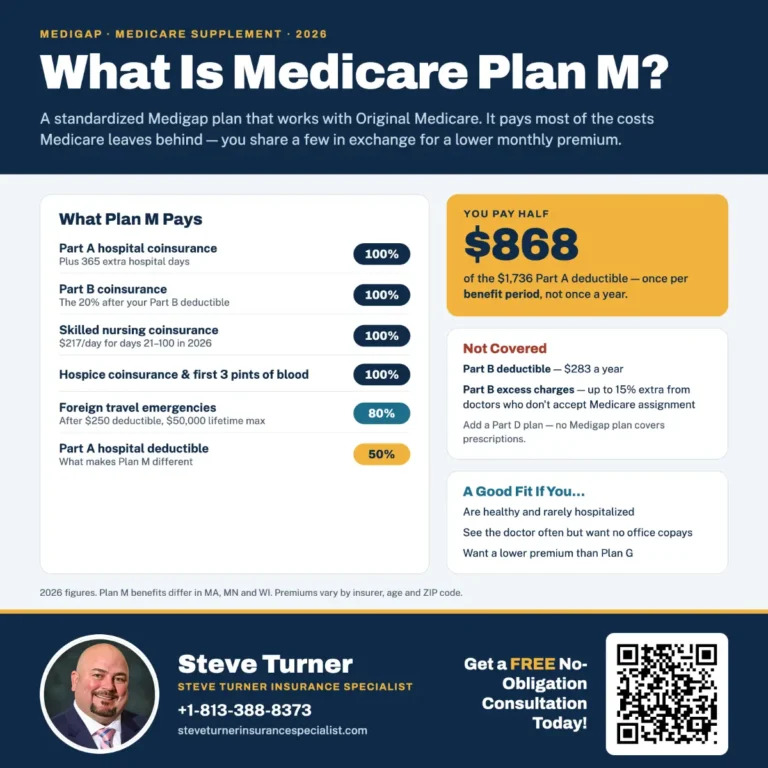
Plan M is sometimes called a “cost-sharing” plan. That’s because you and the plan share one cost: the Part A hospital deductible. The plan pays half, and you pay half.
Is It “Medicare Part M” or “Medicare Plan M”?
I get this question a lot, so let me clear it up. There is no Medicare Part M. Medicare has four parts:
- Part A covers hospital stays.
- Part B covers doctor visits and outpatient care.
- Part C is Medicare Advantage, a different way to get your benefits.
- Part D covers prescription drugs.
Medigap plans use letters too, which is confusing. Plan M is a plan, not a part. It’s an extra policy you buy to go with Parts A and B.
Every Plan M Is the Same (Almost Everywhere)
The federal government sets the benefits for each Medigap letter. That means a Plan M from Company A covers the same things as a Plan M from Company B. The only real differences are the price, the company’s customer service, and how its rates go up over time.
There are three exceptions. Massachusetts, Minnesota, and Wisconsin set up Medigap plans differently. If you live in one of those states, call me, and I’ll explain your options.
What Does Medicare Plan M Cover?
Plan M pays for most of the high costs Original Medicare leaves behind. Here is the full list of what it covers:
| Benefit | What Plan M Pays |
|---|---|
| Part A hospital coinsurance, plus 365 extra hospital days after Medicare runs out | 100% |
| Part B coinsurance (the 20% you’d owe for doctor visits, tests, and outpatient care) | 100% |
| First 3 pints of blood | 100% |
| Hospice care coinsurance or copays | 100% |
| Skilled nursing facility coinsurance | 100% |
| Part A hospital deductible | 50% |
| Foreign travel emergencies | 80%, up to plan limits |
Let me break down the parts that matter most.
1. Your 20% for doctor visits is paid. With Original Medicare alone, you pay 20% of most doctor bills, lab tests, scans, and outpatient surgeries. There’s no cap on that 20%. Plan M pays it all once you meet your Part B deductible. You won’t get a $40 copay bill at each visit like you would with some other plans.
2. Long hospital stays are covered. If you need a long hospital stay, Medicare starts charging you a daily amount after day 60. Plan M pays that, and it adds 365 more hospital days on top.
3. Skilled nursing care is covered. After a hospital stay, you might need rehab in a skilled nursing facility. Medicare charges a daily coinsurance starting on day 21. In 2026, that’s $217 a day. Plan M pays it.
4. Half the hospital deductible is paid. This is the “M” twist. I’ll explain it in detail in the cost section below.
5. Emergency care overseas. If you get sick or hurt while traveling outside the U.S., Plan M pays 80% of the cost of emergency care, up to the plan’s limits. Original Medicare usually pays nothing outside the country.
What Medicare Plan M Does Not Cover
Plan M leaves three costs for you to pay. I always tell my clients about these up front, because no one likes surprises.
- The Part B deductible. In 2026, that’s $283 a year. You pay it yourself before Plan M starts paying your 20%. Think of it as a small yearly “entry fee” for doctor care.
- Half the Part A deductible. In 2026, the full hospital deductible is $1,736 per benefit period. Plan M pays $868, and you pay $868.
- Part B excess charges. Some doctors don’t accept Medicare’s set price as full payment. They can charge up to 15% more. Plan M doesn’t pay that extra amount. (A handful of states don’t allow excess charges at all, and most doctors accept Medicare’s price anyway. I can help you check yours.)
Things No Medigap Plan Covers
These aren’t Plan M problems. No Medicare Supplement plan pays for them:
- Prescription drugs. You’ll want a separate Part D drug plan. I can help you pick one at the same time.
- Routine dental care, like cleanings and fillings.
- Eye exams for glasses and the glasses themselves.
- Hearing aids.
- Long-term custodial care, like help with bathing and dressing in a nursing home.
If you need help with dental, vision, or hearing, I can show you low-cost standalone plans that pair well with Plan M.
What Does Plan M Really Cost? A Real-Life Example
With Plan M, your costs come in two buckets: your monthly premium and the few bills the plan leaves for you. Premiums depend on your age, ZIP code, gender, tobacco use, and the company you choose. That’s why I shop several companies for you.
Now let’s look at the bills. Meet Linda. She’s 67 and has Plan M.
Linda’s year (using 2026 Medicare numbers):
- In February, she visits her doctor for a checkup and some lab work. She pays the $283 Part B deductible first.
- After that, Plan M pays her 20% share for the rest of her doctor visits, tests, and scans all year. She pays $0 for those.
- In June, Linda has a knee replacement and stays in the hospital for three days. Medicare charges a $1,736 hospital deductible. Plan M pays $868. Linda pays $868.
- She spends two weeks in rehab at a skilled nursing facility. Because her stay is under 21 days, Medicare covers it in full.
- Her surgeon accepts Medicare’s price, so there are no excess charges.
Linda’s total out-of-pocket medical bills for the year: $1,151, plus her premiums.
If Linda doesn’t go to the hospital at all, her only medical bill is the $283 Part B deductible.
What’s the Worst Case?
Here’s something important. Plan M has no yearly cap on what you might pay. In most years, that doesn’t matter much. But you’d owe the $868 half-deductible each time you start a new benefit period.
A benefit period starts when you go into the hospital. It ends after you’ve been out of the hospital (and out of skilled nursing care) for 60 consecutive days. So if you go into the hospital in March and again in October, that’s two benefit periods. You’d pay $868 twice, for $1,736 total.
That’s the trade-off with Plan M. You pay a lower premium, and in exchange, you take on a little more risk if you’re in the hospital a lot.
Plan M vs. Plan G vs. Plan N
Plan G and Plan N are the two plans people most often compare to Plan M. All three cover your 20% for doctor care. The difference is in the small out-of-pocket costs.
| What you pay (2026) | Plan M | Plan N | Plan G |
|---|---|---|---|
| Part B deductible ($283) | You pay | You pay | You pay |
| Part A hospital deductible ($1,736) | You pay half ($868) | $0 | $0 |
| Doctor visit copays | $0 | Up to $20 per visit | $0 |
| ER copays | $0 | Up to $50 (waived if you’re admitted) | $0 |
| Part B excess charges | You pay | You pay | $0 |
| Monthly premium | Often lower than G | Often lowest of the three | Usually highest |
Plan M vs. Plan G
Plan G is the most popular Medigap plan for new enrollees. It pays everything except the $283 Part B deductible. With Plan M, you take on two extra risks: half the hospital deductible and excess charges.
Here’s how I help clients decide. I look at the yearly premium difference between the two plans. If Plan M saves you more than $868 a year, it can come out ahead in any year you’re not in the hospital. If the savings are small, Plan G may be worth the extra peace of mind.
Plan M vs. Plan N
Plan N covers the full hospital deductible, but it charges small copays at the doctor’s office and in the ER. Plan M is the opposite. You pay nothing at the doctor’s office, but you pay half if you’re admitted to the hospital.
So here’s a simple rule of thumb:
- Lots of doctor visits, rarely in the hospital? Plan M may suit you better.
- Few doctor visits, worried about a hospital stay? Plan N may suit you better.
One Honest Warning
Not every insurance company sells Plan M in every area. In some ZIP codes, only a few companies offer it. And sometimes Plan N is priced lower than Plan M, which can make Plan N the better deal. That’s why I compare real quotes instead of guessing.
Who Is Medicare Plan M Best For?
After helping many people with their Medigap choices, I’ve noticed that Plan M tends to be a great fit for a certain kind of person. You might be a good match if:
- You’re healthy and rarely go to the hospital. You’ll likely never pay that $868 half-deductible in most years.
- You want a lower monthly premium but still want strong coverage for doctor visits.
- You see your doctors often and don’t want copays at every visit, like with Plan N.
- Your doctors accept Medicare’s price. Most do, so excess charges are rarely a problem.
- You have some savings set aside to cover a surprise $868 bill if you do end up in the hospital.
- You travel outside the country and want some emergency coverage while you’re away.
Who Should Probably Skip Plan M?
Plan M isn’t for everyone. I’ll tell you if it’s not right for you. You may want a different plan if:
- You have a health condition that could lead to hospital stays more than once a year.
- You see specialists who don’t accept Medicare’s price so that excess charges could add up.
- You want predictable costs and don’t want any surprise bills.
- The price gap between Plan M and Plan G is small in your area.
My job isn’t to sell you Plan M. My job is to help you pick the plan that fits you best, even if that’s a different letter.
When Can You Sign Up for Medicare Plan M?
The best time to buy Plan M is during your Medigap Open Enrollment Period. This is a one-time, six-month window. It starts the first month you’re both 65 or older and enrolled in Medicare Part B.
During those six months, you get special protections:
- No health questions. Companies can’t ask about your health to decide whether to sell you a plan.
- No higher price for health problems. They can’t charge you more because of past or current conditions.
- No turning you down. They must sell you any Medigap plan they offer in your state.
What If I Missed That Window?
You can still apply for Plan M any time of year. But in most states, the company can ask health questions and turn you down or charge you more. Some states have extra rules that give you more chances to switch. Special situations, like losing job-based coverage, may also give you a “guaranteed issue” right. I can check which rules apply to you.
What About the Fall Enrollment Period?
Medicare’s Annual Enrollment Period runs from October 15 to December 7 each year. That window is for Medicare Advantage and Part D drug plans. It does not give you a free pass to switch Medigap plans without health questions.
That said, it’s a great time to review your Part D drug plan, which you’ll need alongside Plan M. I can review both for you in one call.
Under 65 and on Medicare?
If you have Medicare because of a disability, your Plan M options depend on your state. Some states require companies to sell to people under 65, and some don’t. Reach out, and I’ll tell you what’s available in your area.
How I Help You Get the Right Plan M (for Free)
Shopping for Medigap on your own can feel like reading a menu in a foreign language. I make it simple. Here’s what working with me looks like:
- We talk. In a quick 15- to 20-minute call, I learn about your doctors, your health, your budget, and what worries you most.
- I shop for you. I compare Plan M prices from the companies I work with in your area. I also pull Plan G and Plan N quotes so you can see the full picture.
- I explain the trade-offs. I show you, in real dollars, what each plan could cost you in a good year and a bad year.
- You decide. No pressure, ever. If Plan M isn’t the best fit, I’ll tell you.
- I help you apply. I handle the paperwork with you, so nothing gets missed.
- I stay with you. After you enroll, I’m still your go-to person. If you have a billing question or want to review your plan next year, call.
Why People Choose to Work With Me
- It costs you nothing. Your premium is the same whether you use me or go direct.
- I’m licensed and local. I know the plans and companies in your area. [Add your states and years of experience here.]
- I compare multiple companies. A company’s own agent can only show you its plans. I can show you more.
- I help with Part D, too. I’ll make sure your prescriptions are covered by a drug plan that works with your Plan M.
- I watch your rates. If your premium jumps, I can see if another company offers a better price.
Ready to See Your Plan M Prices?
Medicare Plan M can give you strong coverage at a lower monthly price, as long as you’re comfortable splitting the hospital deductible. The only way to know if it’s the right deal for you is to compare real quotes side by side.
That’s where I come in. Here’s what you get when you reach out:
- Free Plan M quotes from multiple companies in your ZIP code
- A side-by-side look at Plan M, Plan G, and Plan N
- A plain-English answer on which plan fits you best
- Help choosing a Part D drug plan to go with it
- No cost, no pressure, and no obligation
Medicare PLAN M INSURANCE AGENT AND BROKER
As your Insurance Agent and Broker serving you, my goal is to “help you” and ensure, without a shadow of a doubt, that you and your family are secure and protected from risk. As a licensed Medicare Advantage and Medicare Supplement agent, I take the burden off your shoulders by conducting a thorough needs analysis and researching the benefits that best suit you.
I can help you save on severe medical emergencies and find a plan that offers low- to no-cost doctor visits, prescription medication, and extra benefits such as dental, vision, and hearing, gym membership, and over-the-counter items. I will show you plans where your doctors are in-network and provide a side-by-side comparison of your prescription costs across plans.
Medicare is constantly changing, and I work tirelessly to stay informed about the latest market developments. Every year brings new government regulations, new or modified coverages, and new techniques for controlling benefit costs. To best serve their clients, professionals must understand each benefit or program’s provisions, advantages, and limitations to support economic security.
I am a long-standing member of the National Association of Benefits and Insurance Professionals® (NABIP.ORG) and hold the Registered Employee Benefits Consultant® designation (https://nabip.org/professional-development/rebc-designation). I can provide information on your market’s availability and any expected changes.
After you choose your Medicare Insurance plan, I provide ongoing support year-round; you won’t have to call an (800) number anymore.
If you have questions, issues, or concerns about your plan’s benefits, you can contact me by phone, text, or through my simple-to-use email contact form using the buttons below.
Steve Turner, your Helpful Licensed Agent and Broker
Medicare Plan M Insurance FAQ
OUR CLIENT REVIEWS


CONTACT STEVE TURNER, LICENSED INSURANCE AGENT & BROKER
Questions? Call, text, or book a time below; I answer calls and emails 7 Days a week from 7:00 a.m. to 8:00 p.m., excluding posted holidays.
EMAIL ME: 24×7
OFFICE LOCATION
Address: 14502 N Dale Mabry Hwy, Suite 200, Tampa, FL 33618
Website: steveturnerinsurancespecialist.com
Email: [email protected]
Phone and Text: +1-813-388-8373
Business Hours:
Monday: 7:00 a.m. / 8:00 p.m.
Tuesday: 7:00 a.m. / 8:00 p.m.
Wednesday: 7:00 a.m. / 8:00 p.m.
Thursday: 7:00 a.m. / 8:00 p.m.
Friday: 7:00 a.m. / 8:00 p.m.
Saturday: 7:00 a.m. / 8:00 p.m.
Sunday: 7:00 a.m. / 8:00 p.m.
SERVICE AREA FACTS UNITED STATES
The United States: Facts and Top Visitor Sites
The United States of America is a vast, diverse country with a wide array of cultures, landscapes, and iconic landmarks. Here are some key facts and top attractions:
Facts about the USA
The United States is a vast, diverse country with a rich tapestry of culture, history, and natural beauty. Here is a comprehensive overview of key statistics and top visitor attractions across the nation.
Key U.S. Statistics and Economic Overview
The United States is a global leader in population, economy, and innovation, attracting people from all over the world.
- Population and Demographics: As of 2025, the U.S. population is projected to exceed 343 million, making it the world’s third-most populous country. The population is diverse, with a significant Hispanic and Latino population that accounts for much of the recent growth. The median age is around 39 years, and a growing segment of the population is over 65, reflecting an aging nation.
- Geography: Third largest country by land area, behind Russia and Canada. It spans 3.8 million square miles and has 4 million miles of roads.
- National Parks: 63 national parks nationwide.
- Government-owned Land: The government owns 37% of the land (federal, state, and local).
- Diversity: The U.S. is a diverse country, with a growing non-white population. Non-Hispanic white people currently make up the largest ethnic group, but their share of the population has decreased over time. The Hispanic population has grown the most, increasing by 23% between 2010 and 2020.
- Languages: While English is the primary language, Spanish is the most common non-English language spoken at home, followed by Chinese and Tagalog.
- Aging Population: Americans are living longer, and the 65-and-older population is increasing significantly.
- Economy & Key Industries: The U.S. economy is the largest in the world by nominal GDP. Its economic strength is built on several key industries:
- Financial Services: This sector is a global powerhouse, centered in cities like New York, with major hubs for banking, insurance, and investment.
- Technology and Information Technology (IT): The U.S. leads the world in technology, with major tech hubs in Silicon Valley, Austin, and Seattle driving innovation in software, hardware, and digital services.
- Healthcare and Social Assistance: As the country’s largest private employment sector, healthcare is a massive industry with high demand for skilled workers and ongoing innovation.
- Manufacturing: The U.S. manufacturing sector is a backbone of the economy, producing everything from automobiles and aerospace components to medical equipment and consumer goods.
- Work-from-Home Trends: More Americans work remotely than before the pandemic. In 2022, 15% of Americans worked from home, up from 6% in 2019.
Top Places for Visitors to Explore in the USA
The United States offers an incredible variety of destinations, from iconic cities to breathtaking national parks.
- New York City, New York: A global icon, New York City is famous for its vibrant culture, world-class museums, and iconic landmarks. Visitors can explore Times Square, see a Broadway show, visit the Statue of Liberty, and walk through Central Park. The city offers an endless array of dining and shopping experiences.
- The Grand Canyon, Arizona: A breathtaking natural wonder carved by the Colorado River, the Grand Canyon National Park is a must-see. Visitors can take in panoramic views from the South Rim, hike into the canyon, or take a helicopter tour for a unique perspective.
- Las Vegas, Nevada: Known as “The Entertainment Capital of the World,” Las Vegas is famous for its casinos, luxury hotels, and spectacular live shows. The Las Vegas Strip is a bustling boulevard with unique attractions and a vibrant nightlife.
- Orlando, Florida: The “Theme Park Capital of the World,” Orlando is home to some of the world’s most famous attractions, including Walt Disney World Resort and Universal Orlando Resort. It is a top destination for families and anyone seeking a thrilling, magical vacation.
- Washington, D.C.: The nation’s capital is a city of history and monuments. Visitors can explore the National Mall, which connects the Lincoln Memorial, Washington Monument, and the U.S. Capitol. It’s also home to the Smithsonian Institution’s world-class museums.
- Yellowstone National Park, Wyoming: As the first national park in the U.S., Yellowstone National Park is a marvel of geothermal activity and wildlife. It is home to the famous Old Faithful geyser, the Grand Prismatic Spring, and a wide variety of animals, including bison, bears, and wolves.
- San Francisco, California: This iconic West Coast city is famous for the Golden Gate Bridge, its historic cable cars, and diverse neighborhoods. Visitors can explore Fisherman’s Wharf, Alcatraz Island, and the beautiful Golden Gate Park.
- Hawaii: An archipelago in the Pacific Ocean known for its stunning natural beauty, volcanic landscapes, and rich Polynesian culture. Visitors can relax on beautiful beaches, hike through lush rainforests, and explore the Hawaii Volcanoes National Park on the Big Island.
- Great Smoky Mountains National Park, North Carolina/Tennessee: The Great Smoky Mountains National Park is the most visited national park in the U.S. and is known for its beautiful mountains, diverse plant and animal life, and rich Appalachian culture.
- New Orleans, Louisiana: This historic city on the Mississippi River is famous for its unique blend of cultures, live music, and vibrant festivals. The French Quarter is a lively neighborhood with historic architecture, delicious Creole cuisine, and jazz clubs.
MEDICare PLAN M INSURANCE POSTS
SERVICE AREA
Medicare plan availability differs by state and county. Steve Turner is licensed in AL, CO, FL, GA, NC, SC, TN, and TX.
Steve Turner is a licensed insurance agent and is not connected with or endorsed by the United States Government or the Federal Medicare Program. The Medicare Annual Enrollment Period is October 15 to December 7.
MEDICARE DISCLAIMER
We do not offer every plan available in your area. Any information we provide is limited to those plans we do offer in your area. Please contact Medicare.gov or 1-800-MEDICARE to get information on all of your options.
Steve Turner

Steve Turner, CLU®, REBC® is licensed in AL, CO, FL, GA, NC, SC, TN, and TX · NPN 18030539 · Florida License W333468
Steve Turner is a licensed agent and broker and a long-standing member of the National Association of Benefits and Insurance Professionals NABIP®. Steve holds the Registered Employee Benefits Consultant® (REBC®) designation. Steve also holds the “Chartered Life Underwriter” designation (CLU®), a professional credential for individuals specializing in life insurance and estate planning, conferred by the American College of Financial Services. Since 2016 (over 10 years), Steve has helped individuals, families, Medicare beneficiaries, and small businesses find the right coverage to meet their needs. Steve has earned 180+ Google reviews from happy clients.
Steve Turner is a licensed agent appointed by Florida Blue in Florida.