
How Long Does Disability Insurance Actually Last?

How Long Does Disability Insurance Actually Last? When Does My Coverage End
Why I Started Asking This Question
A few years ago, a friend of mine hurt her back at work. She couldn’t sit or stand for long. She thought, “No problem. I have disability insurance.”
Then the checks stopped after a few months. She was shocked. She had no idea her policy had an end date.
That moment stuck with me. So I dug in and learned how disability insurance really works. The biggest thing I learned? Disability insurance does not last forever by default. How long it pays depends on your plan type and the fine print.
In this guide, I’ll walk you through:
- How long short-term disability lasts
- How long long-term disability lasts
- When your first check shows up
- How Social Security disability works
- What can make your benefits stop early
- How to pick a plan that lasts long enough for you
I’ll keep it simple. No confusing insurance talk. Let’s get into it.
The Quick Answer: How Long Does Disability Insurance Last?
Here’s the short version. Disability insurance lasts for the length of your benefit period. That’s the maximum amount of time your plan will pay you while you can’t work.
Most plans fall into one of these buckets:
| Type of coverage | How long it usually pays |
|---|---|
| Short-term disability | 3 to 6 months (sometimes up to 1 year) |
| Long-term disability | 2 years, 5 years, 10 years, or until age 65 or 67 |
| Social Security disability (SSDI) | As long as you stay disabled, until full retirement age |
But there’s a catch. Your benefits keep coming only as long as you still meet the plan’s rules. If you get better, go back to work, or hit a limit in the fine print, the checks can stop sooner.
So the real answer is: it lasts as long as your benefit period, or as long as you stay disabled, whichever comes first.
How Long Does Short-Term Disability Last?
Short-term disability is made for a quick break from work. Think of it like a bridge. It helps you get from “I just got hurt” to “I’m back on my feet.”
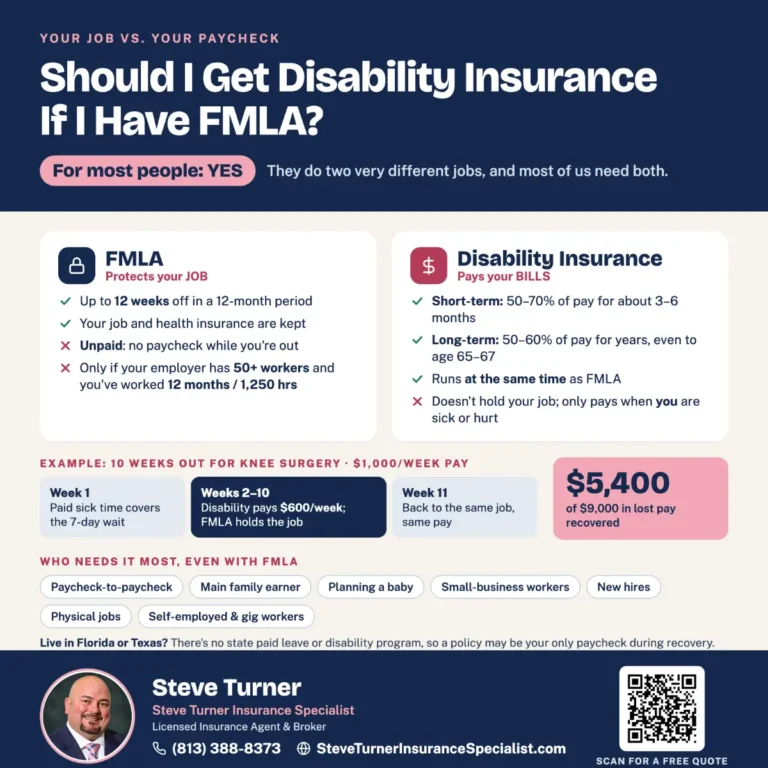
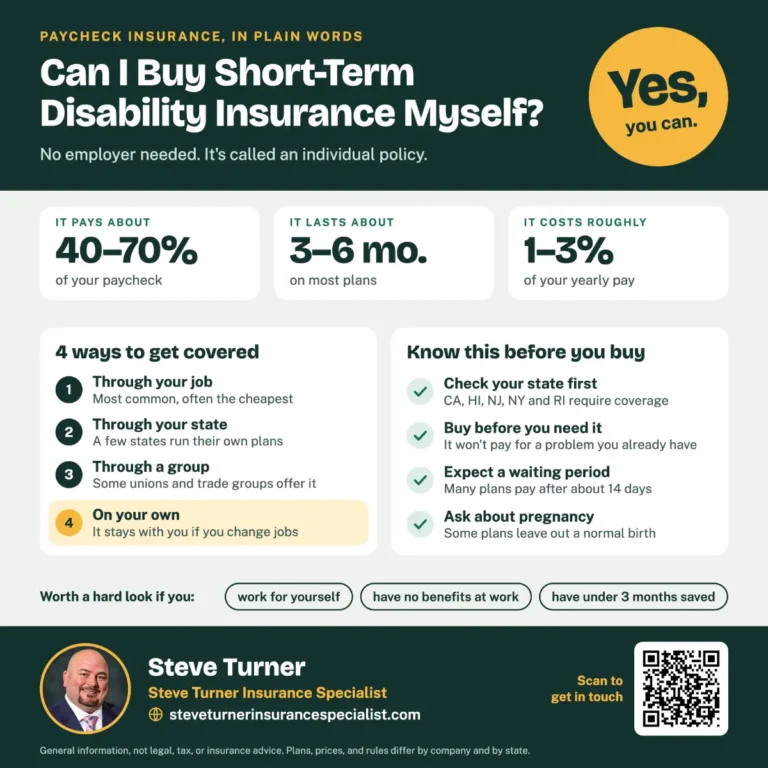
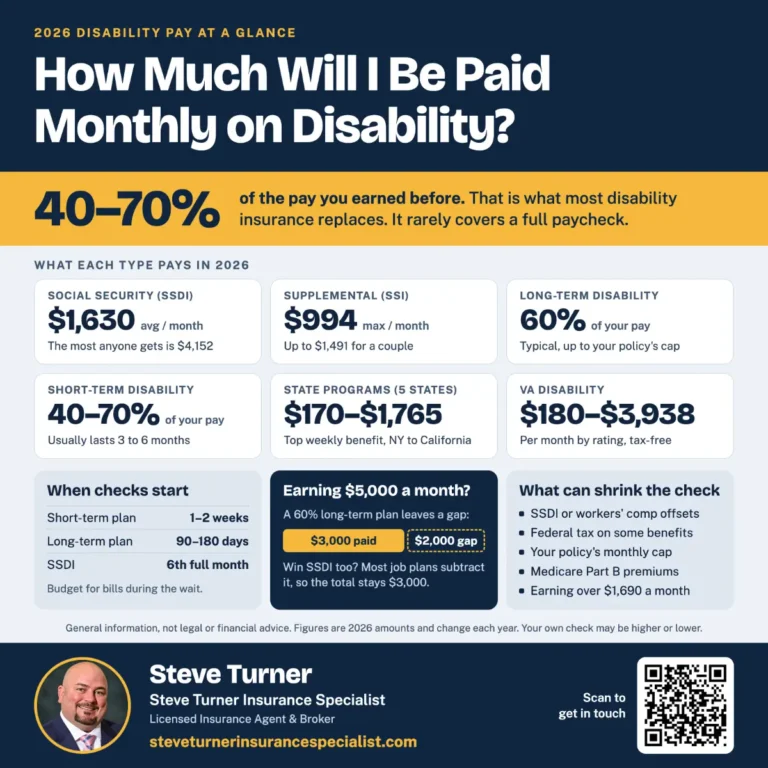
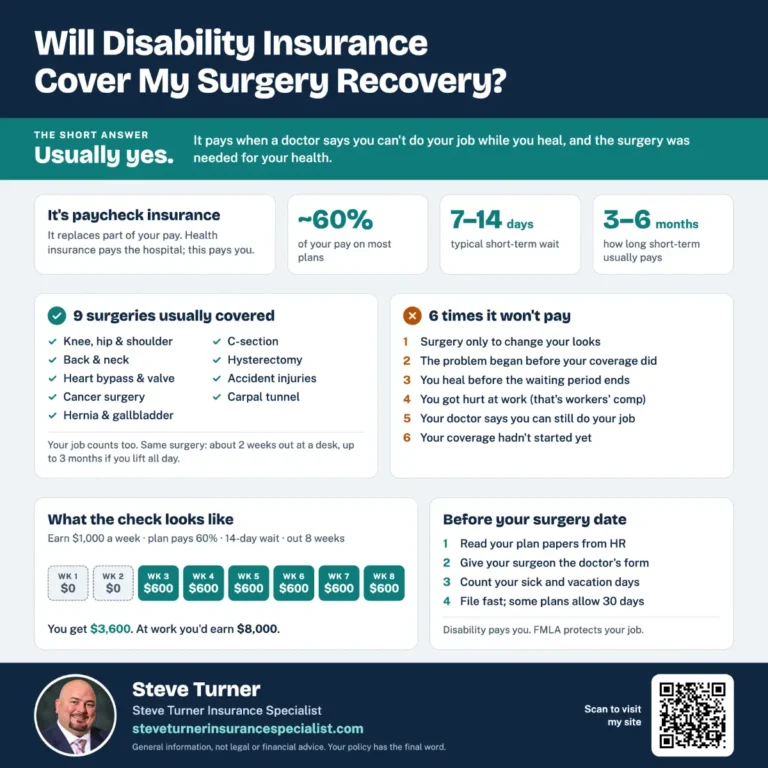
Most short-term plans pay for 3 to 6 months. A few pay for up to a year. They usually replace about 50% to 70% of your paycheck.
Here are common reasons people use short-term disability:
- Having a baby. Many plans pay about 6 weeks for a normal birth and about 8 weeks for a C-section.
- Surgery. A knee or back surgery might keep you home for a few weeks to a few months.
- A bad injury. Think broken bones or a car accident.
- A short illness. Something like pneumonia or a serious infection.
- Mental health. Some plans cover a short leave for anxiety or depression.
Here’s something I didn’t know at first. Short-term disability pays only as long as your doctor says you can’t work. If your plan allows 26 weeks but you heal in 8, the checks stop at 8.
Also, a handful of states run their own short-term disability programs. These include California, New York, New Jersey, Rhode Island, and Hawaii. If you live in one of those states, you may already have some coverage through your job.
What happens when short-term disability runs out?
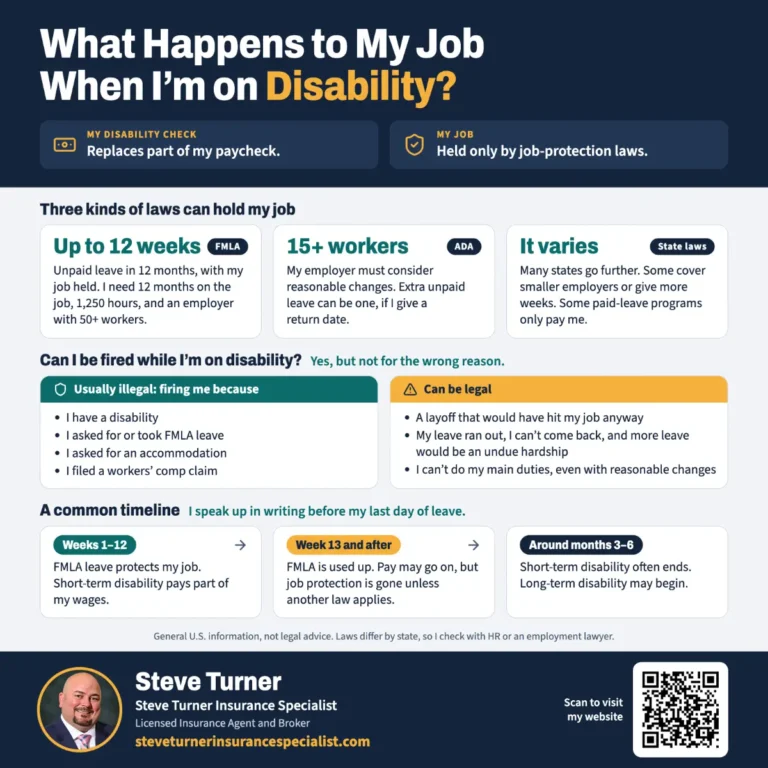
If you’re still not able to work, long-term disability is often the next step. Many work plans are built so short-term coverage ends right around the time long-term coverage kicks in. That’s no accident.
How Long Does Long-Term Disability Last?
Long-term disability is the big one. It’s built for when you can’t work for a long time, maybe even years. It usually pays about 60% of your income.
When you buy a long-term plan, you pick a benefit period. This is the longest the plan will ever pay you for one claim. Here are the most common choices:
- 2 years. This is the cheapest option. It works for many injuries, but it can leave you short if you have a serious illness.
- 5 years. This is a middle-ground choice. It’s a popular pick for people who want to save a little money.
- 10 years. Less common, but some plans offer it.
- To age 65. Your checks can keep coming until you turn 65.
- To age 67. This lines up with the full retirement age for Social Security for most people working today. Many experts like this option best.
- Lifetime. A few older or special policies pay for life. These are rare and expensive.
Here’s how I think about it. A 2-year plan is like a spare tire. It’ll get you down the road for a bit. A “to age 67” plan is like a whole new car. It’s built to go the distance.
Why the benefit period matters so much
Some disabilities don’t get better. Things like multiple sclerosis, a stroke, cancer, or a bad spine injury can keep someone out of work for many years.
If you’re 40 and your plan only pays for 2 years, you could have 25 years of lost pay with no help. That’s why I always tell people to look hard at this number before they sign anything.
When Do Disability Benefits Start? (The Elimination Period)
This part tripped me up at first. Your benefits don’t start the day you get hurt. You have to wait first.
That wait is called the elimination period. It’s kind of like a deductible, but it’s measured in days instead of dollars.
Here’s what it usually looks like:
- Short-term disability: 0 to 14 days. Many plans pay right away for an accident and after 7 days for an illness.
- Long-term disability: 90 days is the most common. Some plans use 30, 60, 180, or even 365 days.
- Social Security disability: You wait 5 full months before your first check.
Does the waiting period count against my benefit period?
Usually, no. Your benefit period clock starts after the waiting period ends. So with a 90-day wait and a 2-year benefit period, you could be out of work for about 2 years and 3 months total before the checks end.
A tip I wish I’d known sooner
A longer waiting period makes your plan cheaper. But you need savings to cover the gap. If you go with a 180-day wait, you’ll need about 6 months of bills saved up. Be honest with yourself about whether you can.
The 2-Year Switch That Ends a Lot of Claims
If you remember one thing from this article, make it this. Many long-term plans change the rules after 24 months.
It all comes down to how your plan defines “disabled.” There are two main ways:
- Own occupation. You count as disabled if you can’t do your job. A surgeon who hurts her hand can’t do surgery, so she gets paid, even if she could teach.
- Any occupation. You count as disabled only if you can’t do any job that fits your schooling, training, and experience.
Here’s the sneaky part. Lots of plans, especially work plans, use “own occupation” for the first 2 years. Then they switch to “any occupation.”
So picture this. You’re a truck driver with a bad back. For 2 years, you get paid because you can’t drive a truck. Then the insurance company says, “You could work a desk job.” And just like that, your checks can stop.
This switch is one of the top reasons long-term claims end before the benefit period runs out.
How I’d protect myself
When I look at a policy, I check for these words:
- “True own occupation” is the strongest. It pays even if you work a different job.
- “Modified own occupation” pays only if you can’t do your job and you aren’t working somewhere else.
- “Any occupation” is the weakest. It’s the hardest to qualify for.
If you have a skilled job, like a nurse, dentist, or engineer, true own occupation is worth looking into.
Work Plans vs. Plans You Buy Yourself
Where you get your coverage also affects how long it lasts. Here’s how the two compare:
| Plan through work (group) | Plan you buy (individual) | |
|---|---|---|
| Cost | Cheap or free | You pay the full price |
| Usual benefit period | 2 years to age 65 | You pick, often up to age 67 |
| Definition of disabled | Often switches to “any occupation” after 2 years | Can lock in “own occupation” |
| If you leave your job | Coverage usually ends | Coverage stays with you |
| Taxes on benefits | Taxed if your boss paid the premium | Tax-free if you paid with after-tax money |
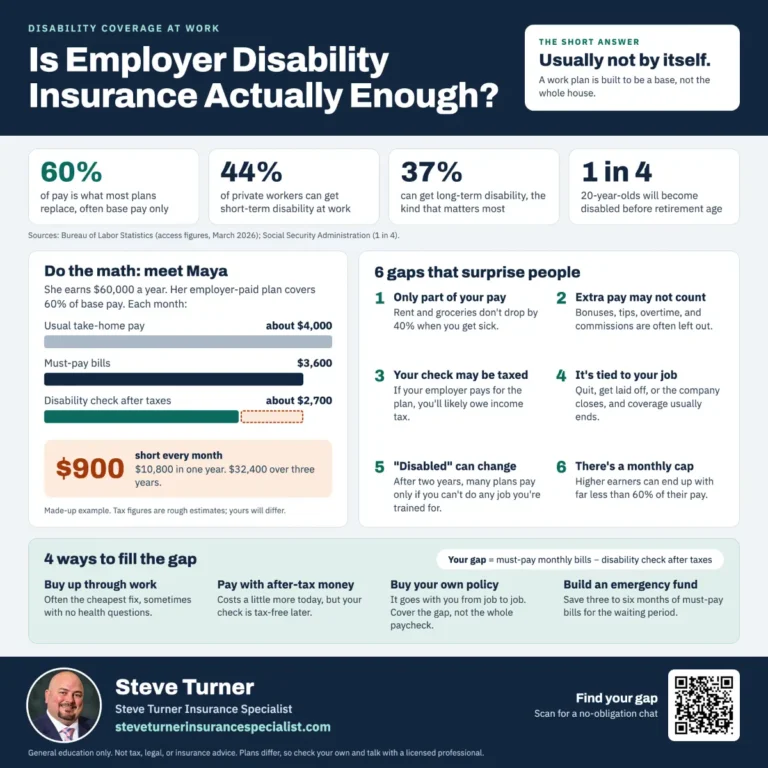
A work plan is a great start. I’d never turn down free coverage. But here’s the thing. If you quit, get laid off, or switch jobs, that coverage usually goes away. And if you get sick later, it can be hard or pricey to buy a new plan.
That’s why some people stack both. They keep the work plan and add a small individual plan on top. That way, part of their safety net goes wherever they go.
How Long Does Social Security Disability (SSDI) Last?
Social Security Disability Insurance, or SSDI, is run by the government. You pay into it through taxes taken out of your paycheck. So in a way, most workers already have some disability coverage.
The good news? SSDI can last a long time. It keeps paying as long as you stay disabled, all the way up to your full retirement age. For most people working today, that’s 67.
When you hit full retirement age, your SSDI turns into regular Social Security retirement. The amount usually stays the same. You don’t have to do anything. It just switches over.
The catch with SSDI
SSDI sounds great, but it has some tough rules:
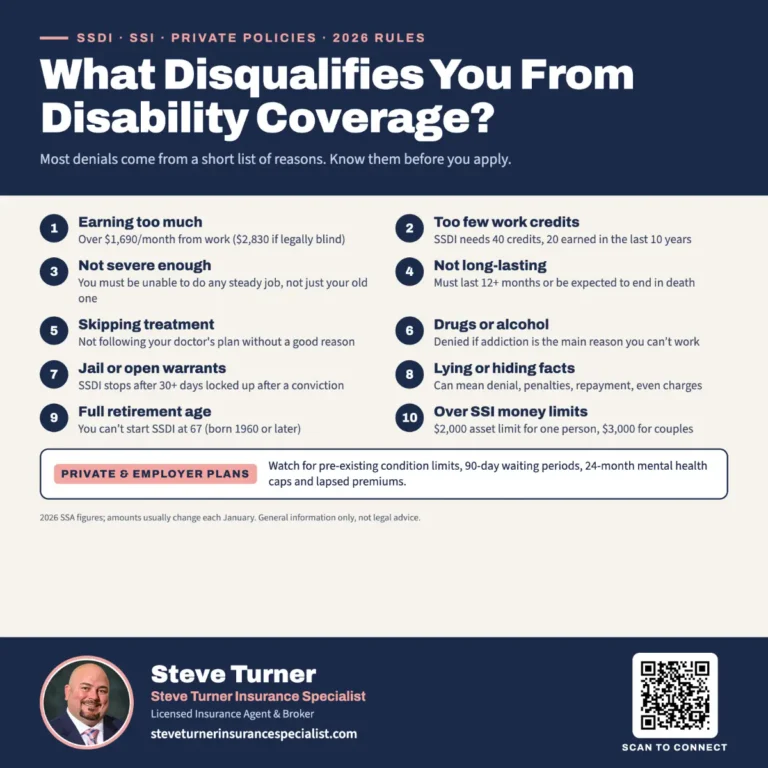
- It’s hard to get. You must be unable to do any real work. Not being able to do your old job isn’t enough.
- Your condition must be long-lasting. It has to be expected to last at least 12 months or end in death.
- You wait 5 months. No checks come during the first 5 full months.
- Approval is slow. Many people get turned down the first time and have to appeal. It can take many months, sometimes more than a year.
- It often isn’t enough to live on. The checks are based on your work history, and many people find them smaller than they hoped.
Does Social Security check up on you?
Yes. Social Security reviews your case from time to time to see if you’re still disabled. If they think you might get better, they may check in every 6 to 18 months. If improvement is possible but not expected soon, they may check in about every 3 years. If your condition isn’t expected to improve, you may check in every 5 to 7 years.
Can I try going back to work?
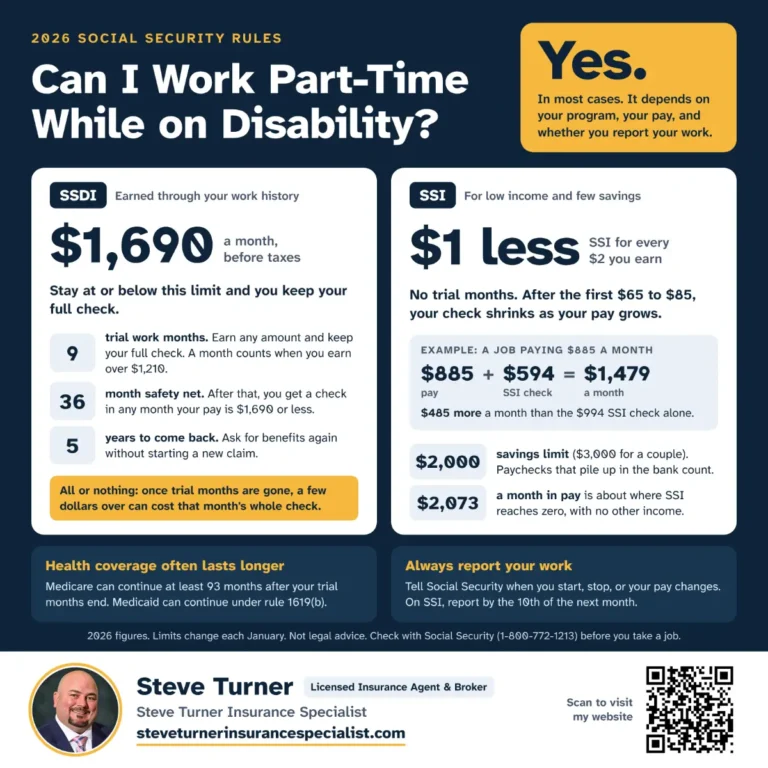
Yes, and I love this part. SSDI gives you a trial work period. You can test out working for 9 months without losing your benefits. After that, you have a 36-month window to restart your checks if you can’t keep working. It takes a lot of fear out of trying.
7 Things That Can End Your Disability Benefits Early
Even with a long benefit period, your checks can stop sooner. Here are the big ones I watch out for:
- You get better. This is the most common reason benefits end. If your doctor clears you to work, the payments stop.
- You go back to work. Many plans cut or stop your checks once you earn a paycheck again. Some offer “partial” or “residual” benefits if you go back part-time and earn less.
- The definition switch. As I mentioned, many plans move from “own occupation” to “any occupation” after 2 years.
- Mental health limits. Lots of long-term plans only pay 24 months for mental health conditions like depression or anxiety. Some plans also limit claims tied to drug or alcohol use.
- “Self-reported” condition limits. Some plans cap payments for conditions that are hard to prove with tests, like certain types of chronic pain or fatigue.
- Pre-existing conditions. If you had a health problem before your coverage started, some plans won’t pay for it during the first year or so.
- Not following the rules. If you skip doctor visits, don’t send in paperwork, or don’t follow your treatment plan, the insurance company can stop paying.
One more thing. Insurance companies often check in on long claims. They may ask for new medical records or send you to their own doctor. It’s smart to keep good records and stay on top of every letter they send.
How I’d Choose the Right Benefit Period
Picking a benefit period is a balancing act. Longer coverage costs more. Shorter coverage leaves you at risk. Here’s the simple process I use:
- Count the years until you retire. If you’re 30, you have about 37 working years left. A 2-year plan covers a tiny slice of that.
- Check what you already have. Look at your work benefits. Find the benefit period, the waiting period, and the disability definition.
- Look at your savings. More savings means you can handle a longer waiting period. That can lower your cost.
- Think about your job. If your job is physical, you’re more likely to get hurt. If your job takes special skills, own-occupation coverage matters more.
- Think about your family. If people count on your paycheck, longer coverage is usually worth it.
- Get a few quotes. Prices can vary a lot. Compare at least two or three plans.
- Ask about riders. These are add-ons. A cost-of-living rider helps your checks keep up with rising prices. A future increase rider lets you buy more coverage later without a new health exam.
For most working adults, I think a benefit period to age 65 or 67 makes the most sense. You’re protecting decades of future paychecks. That’s often your biggest money asset.
Disability Insurance FAQ
Here are the questions people ask me most.
Q: Does disability insurance last for life?
A: Rarely. Most plans stop by age 65 or 67, when retirement benefits are meant to take over. Lifetime plans exist, but they’re rare and expensive.
Q: Can I get disability benefits more than once?
A: Yes. If you recover, return to work, and then get hurt again, you can usually file a new claim. Many plans also have a “recurrent disability” rule. If the same problem comes back within a few months, often 6, your old claim picks back up. You don’t have to sit through a new waiting period.
Q: What happens to my coverage if I leave my job?
A: Work coverage usually ends when you leave. Some plans let you “port” or convert it into a personal plan, but you have to act fast. An individual plan stays with you no matter where you work.
Q: How long can I stay on long-term disability?
A: Up to the end of your benefit period, as long as you still meet the plan’s definition of disabled. Keep an eye out for the 2-year switch and any mental health limits.
Q: Do my checks get smaller over time?
A: Not usually. But they don’t grow either, unless you have a cost-of-living rider. Over 10 or 20 years, rising prices can make the same check feel a lot smaller.
Q: Will my long-term disability check go down if I get SSDI?
A: Often, yes. Many long-term plans subtract your SSDI payment from what they pay. Some even require you to apply for SSDI. Your total usually stays about the same, but the money comes from two places.
Q: Is disability insurance worth it?
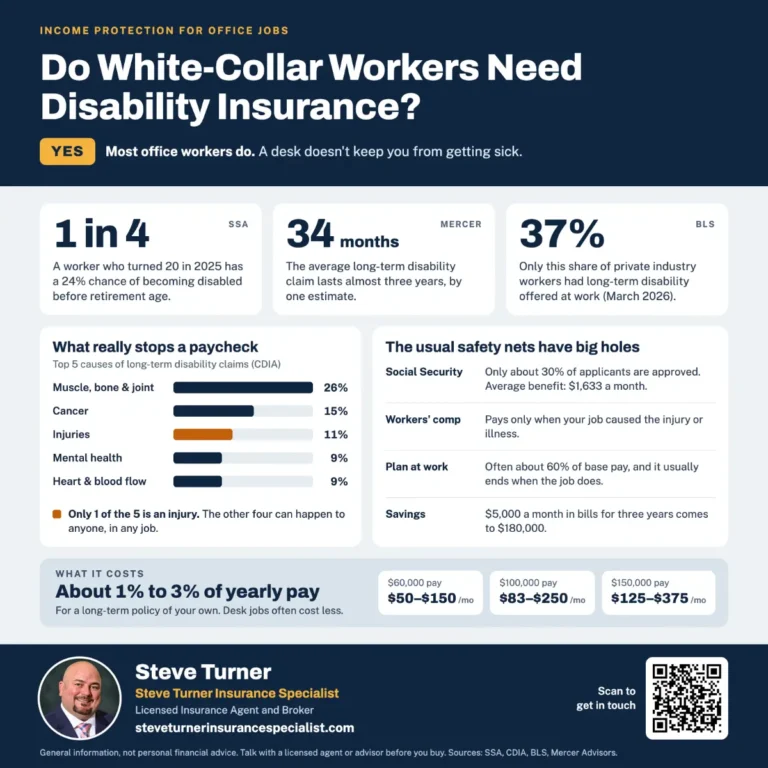
A: I think so for most people who rely on a paycheck. The Social Security Administration has estimated that more than 1 in 4 of today’s 20-year-olds will become disabled before they retire. Your ability to earn money is worth protecting.
The Bottom Line
So, how long does disability insurance actually last? Here’s my final take:
- Short-term disability usually lasts 3 to 6 months.
- Long-term disability lasts for your benefit period, from 2 years up to age 65 or 67.
- SSDI can last until full retirement age, as long as you stay disabled.
But the fine print matters just as much as the number on the front page. The waiting period, the definition of disability, and limits on certain conditions can all change how long you actually get paid.
My friend with the back injury learned that the hard way. You don’t have to. Pull out your policy this week. Find three things: the benefit period, the waiting period, and how it defines “disabled.” Those three answers will tell you how long your safety net really lasts.
If the answer makes you nervous, that’s okay. Now you know, and you have time to fix it.
Why choose Steve Turner Insurance Specialist?
Because I’m an “Insurance Specialist.” An “insurance specialist” is a broad term that includes insurance agents and insurance brokers, but the key difference is who the agent represents versus who the broker represents.
An “insurance agent” works directly for an insurance company and sells its specific policies to clients.
An “insurance broker” acts as an independent intermediary, comparing policies from multiple companies to find the best fit for their client’s needs, essentially representing the client rather than the insurance company.
I am both a licensed Insurance Agent and a licensed Insurance Broker.
My number one goal in life is to help people and ensure, without a shadow of a doubt, that you and your family are secure and protected. I will always be by your side, helping you mitigate risk by providing the industry’s best and most affordable insurance solutions.
I will find insurance plans for the entire family to help cover whatever life throws at you. I can help you save on severe medical emergencies, find a health insurance plan with low- or no-cost doctor visits and affordable prescription medications, and protect your family in the event of an unexpected accident or illness.
Best of all, it doesn’t cost you anything extra to use an experienced Insurance Agent and Broker like me to help you find the Insurance Plans that fit your individual, family, or business needs.
The companies that sell the insurance plans “you choose“ pay me – you don’t pay me. Calling any big insurance company directly won’t get you a lower price, as they will forward your call to the next available insurance agent on their list. You won’t have had any opportunity to learn about the insurance agent you’re speaking with in advance, understand their qualifications or experience level, or make an informed choice about who you want to work with.
Tap the Contact Me text or icon and get in touch by phone or email, or schedule a “No Obligation” chat through my calendar. I look forward to speaking with you!
OUR CLIENT REVIEWS


CONTACT STEVE TURNER, LICENSED INSURANCE AGENT & BROKER
Questions? Call, text, or book a time below; I answer calls and emails 7 Days a week from 7:00 a.m. to 8:00 p.m., excluding posted holidays.
EMAIL ME: 24×7
OFFICE LOCATION
Address: 14502 N Dale Mabry Hwy, Suite 200, Tampa, FL 33618
Website: steveturnerinsurancespecialist.com
Email: [email protected]
Phone and Text: +1-813-388-8373
Business Hours:
Monday: 7:00 a.m. / 8:00 p.m.
Tuesday: 7:00 a.m. / 8:00 p.m.
Wednesday: 7:00 a.m. / 8:00 p.m.
Thursday: 7:00 a.m. / 8:00 p.m.
Friday: 7:00 a.m. / 8:00 p.m.
Saturday: 7:00 a.m. / 8:00 p.m.
Sunday: 7:00 a.m. / 8:00 p.m.
DISABILITY INSURANCE POSTS

INSURANCE OFFERINGS
How Long Does Disability Insurance Actually Last?
HEALTH INSURANCE

MEDICARE ADVANTAGE

MEDICARE SUPPLEMENT

PRESCRIPTION DRUGS

LIFE INSURANCE

DISABILITY INSURANCE
DENTAL INSURANCE

GROUP HEALTH INSURANCE

ACCIDENT INSURANCE

LONG TERM CARE INSURANCE

MEDICAID INSURANCE

MEDICARE INSURANCE

MEDICARE PART A INSURANCE

MEDICARE PART B INSURANCE

MEDICARE PART C INSURANCE

MEDICARE PART D INSURANCE

MEDICARE PLAN G INSURANCE

MEDICARE PLAN N INSURANCE

SERVICE AREA
Medicare plan availability differs by state and county. Steve Turner is licensed in AL, CO, FL, GA, NC, SC, TN, and TX.
MEDICARE DISCLAIMER
We do not offer every plan available in your area. Any information we provide is limited to those plans we do offer in your area. Please contact Medicare.gov or 1-800-MEDICARE for information on all your options.
Steve Turner is a licensed insurance agent and is not connected with or endorsed by the United States Government or the Federal Medicare Program. The Medicare Annual Enrollment Period is October 15 to December 7.
Steve Turner

Steve Turner, CLU®, REBC® is licensed in AL, CO, FL, GA, NC, SC, TN, and TX · NPN 18030539 · Florida License W333468
Steve Turner is a licensed agent and broker and a long-standing member of the National Association of Benefits and Insurance Professionals NABIP®. Steve holds the Registered Employee Benefits Consultant® (REBC®) designation. Steve also holds the “Chartered Life Underwriter” designation (CLU®), a professional credential for individuals specializing in life insurance and estate planning, conferred by the American College of Financial Services. Since 2016 (over 10 years), Steve has helped individuals, families, Medicare beneficiaries, and small businesses find the right coverage to meet their needs. Steve has earned 180+ Google reviews from happy clients.
Steve Turner is a licensed agent appointed by Florida Blue in Florida.