

Do White-Collar Workers Need Disability Insurance?

Do White-Collar Workers Need Disability Insurance? Is Disability Coverage Relevant for Office Jobs
The Short Answer: Yes, Most Office Workers Do
Yes. I think most white-collar workers need disability insurance. If you work at a desk and your family lives on your paycheck, this is coverage worth having.
I know that can sound odd. Office work feels safe. Nobody falls off a roof in a budget meeting. But the biggest risk for a desk worker isn’t an accident. It is getting sick.
Here is the number that shapes how I see it. The Social Security Administration says a worker who turned 20 in 2025 has a 24% chance of becoming disabled before retirement age. That is about 1 in 4. And Social Security uses a very strict test, so that number leaves out many shorter health problems.
One note before we start. I am sharing general information, not personal money advice. Your needs may be different from mine, so talk with a licensed agent or advisor before you buy.
What Is Disability Insurance?
Disability insurance pays you part of your paycheck when you are too sick or hurt to work. Some people call it income protection. I like that name better, because that is what it does.
Think about what you insure today. You insure your car. You insure your home. You may even insure your phone. But the thing that pays for all of those is your income. For most office workers, the power to earn a paycheck is the most valuable thing they own.
Let me show the math. Say you earn $80,000 a year and have 25 working years left. That is $2 million in future pay, before any raises. A disability policy protects that money.
Short-Term vs. Long-Term Disability Insurance
There are two main types. Here is how they compare.
| Short-term disability | Long-term disability | |
|---|---|---|
| How long it pays | A few months, often up to 6 | Years, often until retirement age |
| When it starts | Soon, often after a week or two | Later, often after about 90 days |
| How much it pays | Part of your pay, often about 60% | Part of your pay, often 50% to 80% |
| Good for | Surgery, a broken bone, having a baby | Cancer, a bad back, a stroke, deep depression |
If I could pick only one, I would choose long-term disability insurance. A few months without pay hurts. A few years without pay can wipe out a family’s savings.
5 Myths Office Workers Believe About Disability Insurance
Most white-collar workers skip this coverage because of a few common myths. I want to clear them up one by one.
Myth 1: “My job is safe, so I am safe.”
A desk job protects you from falls and heavy machines. It does not protect you from cancer, back pain, or depression. Sickness does not check your job title first.
Myth 2: “Workers’ comp will pay me.”
Workers’ comp only pays when your job caused the problem. Most health problems do not start at work. In 2024, fewer than 1 in 100 American workers missed work because of a job injury or illness, according to the Council for Disability Income Awareness.
Myth 3: “I already have coverage at work.”
Maybe you do. Many people don’t. Only 37% of private industry workers had a long-term disability plan offered at work in March 2026, the Bureau of Labor Statistics says. And even good work plans have gaps. I cover those below.
Myth 4: “Social Security will take care of me.”
Social Security disability is hard to get, slow to start, and small. It was built as a basic safety net. It was not built to replace an office salary.
Myth 5: “I am young and healthy so that I can wait.”
This myth costs people the most. Insurers set your price by your age and health. The younger and healthier you are, the less you pay. If you wait until you get sick, you may not be able to buy a policy at all.
What Really Keeps Office Workers From Working
Illness keeps far more people out of work than accidents do. Most desk workers miss this fact.
Here are the top five reasons for long-term disability claims, from the Council for Disability Income Awareness:
- Muscle, bone, and joint problems (26%). Think bad backs, sore necks, and worn-out knees.
- Cancer (15%). Treatment can take months and leave you worn out.
- Injuries (11%). Breaks, sprains, and strains.
- Mental health problems (9%). This includes depression and anxiety.
- Heart and blood flow problems (9%). Heart attacks and strokes are on this list.
Now read that list again as an office worker. Only one of the five is an injury. The other four can happen to anyone, in any job.
Some of them fit desk work a little too well. Sitting for long hours can strain your back and neck. Tight deadlines and long days can wear down your mental health. And cancer does not care where you work.
Office Work Needs a Sharp Mind
Here is something I think about a lot. A roofer needs a strong body. An office worker needs a clear head.
My work calls for focus, memory, and long hours in front of a screen. So a health problem does not have to put me in a hospital bed to stop my paycheck. Any of these could do it:
- Brain fog after a long illness
- Pain that makes it hard to sit or type
- Deep sadness that makes it hard to think
- Trouble speaking after a stroke
- Bad headaches that come back again and again
How Long Does a Disability Last?
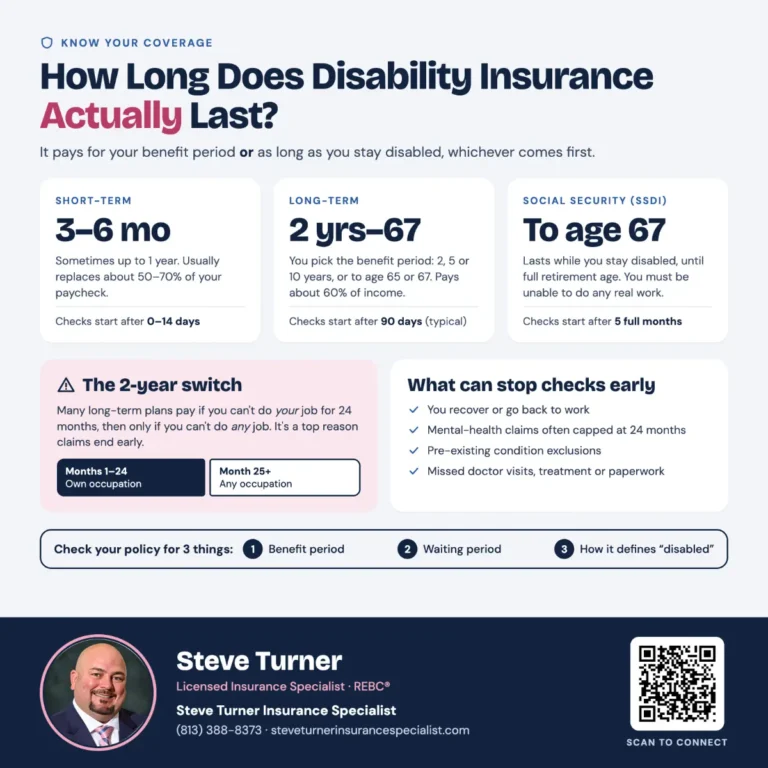
Longer than most people guess. One estimate from Mercer Advisors puts the average long-term disability claim at about 34 months. That is almost three years.
Ask yourself this. Could your family go three years without your pay?
Won’t Social Security, Workers’ Comp, or savings cover me?
Not well. Each helps a little, but none can replace an office paycheck for long. Here are the questions people ask most.
Q: Doesn’t Social Security pay disability benefits?
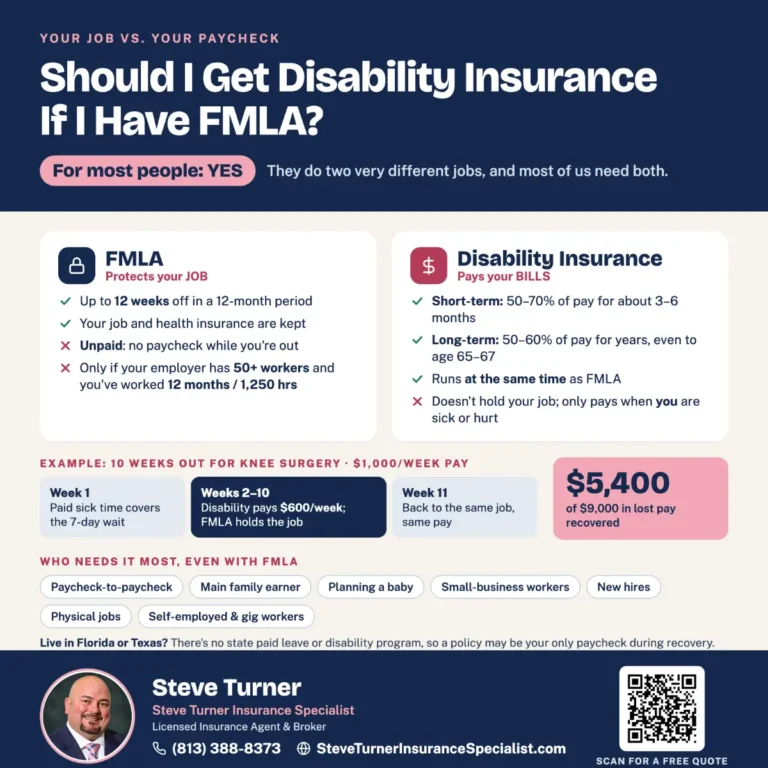
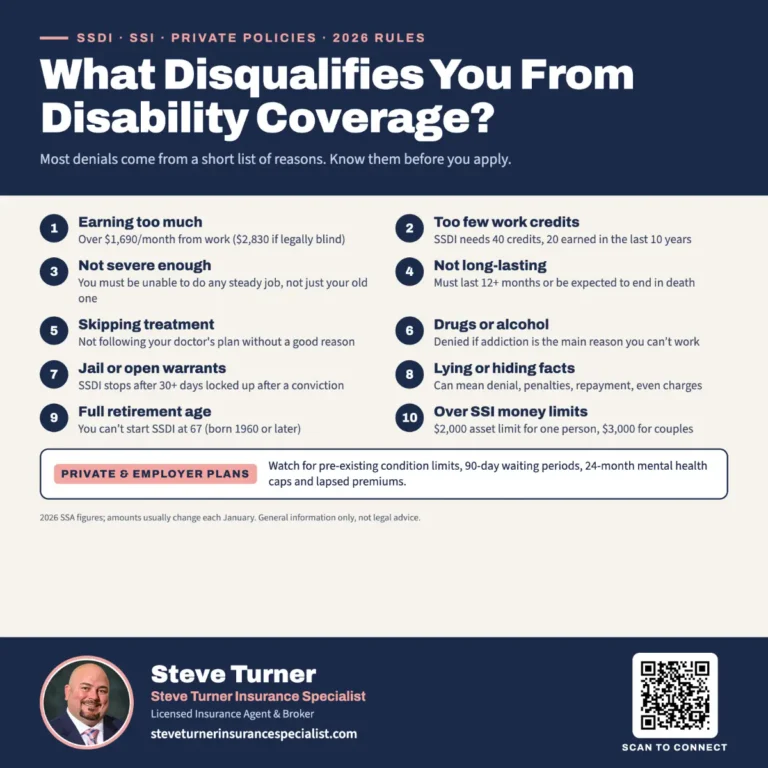
A: Yes, through a program called SSDI. But the rules are strict. The Social Security Administration says you must be unable to do any real paid work. Your problem must also be expected to last at least 12 months or end in death. If you can’t do your own job but could do an easier one, you likely won’t get paid.
Q: How hard is it to get approved?
A: Very hard. From 2014 to 2023, only about 30% of applicants were approved, and only about 20% got a yes on the first try, according to the Council for Disability Income Awareness. The first answer alone often takes three to five months. You must also be disabled for five full months before benefits can start.
Q: How much does SSDI pay?
A: Not much. The average disabled worker got about $1,633 a month in January 2026, according to Social Security data. That is about $19,600 a year. Higher earners get more, but the top benefit in 2026 is $4,152 a month. For most white-collar workers, that is a big pay cut.
Q: What about workers’ comp?
A: It only helps if your job caused the injury or illness. A heart attack at home on a Sunday does not count. Neither does cancer.
Q: Does my state have a plan?
A: A few states do, such as California, New Jersey, and New York. These plans are short-term. They pay for some months, not years.
Q: Can’t I live on my savings?
A: Let’s do the math. Say your family spends $5,000 a month. Three years of bills come to $180,000. Most people do not have that much set aside. In fact, nearly 4 in 10 American adults say they could not pay a surprise $400 bill without borrowing. And if you pull money from a retirement account early, you may owe taxes and fees.
So here is where I land. These safety nets are real, but they have big holes. Disability insurance is what fills them.
Is My Employer’s Disability Plan Enough?
A work plan is a good start, but for many office workers it is not enough on its own.
First, check if you even have one. In March 2026, 44% of private industry workers could get short-term disability coverage at work. Only 37% could get long-term coverage, the Bureau of Labor Statistics reports. Office jobs tend to do better than that, but don’t guess. Ask your HR team.
If you do have a group plan, I would sign up. Group coverage is cheap, and you often don’t need a health exam. But read the fine print. Here are six gaps to watch for.
6 Common Gaps in Group Disability Insurance
- It may cover only part of your pay. Many plans pay about 60% of your base salary. Bonuses and commissions are often left out.
- The benefit may be taxed. If your employer pays for the plan, the IRS counts your benefit as income. So 60% of your pay can shrink even more after taxes.
- There may be a monthly cap. Some plans stop at a set dollar amount each month. High earners hit that cap fast.
- It usually stays with the job. If you quit or get laid off, the coverage often ends. That can leave you with no plan at the worst time.
- The rules can change after two years. Many group plans pay at first if you can’t do your own job. Later, they pay only if you can’t do any job.
- Some health problems have time limits. A plan may pay for mental health claims for only two years.
A Quick Example
Let’s say Maria is a marketing manager. She earns $100,000 in salary plus a $20,000 bonus. Her work plan pays 60% of base pay, and her employer pays for it.
- Her normal pay: $120,000 a year
- Her benefit before taxes: $60,000 a year
- Her benefit after taxes: even less
Maria thought she had 60% coverage. She really has 50%, and it is taxed like a paycheck. A small policy of her own could fill that gap.
How Much Does Disability Insurance Cost?
A long-term disability policy of your own costs about 1% to 3% of your yearly pay; that rule of thumb comes from Mercer Advisors.
Here is what that looks like in dollars.
| Yearly pay | Cost per year | Cost per month |
|---|---|---|
| $60,000 | $600 to $1,800 | $50 to $150 |
| $100,000 | $1,000 to $3,000 | $83 to $250 |
| $150,000 | $1,500 to $4,500 | $125 to $375 |
Group plans at work cost less. Mercer puts them at about $30 to $60 a month.
Here is the good news for desk workers. Insurers see office jobs as low risk, so we often pay less than people who do physical work.
What Changes Your Price
- Your age. Younger buyers pay less.
- Your health. Good health means a lower price.
- Your job. Safer jobs cost less to cover.
- Your sex. Women often pay more than men.
- Smoking. Smokers pay more.
- How much the policy pays. A bigger monthly check costs more.
- How long you wait. A longer wait before pay starts lowers the price.
- How long it pays. Paying until age 65 costs more than paying for five years.
- Extras. Each add-on raises the price.
5 Ways I Would Save Money
- Buy while I am young and healthy.
- Take the group plan at work first, then add a small policy of my own.
- Pick a 90-day wait and keep three months of bills in savings.
- Skip add-ons I don’t need.
- Get prices from more than one company.
Here is how I think about the cost. Picture two job offers. One pays $100,000 with no safety net. The other pays $98,000 and keeps paying if you get too sick to work. I would take the second one every time.
7 Disability Insurance Terms to Know Before You Buy
The words in a policy matter more than the price. Two policies can cost the same and pay out very differently. These are the seven terms I would learn first.
1. Own-Occupation
An own-occupation policy pays if you can’t do your own job. This is the big one for white-collar workers.
Picture a trial lawyer who loses her voice. She could still do other work, like filing papers. With own-occupation coverage, she still gets paid, because she can’t do the job she trained for.
2. Any-Occupation
An any-occupation policy pays only if you can’t do any job that fits your schooling and skills. It costs less, but it is much harder to collect on. If you can afford it, I would pick own-occupation.
3. Elimination Period
This is the wait before your pay starts. Think of it like a deductible, but counted in days. Ninety days is a common choice.
4. Benefit Period
This is how long the policy keeps paying. It could be 2 years, 5 years, 10 years, or until you reach retirement age. Longer is safer, and it costs more.
5. Non-Cancelable
This means the company can’t cancel your policy or raise your price as long as you pay on time. It locks in your deal.
6. Guaranteed Renewable
This is a step down from non-cancelable. The company can’t drop you. But it can raise the price for a whole group of people like you.
7. Partial Disability
Some policies call this residual disability. It pays part of your benefit if you can work only part-time, or if your income drops because of your health. Many people get better slowly, so this feature can matter a lot.
Two Add-Ons Worth a Look
Add-ons are called riders. Two of them stand out to me.
- Cost-of-living rider. Your benefit grows over time, so rising prices don’t eat it up.
- Future increase rider. You can buy more coverage later, as your pay goes up, with no new health exam.
Who Needs Disability Insurance Most?
You need it most if other people or big bills depend on your paycheck. I use one simple test. If my pay stopped for two years, could my family keep our home and pay our bills? If the answer is no, I need coverage.
7 White-Collar Workers Who Should Look Closely
- The main earner. If your family runs on your pay, you have the most to lose.
- Homeowners and renters with small savings. The rent or mortgage is due every month, sick or not.
- High earners. The more you make, the bigger the gap that Social Security and group plans leave.
- Workers with special skills. Doctors, dentists, lawyers, engineers, and accountants spend years training for one kind of work.
- Freelancers and business owners. You have no HR team and no group plan. You are the plan.
- People with student loans or other debt. The payments keep coming, even if your paycheck stops.
- Single people. No second income to fall back on.
Who Might Skip It or Buy Less?
I want to be fair here. Not everyone needs a big policy. You may need less coverage, or none, if:
- You have enough savings to live on for many years.
- You are only a few years from retiring.
- Your partner earns enough to pay all the bills alone.
- You have a strong plan at work and low costs at home.
Even then, I would check the math before I say no. It is easy to think savings will last longer than they really will.
How to Buy Disability Insurance in 7 Steps
Buying a policy takes a little homework, but the steps are simple. This is the order I would follow.
- Add up your must-pay bills. Count housing, food, insurance, debt, and child care. This is the monthly amount you need to protect.
- Read your plan at work. Ask HR for the plan summary. Find out what it pays, how long it pays, and who pays.
- Find your gap. Take your must-pay bills and subtract what your work plan would pay after taxes. What’s left is the gap.
- Pick your key features. For most office workers, I would start with own-occupation coverage, a 90-day wait, and benefits that last until retirement age.
- Get at least three quotes. An independent broker can shop many companies at once. Compare the same features side by side.
- Tell the truth on your application. You will answer health questions, and you may need a short exam. A wrong answer can lead to a claim denial later.
- Check your coverage again every few years. A raise, a new baby, or a new house can change what you need.
One more tip. Don’t wait for the perfect policy. A good policy you own today beats a great one you never buy.
FAQ: Disability Insurance for White-Collar Workers
Q: Is disability insurance worth it if I work at a desk?
A: For most people, yes. Desk workers face the same illnesses as everyone else. And office jobs often cost less.
Q: How much coverage do I need?
A: Aim to cover your must-pay bills. Most policies replace about 50% to 80% of your pay. You can’t insure 100% because insurers want you to have a reason to go back to work.
Q: Are disability benefits taxed?
A: It depends on who paid for the policy. The IRS says that if you pay the full cost with after-tax money, your benefits are not counted as income. If your employer pays, the benefits are taxed. If you split the cost, only the employer’s share is taxed.
Q: Does disability insurance cover mental health?
A: Many policies do. But some limit these claims to two years. Read this part of the policy with care, because mental health is one of the top causes of claims.
Q: Does it cover pregnancy?
A: Short-term plans often do. In fact, pregnancy is the top reason for short-term disability claims, at 22%. You most often need to have the plan before you become pregnant.
Q: Can I buy a policy if I already have a health problem?
A: Often, yes. But the company may charge more or exclude that health problem from your coverage. This is why buying early helps so much.
Q: Is short-term or long-term coverage more important?
A: Long-term, in my view. Savings and sick days can cover a few weeks. They can’t cover a few years.
Q: When should I buy?
A: As soon as someone depends on your paycheck, even if that someone is just you.
The Bottom Line: Protect Your Paycheck
So, do white-collar workers need disability insurance? For most of us, yes. A desk doesn’t keep you from getting sick, and illness drives most long-term claims.
Here is what I would do this week:
- Ask HR what disability coverage I have.
- Add up my must-pay bills.
- Get quotes to fill the gap.
Your income pays for everything else in your life. It is worth protecting.
Why choose Steve Turner Insurance Specialist?
Because I’m an “Insurance Specialist.” An “insurance specialist” is a broad term that includes insurance agents and insurance brokers, but the key difference is who the agent represents versus who the broker represents.
An “insurance agent” works directly for an insurance company and sells its specific policies to clients.
An “insurance broker” acts as an independent intermediary, comparing policies from multiple companies to find the best fit for their client’s needs, essentially representing the client rather than the insurance company.
I am both a licensed Insurance Agent and a licensed Insurance Broker.
My number one goal in life is to help people and ensure, without a shadow of a doubt, that you and your family are secure and protected. I will always be by your side, helping you mitigate risk by providing the industry’s best and most affordable insurance solutions.
I will find insurance plans for the entire family to help cover whatever life throws at you. I can help you save on severe medical emergencies, find a health insurance plan with low- or no-cost doctor visits and affordable prescription medications, and protect your family in the event of an unexpected accident or illness.
Best of all, it doesn’t cost you anything extra to use an experienced Insurance Agent and Broker like me to help you find the Insurance Plans that fit your individual, family, or business needs.
The companies that sell the insurance plans “you choose“ pay me – you don’t pay me. Calling any big insurance company directly won’t get you a lower price, as they will forward your call to the next available insurance agent on their list. You won’t have had any opportunity to learn about the insurance agent you’re speaking with in advance, understand their qualifications or experience level, or make an informed choice about who you want to work with.
Tap the Contact Me text or icon and get in touch by phone or email, or schedule a “No Obligation” chat through my calendar. I look forward to speaking with you!
OUR CLIENT REVIEWS


CONTACT STEVE TURNER INSURANCE AGENT & BROKER
I’m here to take your calls and emails and answer your questions 7 Days a week from 7:00 a.m. to 8:00 p.m., excluding posted holidays.
Steve Turner is a licensed agent and broker and a long-standing member of the National Association of Benefits and Insurance Professionals®. Steve holds the prestigious Registered Employee Benefits Consultant® designation. NABIP® is the preeminent organization for health insurance and employee benefits professionals and works diligently to ensure all Americans have access to high-quality, affordable healthcare and related services.
Steve Turner is a licensed agent appointed by Florida Blue.
Richard Steven Turner’s official Florida state insurance license number (operating as Steve Turner Insurance Specialist) is W333468
EMAIL ME: 24×7
OFFICE LOCATION
Website: steveturnerinsurancespecialist.com
Email: [email protected]
Phone and Text: +1-813-388-8373
Business Hours:
Monday: 7:00 a.m. – 8:00 p.m.
Tuesday: 7:00 a.m. – 8:00 p.m.
Wednesday: 7:00 a.m. – 8:00 p.m.
Thursday: 7:00 a.m. – 8:00 p.m.
Friday: 7:00 a.m. – 8:00 p.m.
Saturday: 7:00 a.m. – 8:00 p.m.
Sunday: 7:00 a.m. – 8:00 p.m.
DISABILITY INSURANCE POSTS
INSURANCE OFFERINGS
Do White-Collar Workers Need Disability Insurance?
HEALTH INSURANCE

MEDICARE ADVANTAGE

MEDICARE SUPPLEMENT

PRESCRIPTION DRUGS

LIFE INSURANCE

DISABILITY INSURANCE
DENTAL INSURANCE

GROUP HEALTH INSURANCE

ACCIDENT INSURANCE

LONG TERM CARE INSURANCE

MEDICAID INSURANCE

MEDICARE INSURANCE

MEDICARE PART A INSURANCE

MEDICARE PART B INSURANCE

MEDICARE PART C INSURANCE

MEDICARE PART D INSURANCE

MEDICARE PLAN G INSURANCE

MEDICARE PLAN N INSURANCE

SERVICE AREA
MEDICARE STATEMENT
We do not offer every plan available in your area. Currently, we represent 7 organizations that offer 70 products in your area. Please contact Medicare.gov or 1-800-MEDICARE for information on all your options.
Steve Turner is a licensed insurance agent and is not connected with or endorsed by the United States Government or the Federal Medicare Program. The Medicare Annual Enrollment Period is October 15 to December 7.
There’s no one-size-fits-all answer. Carefully consider your health status, expected medical needs, prescription drugs, budget, preferred doctors and hospitals, and how comfortable you are with network rules. During the Annual Enrollment Period, you can research the plans available in your Florida county using the Medicare Plan Finder at Medicare.gov, compare costs and benefits, and get free, unbiased counseling from Florida’s SHINE (Serving Health Insurance Needs of Elders) program at floridashine.org or 1-800-963-5337. You can also call 1-800-MEDICARE (1-800-633-4227; TTY 1-877-486-2048), 24 hours a day, 7 days a week.