

Can I Buy Short-Term Disability Insurance Myself?

Can I Buy Short-Term Disability Insurance Myself? Do I Need Employer Coverage to Get Protection
Yes, you can buy short-term disability insurance yourself. You don’t need a boss or a job with benefits to get it. Some insurance companies sell these plans straight to people like you and me.
But I want to be upfront. It isn’t as easy as buying car insurance. Fewer companies sell it. It can cost more than a work plan. And you have to buy it before you get sick, hurt, or pregnant.
In this guide, I’ll walk you through it all in plain words. I’ll show you where to buy a plan, what it costs, and what to check first. I’ll also tell you when I’d skip it and do something else.
The quick answer
Short on time? Here is what I’d want you to know.
- Yes, you can buy your own plan. It’s called an individual short-term disability policy.
- It pays part of your paycheck. Most plans pay about 40% to 70% of what you earn.
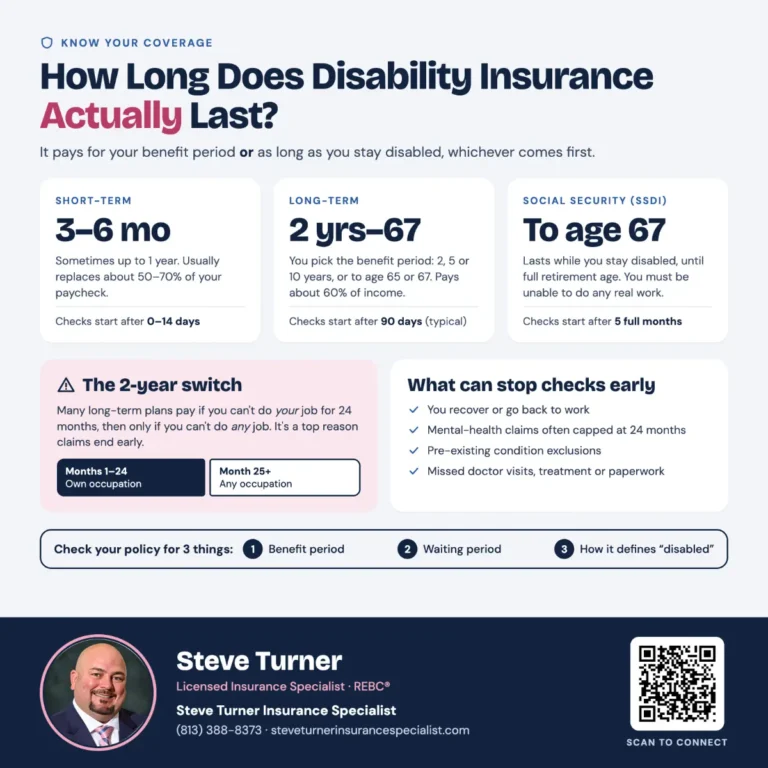
- It lasts a short time. Most plans pay for about 3 to 6 months. Some plans you buy yourself can last a year or more.
- It isn’t free. A common rule of thumb is 1% to 3% of your yearly pay.
- You must buy it early. A plan won’t pay for a problem you already have.
- Your state may already cover you. Check that first, so you don’t pay twice.
What is short-term disability insurance?
Short-term disability insurance pays you money when you can’t work for a while. That’s the whole idea. If you get sick or hurt away from work, the plan sends you part of your paycheck.
I like to think of it as paycheck insurance. Your car has insurance. Your home has insurance. This covers your income.
Here are some things it can help with:
- A broken leg from a fall at home
- Time off after surgery
- A bad back that keeps you in bed
- A serious illness, like cancer
- Healing after you have a baby
3 words you need to know
You’ll see these three terms on every plan. Learn them now, and the rest gets easy.
- Benefit amount. This is how much money you get each week or month.
- Waiting period. This is how long you must be out of work before benefits start. Some companies call it the elimination period.
- Benefit period. This is how long the money keeps coming.
Here’s a quick example. Say I earn $800 a week and my plan pays 60%. I break my leg and can’t work. After the waiting period, I’d get $480 a week. The money stops when I heal or when the benefit period ends.
What it is not
People mix this up with other things all the time. So let me clear that up.
- It isn’t health insurance. Health insurance pays your doctor. Disability insurance pays you.
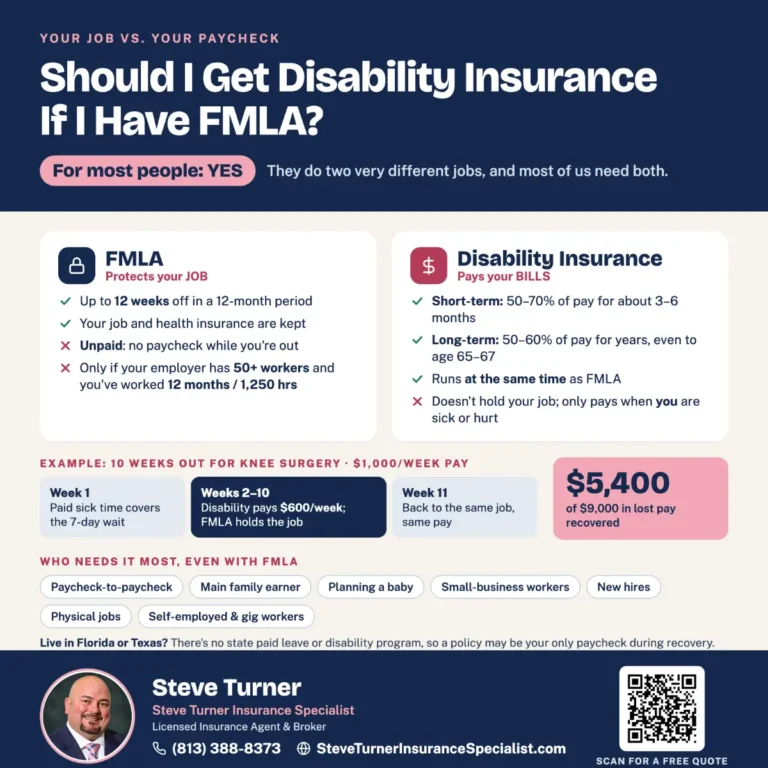
- It isn’t workers’ comp. Workers’ comp is for injuries you get on the job. Short-term disability is for things that happen off the job.
- It isn’t long-term disability. Long-term plans kick in later and can pay for years.
- It isn’t Social Security. Social Security only helps with long, severe disabilities. It doesn’t pay for short ones.
Can I buy short-term disability insurance on my own?
Yes, you can. A plan you buy yourself is called an individual policy. You pick it, you pay for it, and you own it.
But buying your own is only one way to get covered. I count four ways in all.
4 ways to get short-term disability insurance
- Through your job. This is the most common way. Your boss may pay for some or all of it. It’s often the cheapest choice.
- Through your state. A few states run their own plans. If you work there, you may already be covered.
- Through a group. Some unions and trade groups offer plans to their members.
- On your own. You buy a plan from an insurance company, most often through an agent.
Here’s what I like most about option four. The plan belongs to you. If you quit your job or get laid off, your plan goes with you.
Who should think about buying their own plan?
I’d look hard at your own plan if any of these sound like you:
- You work for yourself, freelance, or do gig work.
- Your job doesn’t offer disability benefits.
- You work part-time and can’t join your employer’s plan.
- You change jobs a lot.
- Your family counts on your paycheck.
- You have less than three months of savings.
Who may not need one?
You may be able to skip it if:
- You already have a good plan at work.
- Your state plan covers you.
- You have enough savings to pay your bills for a few months.
Check your state first.
Before you spend a dime, find out what your state gives you. I’d do this step first. You may already be paying for coverage and not know it.
5 states that require short-term disability coverage
- California
- Hawaii
- New Jersey
- New York
- Rhode Island
Puerto Rico also has a similar plan. If you work for a boss in one of these places, you’re most likely covered. The money for it often comes out of your paycheck.
States with paid medical leave
More states now have paid family and medical leave. These plans pay part of your wages when you have a serious health problem. They also pay when you need to care for a new baby or a sick family member.
As of 2026, plans in 12 states and Washington, D.C. are paying benefits:
- California
- Colorado
- Connecticut
- Delaware (started January 2026)
- Maine (started May 2026)
- Massachusetts
- Minnesota (started January 2026)
- New Jersey
- New York
- Oregon
- Rhode Island
- Washington
Maryland and Virginia have passed laws too. Their plans are set to start paying in 2028.
What if I work for myself?
State plans are built for people who work for a boss. If you work for yourself, you may have to sign up on your own. California, for one, has an opt-in plan for self-employed people. Call your state labor office and ask what it offers.
What if my state isn’t on the list?
Then your state has no plan for you. That’s true in most of the country. Your choices are a plan at work or a plan you buy yourself.
Where can I buy short-term disability insurance?
This is the tricky part. Few companies sell short-term plans to individuals. Most of them sell to employers. So you may need to make a few calls.
Here are the four places I’d look.
- A company that sells to individuals. State Farm is one example. It sells short-term disability plans through its agents in most states. It doesn’t sell them in Massachusetts, New Jersey, or Rhode Island.
- An independent agent or broker. These agents work with many companies. They can show you more than one plan at a time.
- A union or trade group. If you belong to one, ask if it has a member plan.
- Your own small business. If you own a business with workers, you may be able to buy a small group plan.
A heads-up about big brand names
Some brands you see in ads don’t sell this plan directly to people. Aflac is a good example. Its website says its short-term disability plan is only sold through employers.
So here is the first question I’d ask any company: “Do you sell short-term disability insurance to individuals in my state?”
You may also hear, “We only sell long-term plans.” That’s common. Don’t hang up yet. I’ll explain later why a long-term plan might be the better buy.
How much does short-term disability insurance cost?
There is no single price. But here is a rule of thumb I find helpful. Disability insurance often costs about 1% to 3% of your yearly pay.
Here’s what that looks like each month.
| Yearly pay | Low end (1%) per month | High end (3%) per month |
|---|---|---|
| $30,000 | $25 | $75 |
| $50,000 | about $42 | $125 |
| $75,000 | about $63 | about $188 |
These are rough numbers, not real quotes. Your price could be lower or higher. The only way to know is to ask for a quote.
6 things that change your price
- Your age. Older buyers tend to pay more.
- Your health. Past health problems, like a back injury, can raise the price.
- Your job. A roofer will likely pay more than a desk worker.
- Your benefit amount. The more money you want each month, the more you pay.
- Your waiting period. A shorter wait costs more.
- Your benefit period. A plan that pays for longer costs more.
Why does a work plan cost less?
A work plan covers a big group of people at once. That spreads out the risk. Many bosses also pay part of the bill, or all of it. When you buy alone, you pay the full price.
That’s why I’d look for a work plan before I buy my own.
7 things to compare before you buy
Two plans can look the same and work very differently. So I’d line them up side by side and check these seven things.
- How much it pays. Ask for the dollar amount, not just the percent. Many plans have a cap. State Farm’s plan, for example, pays from $300 to $3,000 a month.
- How long you wait. Many plans start paying after about 14 days. Some make you wait longer. A longer wait means a lower price, but you need savings to cover the gap.
- How long it pays. Three months? Six? A year? Match it to how long you could be out.
- What “disabled” means. Some plans pay if you can’t do your own job. Others pay only if you can’t do any job. The first kind is better for you.
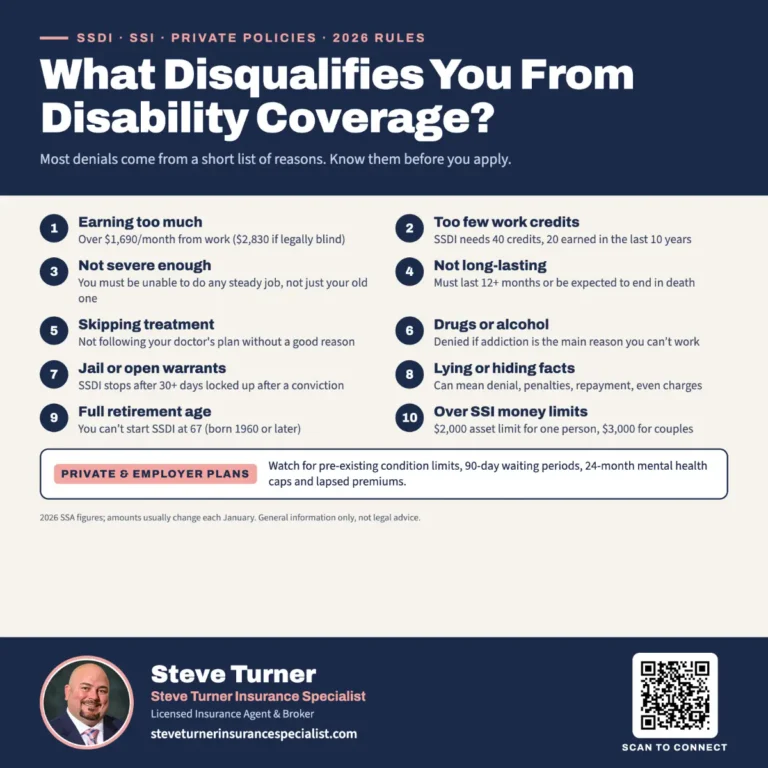
- The rule for old health problems. These are called pre-existing conditions. A plan may not pay for them for the first year or two.
- What’s left out. Every plan has a list of things it won’t pay for. Read the whole list.
- If the price can change, ask if the company can raise your price or cancel your plan. Look for the words “guaranteed renewable.” That means the company can’t drop you as long as you pay.
My tip: ask each company for a sample policy. Then read the parts about waiting, limits, and what’s left out. It’s dull reading, but it can save you from a bad surprise.
How to buy short-term disability insurance in 7 steps
Here is the path I’d follow, start to finish.
- Check what you already have. Ask your boss or HR about a work plan. Then look up your state’s plan.
- Add up your monthly bills. Count rent, food, car costs, and loans. This number tells you how much coverage you need.
- Count your savings. How many weeks could you last with no pay? Your answer helps you pick a waiting period.
- Get two or three quotes. Call an agent or a company that sells to individuals. Give each one the same facts so the prices compare fairly.
- Read the fine print. Use my list of seven things above.
- Fill out the form truthfully. You’ll answer questions about your health, your job, and your pay. Don’t leave anything out. A wrong answer can lead to a denied claim later.
- Pay your first bill and save your papers. Your coverage starts once the company approves you and you pay. Put the policy in a safe spot. Tell someone you trust where you put it.
How long does it take?
It depends on the company. Some short-term plans use a short form and move fast. Others take longer if the company needs your health records. Ask the agent what to expect before you apply.
What doesn’t short-term disability insurance cover?
No plan pays for everything. Here are things most plans leave out:
- Getting hurt at work. Workers’ comp covers that.
- Health problems you had before you bought the plan. At least for a set time.
- Harm you cause to yourself on purpose.
- Injuries from breaking the law.
- Surgery you choose for looks. This means cosmetic surgery.
- Losing your job. A layoff isn’t a disability.
Each plan has its own list. Yours may be longer or shorter.
Does short-term disability cover pregnancy?
Sometimes. This one trips up a lot of people, so I want to be careful here.
- State plans and many work plans do pay for the weeks you need to heal after birth.
- Some plans you buy yourself don’t. State Farm’s plan, for example, leaves out normal pregnancy and childbirth in most states. It does cover problems that come up during a pregnancy.
- Timing matters a lot. If a plan covers birth, you almost always have to buy it before you get pregnant. If you’re already pregnant, the plan will most likely treat it as a pre-existing condition.
You may have heard that insurance can’t turn you down for a pre-existing condition. That rule is for health insurance. It doesn’t apply to disability insurance.
So if you’re planning for a baby, I’d ask two things in writing. Does this plan pay for a normal birth? And how long do I need to have the plan first?
Pros and cons of buying your own plan
I like to see both sides before I spend money. Here’s my list.
The good:
- The plan is yours. It stays with you if you change jobs.
- You choose the amount, the wait, and the length.
- It starts paying fast, often in about two weeks.
- The money is usually tax-free when you pay the bill yourself with after-tax dollars. The IRS explains the rule here.
The not-so-good:
- Few companies sell it to individuals.
- It can cost a lot for the short time it pays.
- You have to answer health questions. You could be turned down.
- Old health problems may not be covered at first.
- A normal pregnancy may not be covered at all.
5 other ways to protect your paycheck
What if you can’t find a plan, or the price is too high? You still have choices. Here are five I’d think about.
- Build an emergency fund. Try to save three to six months of bills. This is your own short-term plan, and it has no fine print.
- Buy long-term disability insurance. It’s easier to buy on your own. It also covers the bigger risk: being out of work for years. Many long-term plans start after about 90 days, so your savings can fill the gap.
- Ask your boss to add a plan. Some employers offer plans that workers pay for themselves. It never hurts to ask.
- Use your state plan. If your state lets self-employed people opt in, look at the cost.
- Save your sick days. Paid time off can cover a short illness.
If I had to pick just one, I’d pick savings plus a long-term plan. The insurance broker Policygenius says long-term coverage protects you better because it pays for much longer.
Common questions about buying short-term disability insurance
Can I buy short-term disability insurance if I’m self-employed?
Yes. This kind of plan can be a good fit when you work for yourself. Be ready to show proof of your income, like a tax return. The company uses it to set how much it will pay you.
Can I buy short-term disability insurance if I’m already sick or hurt?
You can apply, but it likely won’t help with that problem. Plans don’t pay for health issues you had before you bought them, at least for a while. The company might also say no. That’s why I’d buy while I’m healthy.
Can I buy it if I don’t have a job?
Most likely not. This insurance replaces a paycheck. If you have no paycheck, there is nothing to replace. Most companies want you to be working when you apply.
How fast will I get paid?
After the waiting period ends, many short-term plans pay out in about 14 days. You’ll need a doctor to confirm you can’t work.
Do I pay taxes on the money?
Usually not, if you paid for the plan yourself with after-tax money. If your boss paid, the money is usually taxed. I’m not a tax expert, so check with one about your case.
Can I have a work plan and my own plan too?
Often, yes. But some plans pay less if you get money from another plan. Ask each company how they work together before you buy.
Is short-term or long-term disability insurance better?
They do different jobs. Short-term covers the first weeks or months. Long-term covers the years after that. If I could afford only one, I’d choose long-term and use savings for the short gap.
Will I need a medical exam?
It depends on the company. Many short-term plans only ask health questions on a form. Some may want more. Ask before you apply.
The bottom line
So, can you buy short-term disability insurance yourself? Yes, you can. You don’t need a boss to do it for you.
But I’d slow down before I signed anything. First, check your job and your state. You may already be covered. Next, get a few quotes and read the fine print. Then ask yourself one question: is this plan worth the price for me?
For some people, the answer is a clear yes. If you work for yourself, have little savings, and live in a state with no plan, your own policy can keep the lights on. For others, savings and a long-term plan will do the job for less.
Either way, I think the worst plan is no plan. Your paycheck pays for everything else in your life. It’s worth protecting.
This article is for general information. It isn’t legal, tax, or insurance advice. Plans, prices, and rules differ by company and by state.
Why choose Steve Turner Insurance Specialist?
Because I’m an “Insurance Specialist.” An “insurance specialist” is a broad term that includes insurance agents and insurance brokers, but the key difference is who the agent represents versus who the broker represents.
An “insurance agent” works directly for an insurance company and sells its specific policies to clients.
An “insurance broker” acts as an independent intermediary, comparing policies from multiple companies to find the best fit for their client’s needs, essentially representing the client rather than the insurance company.
I am both a licensed Insurance Agent and a licensed Insurance Broker.
My number one goal in life is to help people and ensure, without a shadow of a doubt, that you and your family are secure and protected. I will always be by your side, helping you mitigate risk by providing the industry’s best and most affordable insurance solutions.
I will find insurance plans for the entire family to help cover whatever life throws at you. I can help you save on severe medical emergencies, find a health insurance plan with low- or no-cost doctor visits and affordable prescription medications, and protect your family in the event of an unexpected accident or illness.
Best of all, it doesn’t cost you anything extra to use an experienced Insurance Agent and Broker like me to help you find the Insurance Plans that fit your individual, family, or business needs.
The companies that sell the insurance plans “you choose“ pay me – you don’t pay me. Calling any big insurance company directly won’t get you a lower price, as they will forward your call to the next available insurance agent on their list. You won’t have had any opportunity to learn about the insurance agent you’re speaking with in advance, understand their qualifications or experience level, or make an informed choice about who you want to work with.
Tap the Contact Me text or icon and get in touch by phone or email, or schedule a “No Obligation” chat through my calendar. I look forward to speaking with you!
OUR CLIENT REVIEWS


CONTACT STEVE TURNER INSURANCE AGENT & BROKER
I’m here to take your calls and emails and answer your questions 7 Days a week from 7:00 a.m. to 8:00 p.m., excluding posted holidays.
Steve Turner is a licensed agent and broker and a long-standing member of the National Association of Benefits and Insurance Professionals®. Steve holds the prestigious Registered Employee Benefits Consultant® designation. NABIP® is the preeminent organization for health insurance and employee benefits professionals and works diligently to ensure all Americans have access to high-quality, affordable healthcare and related services.
Steve Turner is a licensed agent appointed by Florida Blue.
Richard Steven Turner’s official Florida state insurance license number (operating as Steve Turner Insurance Specialist) is W333468
EMAIL ME: 24×7
OFFICE LOCATION
Website: steveturnerinsurancespecialist.com
Email: [email protected]
Phone and Text: +1-813-388-8373
Business Hours:
Monday: 7:00 a.m. – 8:00 p.m.
Tuesday: 7:00 a.m. – 8:00 p.m.
Wednesday: 7:00 a.m. – 8:00 p.m.
Thursday: 7:00 a.m. – 8:00 p.m.
Friday: 7:00 a.m. – 8:00 p.m.
Saturday: 7:00 a.m. – 8:00 p.m.
Sunday: 7:00 a.m. – 8:00 p.m.
DISABILITY INSURANCE POSTS
INSURANCE OFFERINGS
Can I Buy Short-Term Disability Insurance Myself?
HEALTH INSURANCE
MEDICARE ADVANTAGE

MEDICARE SUPPLEMENT

PRESCRIPTION DRUGS
LIFE INSURANCE

DISABILITY INSURANCE
DENTAL INSURANCE

GROUP HEALTH INSURANCE

ACCIDENT INSURANCE

LONG TERM CARE INSURANCE

MEDICAID INSURANCE

MEDICARE INSURANCE

MEDICARE PART A INSURANCE

MEDICARE PART B INSURANCE

MEDICARE PART C INSURANCE

MEDICARE PART D INSURANCE

MEDICARE PLAN G INSURANCE

MEDICARE PLAN N INSURANCE

SERVICE AREA
MEDICARE STATEMENT
We do not offer every plan available in your area. Currently, we represent 7 organizations that offer 70 products in your area. Please contact Medicare.gov or 1-800-MEDICARE for information on all your options.
Steve Turner is a licensed insurance agent and is not connected with or endorsed by the United States Government or the Federal Medicare Program. The Medicare Annual Enrollment Period is October 15 to December 7.
There’s no one-size-fits-all answer. Carefully consider your health status, expected medical needs, prescription drugs, budget, preferred doctors and hospitals, and how comfortable you are with network rules. During the Annual Enrollment Period, you can research the plans available in your Florida county using the Medicare Plan Finder at Medicare.gov, compare costs and benefits, and get free, unbiased counseling from Florida’s SHINE (Serving Health Insurance Needs of Elders) program at floridashine.org or 1-800-963-5337. You can also call 1-800-MEDICARE (1-800-633-4227; TTY 1-877-486-2048), 24 hours a day, 7 days a week.