

How Quickly Can Employees Get Group Health Insurance Coverage?

How Quickly Can Employees Get Group Health Insurance Coverage? Understanding Waiting Periods and Enrollment Timelines
Starting a new job is exciting. You get a new desk, new coworkers, and maybe a bigger paycheck. But I hear one question all the time: “When does my health insurance kick in?”
It is a fair question. Nobody wants to break an arm or catch the flu while they are stuck waiting for coverage. And if you run a business, you want to know how fast you have to get your new team members covered.
I have spent a lot of time digging into the rules. The good news is that the answer is not a mystery. A federal law sets a clear limit. A few twists can also make the wait longer or shorter.
In this article, I will walk you through:
- How long the wait can legally be
- What a “waiting period” really means
- How orientation periods work
- What happens if you work part-time or have changing hours
- How life events like marriage or a new baby can speed things up
- How to stay covered while you wait
- Easy tips for both workers and employers
Let’s jump in.
The Short Answer: No Longer Than 90 Days
Here is the quick answer. Once you are eligible for your company’s health plan, your coverage must start within 90 days. That is the law.
This rule comes from the Affordable Care Act (ACA). It says a group health plan cannot make an eligible worker wait more than 90 days for coverage. The rule covers plans of every size. It doesn’t matter if your company has 5 workers or 5,000. It also covers both insured plans and self-funded plans.
Some employers do not make you wait at all. Your coverage might start on your very first day. Others make you wait until the first day of the next month. Still others require you to wait the full 90 days.
What Is a “Waiting Period”?
A waiting period is the time between when you become eligible for the plan and when your coverage actually starts. Think of it like a line at an amusement park. Once you get in line, you have to wait your turn. But the law says the line can’t be longer than 90 days.
How the 90 Days Are Counted
This part trips people up, so I want to be clear:
- Every calendar day counts. Weekends count. Holidays count. It is not 90 work days.
- It is 90 days, not three months. Three months can be 92 days. That is too long. Your coverage has to start by day 91.
- The clock starts when you are eligible. For most full-time workers, that is the day you start your job.
- A weekend shortcut is allowed. If day 91 lands on a weekend or holiday, the plan may start your coverage a little early. It can’t start late.
Here is an example from the federal rules. Say you start a full-time job on January 19. Your coverage must start no later than April 19 (in a year when February has 28 days).
What If I Forget to Sign Up?
The 90-day limit is about when coverage is offered, not when you fill out your forms. If your employer lets you start coverage on time but you wait to turn in your paperwork, your employer hasn’t broken the rule. So don’t drag your feet. Turn in your enrollment forms as soon as you get them.
5 Common Waiting Periods Employers Use
Every company can choose its own waiting period, as long as it’s 90 days or less. Here are the ones I see most often:
- Day one. Coverage starts the day you start work. This is the best deal for workers. Companies that are trying hard to hire often use it.
- First of the month after you start; if you start on March 10, coverage begins April 1. This is popular because it simplifies payroll.
- 30 days. Coverage starts after you have worked about one month.
- First of the month after 30 or 60 days. This mixes a set number of days with a clean start date.
- 90 days. This is the longest wait allowed on its own. Some smaller businesses use it to make sure a new hire is staying before they pay for coverage.
| Waiting period | If you start June 10, coverage begins about… |
|---|---|
| Day one | June 10 |
| First of next month | July 1 |
| 30 days | July 10 |
| First of month after 60 days | September 1 |
| 90 days | By September 8 |
Ask your hiring manager or HR team which one your company uses. It should also be written in your benefits guide.
The One-Month Orientation Period for Employers
Employers can add a little more time in one way. It is called an orientation period.
An orientation period is a short trial time at the start of a job. During this time, you and your boss can see whether the job is a good fit. The company might train you or check that you can do the work.
The rules say an orientation period can last no more than one month. After it ends, the 90-day waiting period can begin.
To figure out one month, add one calendar month to your start date, then subtract one day. For example:
- Start on May 3 → orientation ends June 2
- Start on October 1 → orientation ends October 31
- Start on January 30 → orientation ends February 28 (or 29 in a leap year)
How Long Could the Total Wait Be?
If a company uses both a one-month orientation period and the full 90-day waiting period, the total wait can be about four months.
Here is a real example from the federal rules. A worker starts full-time on October 16. The orientation period ends on November 15. Coverage must begin by February 14. That is the 91st day after the orientation ends.
In my view, four months is a long time to go without coverage. The good news is that most employers don’t stack the two. Still, it is smart to ask so you are not caught off guard.
A Note for Larger Employers
Companies with 50 or more full-time workers have another rule to think about. It is called the employer mandate. Under it, these bigger employers must offer coverage to full-time workers or risk paying a tax penalty. Using both the full orientation period and the full 90-day wait could cause trouble under that rule. So many large employers keep the wait shorter to stay safe.
What About Part-Time, Seasonal, and Variable-Hour Workers?
The 90-day clock starts when you become eligible. That word matters a lot. Not every worker is eligible on day one.
The law does not force employers to offer health insurance to every worker. A company can choose to cover only full-time workers. It can also limit coverage to certain job types. The 90-day rule only kicks in once you meet the eligibility requirements.
Changing Job Titles
Say your company only covers managers. You start as a cashier. You are not eligible yet, so no clock is running. Then you get promoted to manager. Now the clock starts. Your coverage must begin within 90 days of your promotion.
The same applies to jobs that require a license or special certificate. The clock starts once you earn it.
Workers With Changing Hours
Some jobs don’t have a set schedule. You might work 20 hours one week and 45 the next. These are called variable-hour jobs. Restaurants, stores, and hospitals have many.
When a company can’t tell whether you will work full time, it can watch your hours for a while first. This is called a measurement period. Here is how it works:
- The measurement period can last up to 12 months.
- It must start between your first day and the first day of the next month.
- If you turn out to be full-time, coverage must start no later than about 13 months after you were hired. (If you started mid-month, the plan can round up to the first of the next month.)
That can feel like a long time. But it gives employers a fair way to decide who counts as full-time.
Part-Time Workers and the 1,200-Hour Rule
Some plans cover part-time workers after they have worked a certain number of total hours. The rules cap this at 1,200 hours. Once you hit that number, the normal 90-day limit applies.
For example, say you work 25 hours a week and reach 1,200 hours on December 15. Your coverage must start within 90 days of that date.
Rehired Workers
What if you leave a job and come back later? Your employer may treat you like a brand-new hire. That means you might have to wait again. But the company can’t fire and rehire people to dodge the 90-day rule. That is not allowed.
Life Event Rule: Get You Covered Faster
What if you already work somewhere but skipped the health plan? Maybe you were on a parent’s plan or your spouse’s plan. Can you join later?
Yes. You have two main ways in.
1. Open Enrollment
Most companies hold open enrollment once a year. It usually happens in the fall, and coverage often starts January 1. During this window, anyone who is eligible can sign up, switch plans, or drop coverage. You don’t need a reason.
The downside? If you miss it, you usually have to wait a whole year for the next one.
2. Special Enrollment
Certain big life changes open a special enrollment window. A federal law called HIPAA gives you this right. Under it, you can usually sign up within 30 days of the event. You don’t have to wait for open enrollment.
Here are the most common events that let you sign up:
- You get married. You can add yourself and your new spouse.
- You have a baby. Coverage for a newborn can go back to the day the baby was born.
- You adopt a child or have a child placed with you for adoption.
- You lose other health coverage. For example, your spouse loses their job, or you age off a parent’s plan at 26.
- You lose Medicaid or CHIP. For this one, you usually get 60 days instead of 30.
- You become eligible for Medicaid or CHIP help to pay for your work plan. This also comes with a 60-day window.
If you sign up for one of these reasons, the regular waiting period doesn’t apply. Coverage usually starts quickly, often on the event date or the first of the next month.
My tip: Don’t wait until day 29. Call HR the same week the life change happens. Ask what papers they need, like a marriage license or birth certificate.
How to Stay Covered While You Wait
A waiting period can leave you with a gap. Even one month without insurance can be risky. One trip to the emergency room can cost thousands of dollars. Here are the options I would look at, in order:
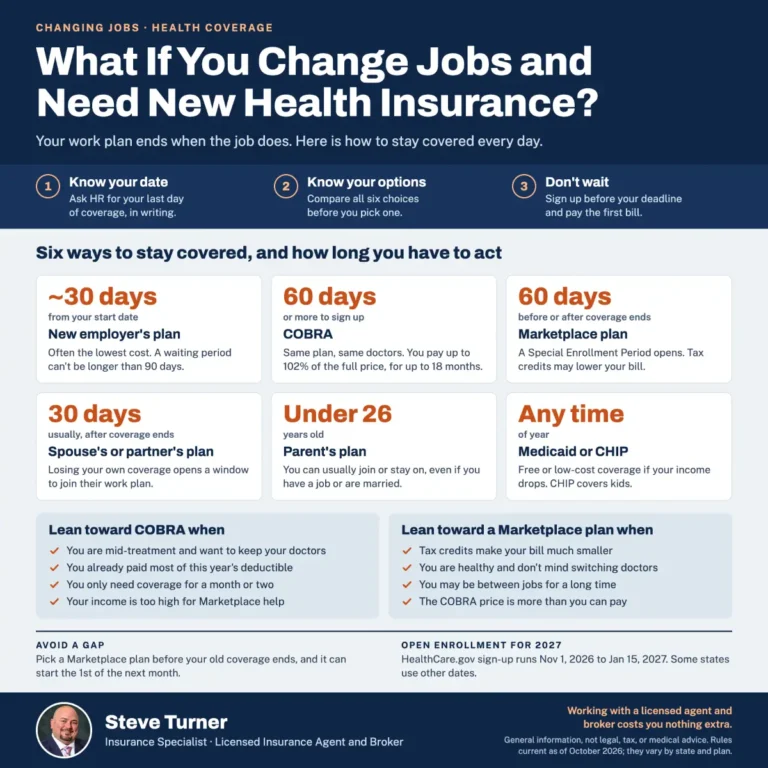
- Stay on your old job’s plan for a few more weeks. Many plans keep you covered through the end of the month you leave. Ask your old employer for your exact end date before you quit.
- Use COBRA. COBRA is a law that lets you keep your old job’s plan after you leave. It usually lasts up to 18 months. You often have 60 days to decide. The catch is cost. You may pay the full price plus a small fee, since your old employer stops contributing. Still, it can be worth it for a short gap.
- Shop the Health Insurance Marketplace. Losing job-based coverage lets you sign up at HealthCare.gov or your state’s site. You usually have 60 days to do it. You might qualify for help paying the monthly cost, depending on your income.
- Join a spouse’s or parent’s plan. If you are under 26, you can usually stay on a parent’s plan. Losing your own coverage may also let you join a spouse’s plan through special enrollment.
- Check Medicaid or CHIP. If your income is low, you or your kids might qualify. You can apply year-round.
- Look at short-term plans with care. These plans are cheap for a reason. They often skip key benefits and may not cover existing health problems. Read the fine print.
A Simple Trick: Time Your Start Date
If you can, plan your last day and first day around the calendar. For example, if your old plan ends on the last day of the month, and your new plan starts the first day of the next month, you won’t have a gap at all. A few days of planning can save you a lot of worry.
7 Tips for New Employees
I want you to walk into your new job ready. Here is my checklist:
- Ask about benefits before you accept the offer. “When does my health coverage start?” is a normal question. A good employer will answer it.
- Get the start date in writing. Your offer letter or benefits guide should say it.
- Find out if there is an orientation period. That can add up to a month.
- Turn in your enrollment forms right away. Late forms can push back your start date.
- Check your old coverage end date. Know exactly when it stops.
- Plan for the gap. Pick COBRA, the Marketplace, or another plan if needed.
- Save your ID card info. Once you are covered, keep your member number handy on your phone.
7 Tips for Employers
If you run a business or work in HR, a smart waiting period can help you hire and keep good people. Here is what I suggest:
- Never go past 90 days. Breaking the rule can lead to IRS penalties of up to $ 100 per person, per day.
- Write your rules down. Your plan papers should list who is eligible, the waiting period, and any orientation period.
- Keep orientation periods real. They must be true training or trial periods and can’t run longer than one month.
- Track hours carefully. If you use measurement periods or hour counts, good records keep you safe.
- Think about a shorter wait. “First of the month after hire” is easy to run and looks great to job seekers.
- Remember the employer mandate. If you have 50 or more full-time workers, check that your waiting period fits those rules too.
- Explain it clearly to new hires. Put the coverage start date in the offer letter. Fewer surprises means happier workers.
In my experience, a shorter waiting period is one of the cheapest perks you can offer. It costs a little more up front. But it tells new hires, “We’ve got your back from the start.”
Frequently Asked Questions
Q: Can my employer make me wait six months for health insurance?
A: Not if you are already eligible. A wait based only on time can’t go past 90 days. The only add-on allowed is an orientation period of up to one month. A longer wait could happen if you work changing hours and your employer uses a measurement period.
Q: Does my health insurance start on my first day of work?
A: It might. Some employers start coverage on day one. Many others start it on the first of the next month. Check your offer letter or ask HR.
Q: Does the 90-day rule apply to small businesses?
A: Yes. If a small business offers a group health plan, it must follow the 90-day limit. But small businesses with fewer than 50 full-time workers don’t have to offer health insurance.
Q: Are weekends counted in the 90 days?
A: Yes. Every calendar day counts, including weekends and holidays.
Q: Is the waiting period the same as three months?
A: No. Three months can be more than 90 days. The limit is 90 days, period.
Q: Can my family join at the same time I do?
A: Usually, yes. If your plan covers family members, they generally follow the same waiting period. Check your plan to see who you can add.
Q: I just had a baby. How fast can I add them?
A: Fast. You usually have 30 days to add your baby, and coverage can go back to the day of birth. Call HR as soon as you can.
Q: What happens if my employer breaks the 90-day rule?
A: The employer can face a penalty of up to $100 per day for each person affected. If you think your wait is too long, you can contact the U.S. Department of Labor’s Employee Benefits Security Administration at 1-866-444-3272.
Q: Do I have to sign up for my employer’s plan?
A: No. You can turn it down. Just know that skipping it may affect whether you can get help paying for a Marketplace plan.
The Bottom Line
So, how quickly can employees get group health insurance coverage? Once you are eligible, coverage must start within 90 days. Some employers add a one-month orientation period first. Workers with changing hours may wait longer while the company tracks their schedule. Big life events like a new baby or a wedding can also get you covered fast.
My best advice is simple. Ask early, get the date in writing, and have a plan for any gap. A few questions now can save you a big medical bill later.
This article is for general information and is not legal advice. Plan rules and state laws can differ, so check with your HR team or a benefits expert about your own situation.
Why choose Steve Turner Insurance Specialist?
Because I’m an “Insurance Specialist.” An “insurance specialist” is a broad term that includes insurance agents and insurance brokers, but the key difference is who the agent represents versus who the broker represents.
An “insurance agent” works directly for an insurance company and sells its specific policies to clients.
An “insurance broker” acts as an independent intermediary, comparing policies from multiple companies to find the best fit for their client’s needs, essentially representing the client rather than the insurance company.
I am both a licensed Insurance Agent and a licensed Insurance Broker.
My number one goal in life is to help people and ensure, without a shadow of a doubt, that you and your family are secure and protected. I will always be by your side, helping you mitigate risk by providing the industry’s best and most affordable insurance solutions.
I will find insurance plans for the entire family to help cover whatever life throws at you. I can help you save on severe medical emergencies, find a health insurance plan with low- or no-cost doctor visits and affordable prescription medications, and protect your family in the event of an unexpected accident or illness.
Best of all, it doesn’t cost you anything extra to use an experienced Insurance Agent and Broker like me to help you find the Insurance Plans that fit your individual, family, or business needs.
The companies that sell the insurance plans “you choose“ pay me – you don’t pay me. Calling any big insurance company directly won’t get you a lower price, as they will forward your call to the next available insurance agent on their list. You won’t have had any opportunity to learn about the insurance agent you’re speaking with in advance, understand their qualifications or experience level, or make an informed choice about who you want to work with.
Tap the Contact Me text or icon and get in touch by phone or email, or schedule a “No Obligation” chat through my calendar. I look forward to speaking with you!
OUR CLIENT REVIEWS


CONTACT STEVE TURNER INSURANCE AGENT & BROKER
I’m here to take your calls and emails and answer your questions 7 Days a week from 7:00 a.m. to 8:00 p.m., excluding posted holidays.
Steve Turner is a licensed agent and broker and a long-standing member of the National Association of Benefits and Insurance Professionals®. Steve holds the prestigious Registered Employee Benefits Consultant® designation. NABIP® is the preeminent organization for health insurance and employee benefits professionals and works diligently to ensure all Americans have access to high-quality, affordable healthcare and related services.
Steve Turner is a licensed agent appointed by Florida Blue.
Richard Steven Turner’s official Florida state insurance license number (operating as Steve Turner Insurance Specialist) is W333468
EMAIL ME: 24×7
OFFICE LOCATION
Website: steveturnerinsurancespecialist.com
Email: [email protected]
Phone and Text: +1-813-388-8373
Business Hours:
Monday: 7:00 a.m. – 8:00 p.m.
Tuesday: 7:00 a.m. – 8:00 p.m.
Wednesday: 7:00 a.m. – 8:00 p.m.
Thursday: 7:00 a.m. – 8:00 p.m.
Friday: 7:00 a.m. – 8:00 p.m.
Saturday: 7:00 a.m. – 8:00 p.m.
Sunday: 7:00 a.m. – 8:00 p.m.
Group HEALTH INSURANCE POSTS

INSURANCE OFFERINGS
How Quickly Can Employees Get Group Health Insurance Coverage?
HEALTH INSURANCE

MEDICARE ADVANTAGE

MEDICARE SUPPLEMENT

PRESCRIPTION DRUGS

LIFE INSURANCE

DISABILITY INSURANCE

DENTAL INSURANCE

GROUP HEALTH INSURANCE

ACCIDENT INSURANCE

LONG TERM CARE INSURANCE

MEDICAID INSURANCE

MEDICARE INSURANCE

MEDICARE PART A INSURANCE

MEDICARE PART B INSURANCE

MEDICARE PART C INSURANCE

MEDICARE PART D INSURANCE

MEDICARE PLAN G INSURANCE

MEDICARE PLAN N INSURANCE

SERVICE AREA
MEDICARE STATEMENT
We do not offer every plan available in your area. Currently, we represent 7 organizations that offer 70 products in your area. Please contact Medicare.gov or 1-800-MEDICARE for information on all your options.
Steve Turner is a licensed insurance agent and is not connected with or endorsed by the United States Government or the Federal Medicare Program. The Medicare Annual Enrollment Period is October 15 to December 7.
There’s no one-size-fits-all answer. Carefully consider your health status, expected medical needs, prescription drugs, budget, preferred doctors and hospitals, and how comfortable you are with network rules. During the Annual Enrollment Period, you can research the plans available in your Florida county using the Medicare Plan Finder at Medicare.gov, compare costs and benefits, and get free, unbiased counseling from Florida’s SHINE (Serving Health Insurance Needs of Elders) program at floridashine.org or 1-800-963-5337. You can also call 1-800-MEDICARE (1-800-633-4227; TTY 1-877-486-2048), 24 hours a day, 7 days a week.