

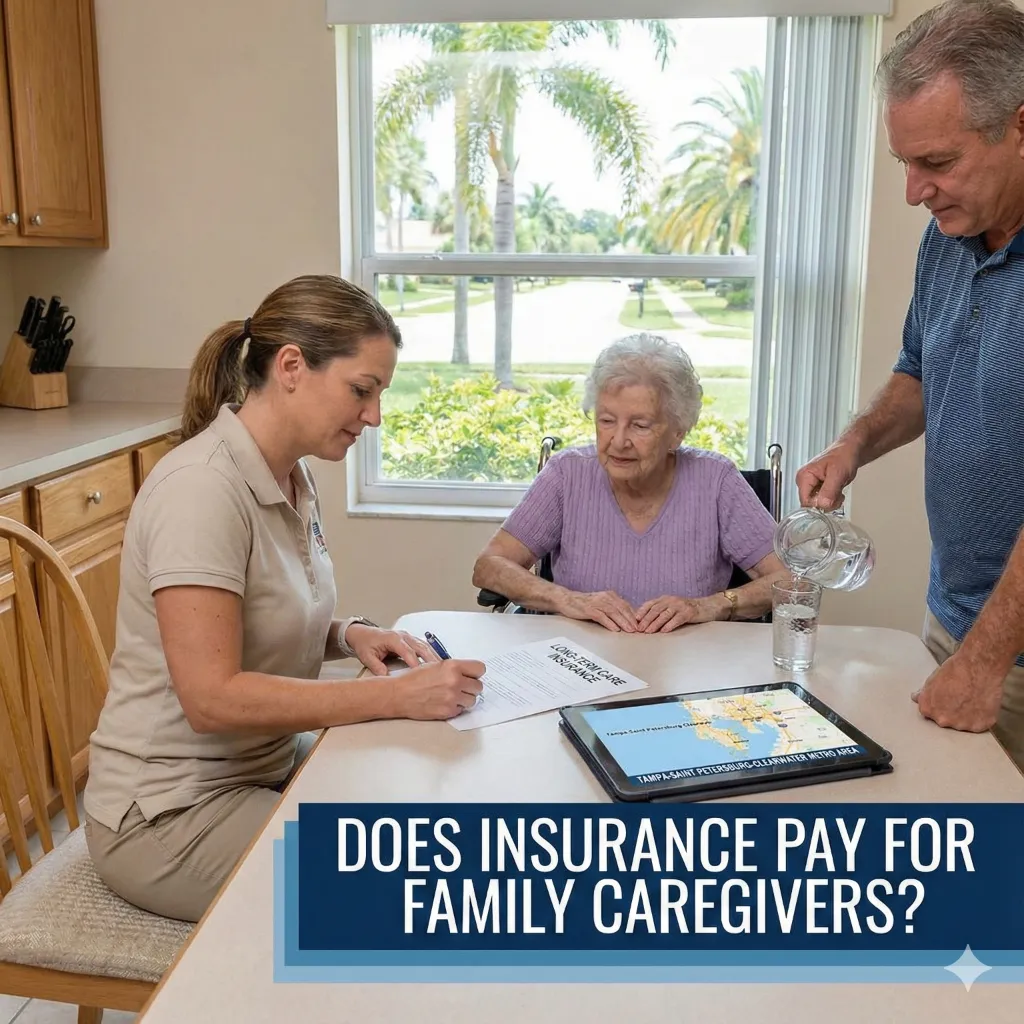
Does Long-Term Care Insurance Pay for Family Caregivers?
If you are caring for a parent, spouse, grandparent, or other loved one, one question usually comes up fast:
Does long-term care insurance pay for family caregivers?
The best honest answer is:
Sometimes, yes. Sometimes, no. And the difference usually comes down to the exact policy language. The federal government’s consumer guidance says that some long-term care insurance policies allow family members to get paid as caregivers, but it also warns consumers to contact the insurance agent and get written confirmation of benefits. Florida’s consumer guidance makes the same broader point from another angle: long-term care insurance policies are not standardized, and each insurer defines its own terms, benefits, and exclusions. (USAGov)
That is why this topic causes so much confusion.
One family assumes the daughter can be paid to care for Mom at home, because “the policy covers home care.” Another family files a claim and learns that the insurer will reimburse only care delivered by a licensed agency. A third family owns a cash-benefit or indemnity-style policy and discovers that, once benefits are approved, the policyholder can use that money more flexibly, including to compensate a relative in practice. The words home care, caregiver, licensed provider, informal care, reimbursement, and cash indemnity do not all mean the same thing, and those differences matter. Florida’s Department of Financial Services specifically warns that these contracts can be complicated and that each insurer defines benefits and exclusions in its policy. ACL’s long-term care guidance also explains that long-term care insurance pays or reimburses up to a selected limit for covered services that help with Activities of Daily Living, and that exact coverage depends on the policy purchased. (FLDFS)
So, if you are searching for a simple yes-or-no answer, here it is:
Short Answer
Yes, long-term care insurance can pay for family caregivers, but only if the policy allows it and the claim meets the policy’s rules. Some policies allow payment to family members. Others do not. Some require the caregiver to be licensed or employed through an approved home care agency. Others pay a fixed cash benefit to the insured, giving the family more flexibility in how that money is used once eligibility is triggered. The safest next step is not to guess. It is to review the policy and get written confirmation from the insurer or claims department. (USAGov)
That is the core answer.
But if you want to make the right decision for your family, you need more than the short answer. You need to understand when a family member can be paid, why some claims are denied, what policy wording to look for, and how to avoid making an expensive mistake.
This guide walks through all of that in plain English.
Why This Question Matters So Much
Most long-term care in America does not begin in a nursing home. It begins quietly, at home.
It starts when Dad can no longer shower safely by himself. When your mother begins forgetting medications and leaving the stove on. When a spouse who used to be fully independent suddenly needs help getting dressed, walking to the bathroom, eating, transferring out of bed, or staying safe because of dementia. ACL’s long-term care guidance notes that most long-term care is provided at home and that home care can include help from an unpaid family member or friend, as well as professional caregivers and therapists. CMS also describes caregivers broadly as family members, friends, or neighbors who provide unpaid assistance to a person with a chronic illness or disabling condition. (ACL Administration for Community Living)
That is why the family caregiver question is not just a technical insurance question. It is a financial survival question.
If a son cuts his work hours in half to care for his mother, or a daughter leaves her job to care for her father, the family may lose income right when care costs are rising. At the same time, Medicare generally does not pay for most long-term custodial care. Medicare says it does not provide long-term care coverage or custodial care unless medical care is needed, and that Medicare and most health insurance do not pay for long-term care services in a nursing home or in the community. (Medicare)
So families naturally ask:
“If we already paid premiums for long-term care insurance, can the policy help pay the person actually doing the care?”
That is a smart question. In many cases, it should be one of the first questions asked.
What Long-Term Care Insurance Is Really Designed to Cover
Long-term care insurance is designed to help pay for services and supports for people who need assistance over time due to chronic illness, disability, frailty, or cognitive decline. The National Institute on Aging explains that these policies can cover a wide range of benefits in different settings, including the person’s home, assisted living, or a nursing home, but the exact coverage depends on the type of policy and services included. ACL similarly explains that policies reimburse a daily amount, up to a selected limit, for services that assist with Activities of Daily Living such as bathing, dressing, or eating. (National Institute on Aging)
Those Activities of Daily Living, often called ADLs, are the basic tasks people need to function safely day-to-day. They usually include things like bathing, dressing, eating, toileting, continence, and transferring. The NAIC shopper’s guide explains that benefit eligibility is commonly tied to a person’s inability to perform a required number of Activities of Daily Living or to cognitive impairment.
That matters because a long-term care policy is not usually triggered simply because a family wants help, or because a loved one is getting older. It is typically triggered when the insured meets the contract’s definition of needing care.
So before asking whether the policy will pay a family caregiver, you first need to ask:
- Has the insured met the policy’s benefit trigger?
- Is home care a covered setting?
- Does the policy recognize a family member as an eligible paid caregiver?
If the answer to any one of those is no, the family may not get the result they expect.
The Big Misunderstanding: “Home Care” Does Not Always Mean “Paying My Daughter”
This is where many claims go off track.
A policy may say it covers home care, but that does not automatically mean it will pay any relative who helps at home. Florida’s consumer guidance says long-term care insurance contracts are not standardized and that each insurer defines its own terms, benefits, and exclusions. That means one policy’s home care benefit can be meaningfully different from another’s. (FLDFS)
In real life, long-term care policies tend to fall into a few broad patterns:
1. Reimbursement-Based Policies
These policies typically reimburse actual covered expenses, up to the daily or monthly limit. If the policy reimburses only covered expenses and the contract defines covered home care as care delivered by a licensed provider or an approved agency, then a family member may not qualify unless they meet that definition. The NAIC guide explains that policies can pay benefits through various methods, including reimbursement, making the payment structure itself an important part of understanding coverage.
2. Indemnity or Cash-Benefit Policies
These policies generally pay a set cash amount once the insured qualifies for benefits. That can create much more flexibility because the money is paid to the insured rather than being tied line-by-line to reimbursable invoices. In those cases, the insured may be able to use the cash benefit to compensate a family caregiver, pay a neighbor, combine paid and unpaid help, or cover related care costs. The NAIC guide identifies indemnity-style benefits as one of the standard ways long-term care benefits can be paid.
3. Hybrid or Asset-Based Policies
These can blend life insurance or annuity value with long-term care benefits. The Florida and NAIC consumer guides both note that long-term care coverage products can vary widely, including newer hybrid structures, and that the contract wording is what determines how benefits work.
That is why two families can both say “We have long-term care insurance,” yet get totally different answers to the family caregiver question.
So, Does Long-Term Care Insurance Pay Family Caregivers?
Here is the clearest useful answer:
Yes, some long-term care insurance policies pay family caregivers. But many do not pay automatically, and many require you to prove that the family member qualifies under the policy’s definition of an eligible caregiver or that the policyholder is receiving a cash benefit that can be used flexibly. USA.gov says some long-term care insurance policies allow family members to receive payment as caregivers and recommends requesting written confirmation of benefits. Florida’s consumer guidance warns that policy terms are not standardized. Together, those two points tell you exactly how to think about this: possible, but policy-dependent. (USAGov)
That means the right answer for SEO is not just “yes.”
The right answer for real people is:
Sometimes yes, but only after you verify the rules in the policy and the claims process.
The Most Common Situations Where a Family Caregiver May Be Paid
Family Caregiver Situation #1: The Policy Pays a Cash Benefit
This is often the cleanest scenario.
If the long-term care policy pays a monthly or daily cash benefit once the insured qualifies, the insured may have broad discretion in how to use that money for care needs. In practice, that can include paying a daughter, son, sibling, or other relative who is providing care, even if the family member is not working through a home care agency. Because the benefit is not always tied to the exact same reimbursement rules as a traditional expense-based claim, these policies often create more flexibility for families. The NAIC guide’s discussion of different benefit payment methods is what makes this distinction so important.
Family Caregiver Situation #2: The Relative Meets the Policy’s Provider Rules
Some policies may allow payment to a family member if that relative meets specific requirements under the contract. For example, the policy may require that the caregiver be licensed, certified, or operating under an approved care plan. While official consumer guidance does not promise that relatives will qualify, Florida’s consumer materials make clear that definitions and exclusions are set by the policy, and USA.gov confirms that some policies do allow family caregivers to be paid. (USAGov)
Family Caregiver Situation #3: The Policy Covers Home Care Broadly Enough That Family Help Fits
Some home care benefits are broad, especially in newer or more flexible contracts. If the plan of care is documented, the insured qualifies medically, and the policy language does not exclude family caregivers, a claim may be possible. Again, the deciding factor is the contract language, not a generic article online. Florida’s Department of Financial Services explicitly says the insurer must provide an Outline of Coverage to help explain the terms, benefits, and exclusions. (FLDFS)
The Most Common Reasons a Policy Will Not Pay a Family Caregiver
Families should also understand where the answer is likely to be no.
1. The Policy Only Pays Licensed or Agency-Based Care
Some policies reimburse only covered services delivered through licensed home health agencies, approved providers, or contracted vendors. If a daughter or son is simply helping informally at home, that may not qualify under a reimbursement model. This is one reason USA.gov tells consumers to ask for written confirmation instead of assuming that “family caregiving” is covered. (USAGov)
2. The Insured Has Not Triggered Benefits Yet
Even if the family caregiver would qualify, the policy may not pay until the insured has met the benefit trigger. The NAIC guide explains that long-term care insurance commonly requires the inability to perform a certain number of Activities of Daily Living or cognitive impairment before benefits begin.
3. The Elimination Period Has Not Been Satisfied
Many long-term care policies have an elimination period, sometimes called a waiting period, before benefits are payable. During that time, the family may still be doing the work, but the insurer is not yet paying benefits. The NAIC glossary and policy comparison guidance discuss elimination periods as a core part of how these policies work.
4. The Relative Is Specifically Excluded
Some policies may exclude spouses, household members, or unpaid informal caregivers from reimbursement. Since Florida’s consumer guidance stresses that exclusions are defined by the policy itself, families should never assume that a relative counts as an eligible paid caregiver unless they have verified that in writing. (FLDFS)
5. The Care Is Not Documented Correctly
Even when a policy could pay, claims often fail because the care plan, invoices, timesheets, physician certification, or assessment paperwork is incomplete. Long-term care claims are not just about need. They are also about documentation.
Reimbursement vs. Cash Indemnity: The Most Important Difference Most People Miss
If you remember only one technical point from this article, make it this one:
The way the policy pays out is often just as important as what it covers.
The NAIC shopper’s guide explains that long-term care insurance benefits are generally paid using one of several methods, including reimbursement and indemnity approaches. That distinction can completely change whether family caregiving works financially.
Reimbursement Policies
A reimbursement policy usually pays back actual covered expenses up to the policy’s limit. So if the contract says covered home care must be delivered by a licensed provider, you may not be reimbursed for paying your daughter unless she satisfies the contract’s definition of an eligible provider.
Indemnity or Cash Policies
An indemnity or cash-benefit policy usually pays the set benefit once the insured qualifies, regardless of whether actual spending exactly matches the benefit amount. This can make these policies much more family-caregiver-friendly in practice, because the insured can use the benefit wherever it is most needed.
For families hoping to keep a loved one at home, that difference is enormous.
A reimbursement policy may push the family toward agency care.
A cash policy may let the family build a care arrangement around a relative they already trust.
That is one reason why a policy that looks “good” on a quote sheet may work very differently in real life once a claim begins.
Does Long-Term Care Insurance Pay a Spouse?
Sometimes families ask an even narrower question:
“Will the policy pay the husband or wife who is doing the care?”
The only honest answer is: it depends on the policy. Because policies are not standardized, there is no universal nationwide rule that says spouses are always eligible or always excluded under private long-term care insurance. Florida’s Department of Financial Services makes clear that insurers define terms and exclusions in the contract. (FLDFS)
That said, spouse caregiving raises extra practical issues:
- Some policies do not treat a spouse as an eligible reimbursable provider.
- Even if the policy pays a cash benefit, using that money to compensate a spouse may raise tax, payroll, estate-planning, or recordkeeping questions that the family should review with a qualified advisor.
- In some households, paying a spouse may not address the underlying issue: caregiver burnout.
So if the spouse question applies to your family, do not settle for a verbal answer from a call-center rep. Get the answer in writing.
Does Long-Term Care Insurance Pay Children to Care for a Parent?
This is probably the most common version of the question.
A son or daughter may be the person most willing, most trusted, and most available to help a parent remain at home. Since ACL notes that most long-term care is provided at home and that family members are a major part of that care ecosystem, this arrangement is extremely common in real life. (ACL Administration for Community Living)
Can long-term care insurance pay for that adult child?
Yes, it can, if the policy allows it. But the child should not assume that because they are doing the work, the insurer will automatically reimburse them. The family needs to verify:
- whether home care is covered,
- whether a relative can count as a paid caregiver,
- whether licensing or certification is required,
- whether a care plan is needed,
- whether the benefit is reimbursement-based or cash-based,
- and what records must be kept. (USAGov)
What You Should Ask the Insurance Company Right Now
If your loved one already has a policy, call the insurer or claims department and ask these exact questions:
1. Does this policy allow payment to a family caregiver?
Ask for a yes-or-no answer tied to the actual policy language.
2. If yes, which family members are eligible?
Ask whether a spouse, adult child, sibling, grandchild, or household member can qualify.
3. Is the benefit reimbursement-based or cash indemnity?
This question alone can save hours of confusion later. The NAIC guide confirms that policies use different benefit payment methods.
4. Does the caregiver have to be licensed, certified, or employed by an agency?
Do not assume that “home care” means “anyone at home.”
5. What medical trigger must be met?
Ask whether the insured must be unable to perform two Activities of Daily Living, have severe cognitive impairment, or satisfy another standard. The NAIC guide says these are core benefit triggers.
6. Is there an elimination period?
If so, ask how it is counted and whether family-provided care can count toward satisfying it.
7. What paperwork is required?
Ask whether the insurer needs physician certification, an assessment, a plan of care, invoices, timesheets, or care notes.
8. Can you send me the answer in writing?
USA.gov specifically advises consumers to ask for written confirmation of benefits. (USAGov)
That last step is critical. Families routinely rely on casual phone answers that do not hold up later when a claim reviewer opens the file.
The Written Confirmation Rule: Why It Matters
One of the most practical lines in the federal consumer guidance comes from USA.gov: contact your insurance agent and ask for a written confirmation of benefits. That advice is easy to skip, but it may be the most valuable sentence on the page. (USAGov)
Why?
Because long-term care claims happen during stress. A hospital discharge. A dementia diagnosis. A fall. A spouse exhausted beyond words. In moments like that, families hear what they hope they heard. They remember what they thought the agent said years ago. They rely on a customer-service call that may not reflect the full policy wording.
Written confirmation helps solve that problem.
When you get the answer in writing, you create clarity on:
- whether a family member qualifies,
- What care setting is covered?
- What documentation is needed?
- What exclusions apply?
- and how the policy pays.
That makes it much easier to plan care without guessing.
Why Families Want This Option in the First Place
The reason this keyword is searched so often is simple: family caregiving is not only emotional. It is expensive.
Medicare makes it clear that it does not cover most long-term care or custodial care. That means if a loved one needs help with bathing, dressing, supervision, meal preparation, mobility, or staying safe at home, families often pay privately unless they qualify for Medicaid or own a long-term care policy. (Medicare)
And private care is costly. Current care-cost data show that long-term care services remain expensive nationally, with 2025 national median costs reported at about $35 per hour for a non-medical caregiver, $6,200 per month for assisted living, and $129,575 per year for a private nursing home room. CareScout’s 2025 data also show significant care costs in Florida, underscoring why families seek home-based alternatives and why paying a family caregiver can matter financially. (CareScout)
So when an adult child asks whether a policy can pay them, that question is usually not about “making money off Mom.”
It is about whether the family can realistically keep a loved one at home without destroying the caregiver’s own financial stability.
Tampa and Florida Families: Why This Matters Locally
If you are writing for Florida readers, including those in the Tampa–St. Petersburg–Clearwater area, this topic has an added layer of importance. Florida participates in the Long-Term Care Partnership Program, and state guidance explains that qualifying Partnership policies are tax-qualified, include required inflation protection, and offer dollar-for-dollar asset protection if the insured later needs to apply for long-term care Medicaid assistance. (Florida Health Care Admin)
That does not mean every Florida long-term care policy will pay a family caregiver. It does mean Florida families should look carefully at the policy they own, because the policy may carry benefits that affect both care planning and asset protection. Florida’s guidance also emphasizes that agents selling qualified Partnership policies need extra training, which is a good reminder that long-term care insurance is a specialty area and not something to handle casually.
So, for Florida readers, the family caregiver question should be asked together with two more:
- Is this a Florida Partnership-qualified policy?
- If the loved one eventually needs Medicaid, how do current private-pay decisions affect the bigger care plan?
Medicare, Medicaid, and Long-Term Care Insurance: Do Not Mix Them Up
Families often confuse these programs.
Medicare
Medicare generally does not pay for most long-term custodial care. It may cover certain medical services, short-term skilled nursing care under limited conditions, and some home health services, but Medicare says it does not provide long-term care coverage or custodial care unless medical care is needed. (Medicare)
Medicaid
USA.gov explains that many states allow a family member or friend to become a paid caregiver through certain Medicaid programs, often under consumer-directed models, but the rules vary by state. Florida’s AHCA explains that the state’s managed long-term care program and related eligibility processes are separate government systems with their own requirements. (USAGov)
Long-Term Care Insurance
Private long-term care insurance is different. It is a contract. Whether a family caregiver is paid depends on the policy wording, the benefit trigger, the payment method, and the claim rules. USA.gov’s guidance that “some policies allow family members to get paid” is accurate precisely because it is limited. It does not say all policies do. (USAGov)
This is why a family can hear that Medicaid might pay a relative caregiver and incorrectly assume their private long-term care policy works the same way. It often does not.
The Three Biggest Claim Mistakes Families Make
Mistake #1: Assuming “Home Care Covered” Means “Family Caregiver Covered”
It might. It might not. The policy controls. (FLDFS)
Mistake #2: Waiting Until a Crisis to Read the Contract
By the time a hospitalization or dementia crisis happens, the family is often too overwhelmed to review the Outline of Coverage, elimination period, and provider definitions carefully. Florida requires insurers to provide an Outline of Coverage to explain the terms. Read it before a crisis, not during one. (FLDFS)
Mistake #3: Not Getting the Answer in Writing
Again, this is why the USA.gov advice matters so much. Written confirmation reduces misunderstandings and streamlines claims. (USAGov)
Frequently Asked Questions
Does long-term care insurance pay family caregivers who care for a loved one at home?
Sometimes. If the policy covers home care and allows relatives to be paid, then yes. If it only covers licensed providers or agency-based care, then maybe not. Federal consumer guidance says some policies allow family caregivers to be paid, but you need written confirmation. (USAGov)
Does long-term care insurance pay a spouse to be a caregiver?
Possibly, but not always. There is no universal rule for private long-term care insurance. The policy’s definitions and exclusions decide the answer. (FLDFS)
Does long-term care insurance pay an adult child to care for a parent?
It can, especially under some flexible or cash-benefit policies, but families should verify the policy’s provider rules, documentation requirements, and payment structure before assuming coverage.
Does Medicare pay family caregivers?
Original Medicare generally does not pay wages to family caregivers and does not cover most long-term custodial care. Medicare may cover some medical home health services under strict conditions, but that is not the same thing as paying a relative for ongoing non-medical caregiving. (Medicare)
If the policy pays a cash benefit, can the family use that money to pay a relative?
Often, that is one of the practical advantages of cash-benefit or indemnity-style long-term care coverage. The exact rules still depend on the contract and claim status, but these designs tend to be more flexible than reimbursement-only contracts. The NAIC guide confirms that long-term care policies can use different benefit payment methods, including indemnity.
What if the family member is already providing unpaid care?
That does not guarantee the insurer will retroactively pay for it. The family should verify whether the care counts toward the elimination period, whether the caregiver qualifies under the policy, and what documentation is required.
What to Do Next if You Already Have a Policy
If your loved one already owns long-term care insurance, here is the smartest order of operations:
- Pull the full policy and the Outline of Coverage. Florida’s consumer guidance says this document helps explain terms, benefits, and exclusions. (FLDFS)
- Find the sections on eligibility, home care, covered providers, exclusions, elimination period, and method of payment. The NAIC guide makes clear that these are core benefit design features.
- Call the insurer’s claims department, not just the sales line.
- Ask whether a family caregiver can be paid under this contract.
- Ask for the answer in writing. USA.gov specifically recommends written confirmation. (USAGov)
- Do not start paying a relative and assume reimbursement later. Verify first.
- If the answer is no, ask what home care providers are eligible. Sometimes the policy will still help by paying outside caregivers, preserving the family caregiver’s energy and time.
- If the answer is yes, ask exactly what paperwork must be kept.
That process is not glamorous, but it prevents expensive surprises.
What to Look for If You Are Shopping for a New Policy
If your real question is not “Will our current policy pay family caregivers?” but rather “How do I buy a policy that gives my family that option later?” then focus on these features:
1. Home Care Coverage
A policy that heavily favors facility care and skimps on home care may be a bad fit if your goal is to age in place. NIA and ACL both note that policies vary widely across settings, including home care, assisted living, and nursing homes. (National Institute on Aging)
2. Flexible Benefit Payment Design
Ask whether the policy is reimbursement-based or indemnity/cash-based. This can directly affect whether family caregiving is workable.
3. Clear Language on Informal or Family Caregiving
Do not settle for vague sales language. Ask whether relatives can be compensated and under what conditions.
4. Realistic Elimination Period
A 90-day elimination period may not sound terrible until you realize the family will be carrying the cost and labor during that time.
5. Inflation Protection
Florida’s Partnership guidance notes that qualifying Partnership policies include inflation protection requirements, and this matters because care costs rise over time.
6. Pool of Money or Benefit Duration
A policy that is too small may technically help, but still leave the family underinsured when care needs stretch for years.
The Real Bottom Line
So, let’s answer the headline question one more time, as clearly as possible:
Does Long-Term Care Insurance Pay for Family Caregivers?
Yes, some long-term care insurance policies do pay family caregivers. But many do not, and no one should assume coverage without checking the actual contract and getting written confirmation. Federal consumer guidance says some policies allow family members to be paid. Florida consumer guidance states that long-term care policies are not standardized and that each insurer defines its own benefits and exclusions. That combination tells you everything important: it is possible, but policy-specific. (USAGov)
If you remember nothing else, remember these three rules:
Rule 1: Home care coverage does not automatically mean family caregiver coverage. (FLDFS)
Rule 2: Cash-benefit or indemnity policies tend to be more flexible than reimbursement-only policies when family members are providing care.
Rule 3: Get the answer in writing before you make financial decisions based on the policy. (USAGov)
For many families, this one clarification can change everything. It can mean the difference between burning through savings, forcing a rushed facility placement, or building a workable care plan around the person who already knows and loves the insured best.
And that is why this is not just an insurance question.
It is a family stability question. A dignity question. A stay-at-home-longer question. And for many households, it is one of the most important long-term care questions they will ever ask.
OUR CLIENT REVIEWS


CONTACT STEVE TURNER INSURANCE AGENT & BROKER
I’m here to take your calls and emails and answer your questions 7 Days a week from 7:00 a.m. to 8:00 p.m., excluding posted holidays.
Steve Turner is a licensed agent, broker, and a longstanding member of the National Association of Benefits and Insurance Professionals®. Steve holds the prestigious Registered Employee Benefits Consultant® designation. NABIP® is the preeminent organization for health insurance and employee benefits professionals and works diligently to ensure all Americans have access to high-quality, affordable Healthcare and related services.
Steve Turner is a licensed agent appointed by Florida Blue.
EMAIL ME: 24×7
OFFICE LOCATION
Website: steveturnerinsurancespecialist.com
Email: [email protected]
Phone and Text: +1-813-388-8373
Business Hours:
Monday: 7 am to 8 pm
Tuesday: 7 am to 8 pm
Wednesday: 7 am to 8 pm
Thursday: 7 am to 8 pm
Friday: 7 am to 8 pm
Saturday: 7 am to 8 pm
Sunday: 7 am to 8 pm
SOCIAL FOLLOW + SHARE
LONG-TERM CARE INSURANCE POSTS



INSURANCE OFFERINGS
Does Long-Term Care Insurance Pay for Family Caregivers?
HEALTH INSURANCE

MEDICARE ADVANTAGE

MEDICARE SUPPLEMENT

PRESCRIPTION DRUGS

LIFE INSURANCE

DISABILITY INSURANCE

DENTAL INSURANCE

GROUP HEALTH INSURANCE

ACCIDENT INSURANCE

LONG TERM CARE INSURANCE

MEDICAID INSURANCE

MEDICARE INSURANCE

MEDICARE PART A INSURANCE

MEDICARE PART B INSURANCE

MEDICARE PART C INSURANCE

MEDICARE PART D INSURANCE

MEDICARE PLAN G INSURANCE

MEDICARE PLAN N INSURANCE

SERVICE AREA
MEDICARE STATEMENT
The Medicare Annual Enrollment Period is October 15th to December 7th. Steve Turner is not connected with or endorsed by the United States Government or the Federal Medicare Program. Some plans may not be available in your area, and any information I provide is limited to those offered. Please contact Medicare.gov or 1-800-MEDICARE to get information on all of your options.
There’s no one-size-fits-all answer. Carefully evaluate your health status, anticipated medical needs, prescription drug usage, budget, preferred doctors and hospitals, and tolerance for network rules. During the Medicare Annual Enrollment Period (October 15th to December 7th), thoroughly research the specific plans available in your Florida county using the Medicare Plan Finder on Medicare.gov, compare their costs and benefits, and consider seeking free, personalized counseling from Florida’s SHINE (Serving Health Insurance Needs of Elders) program.