

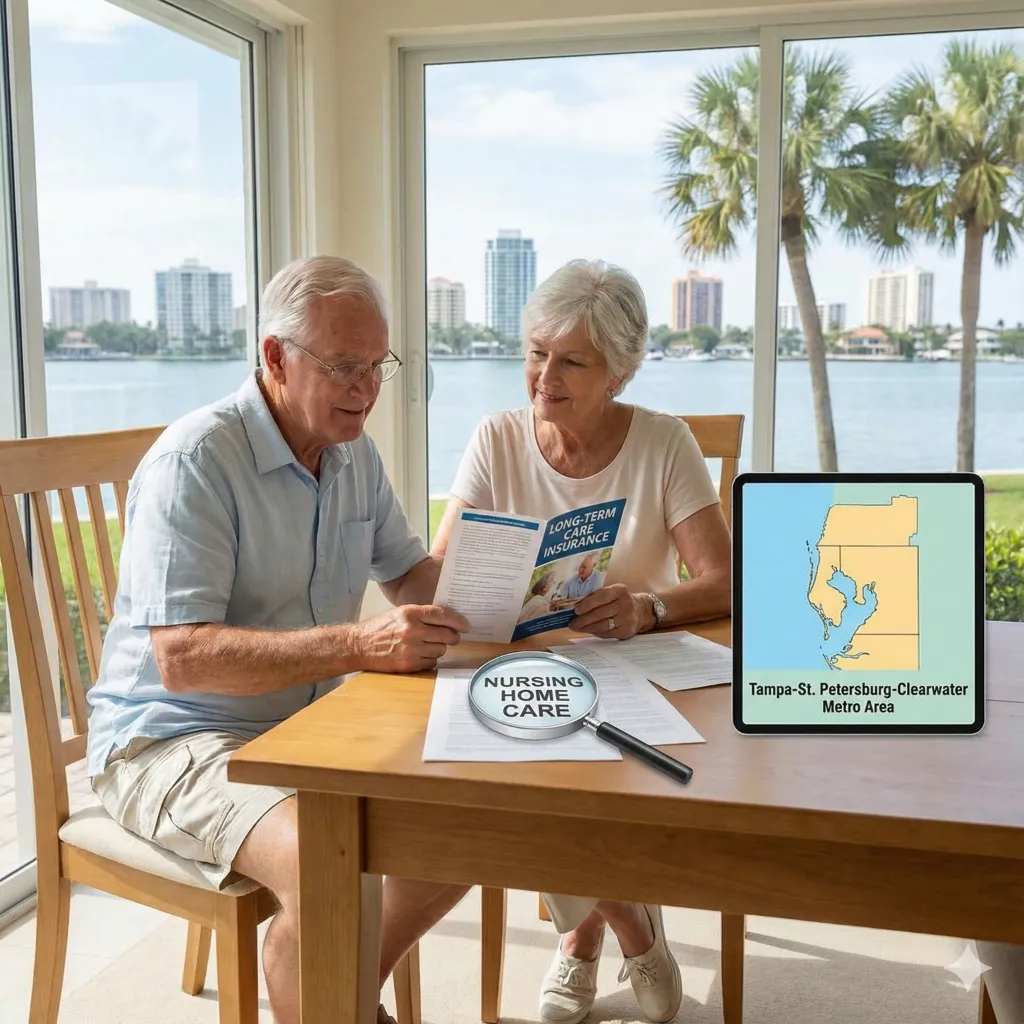
Does Long-Term Care Insurance Cover Nursing Home Care? The Definitive 2026 Guide for Tampa Bay Families
As a Long-Term Care Insurance Agent and Broker who has spent decades serving the Tampa-Saint Petersburg-Clearwater Metro Area, I’ve sat at hundreds of kitchen tables from the quiet streets of Sun City Center to the vibrant waterfront homes of Snell Isle. In every conversation, the same cloud of uncertainty hangs in the air.
Seniors and their adult children are worried—not just about health, but about the staggering cost of aging in Florida. The question I hear most often is: “Does long-term care insurance actually cover nursing home care here in the Tampa Bay area?”
The answer is a definitive yes, but with a crucial caveat: How it covers that care, and for how long, depends entirely on the architecture of your policy. In 2026, when the cost of a private room in a Tampa nursing home has eclipsed six figures, understanding these nuances is the only way to protect your legacy from being consumed by healthcare costs.
This guide provides a comprehensive deep dive into the intersection of insurance and skilled nursing care, specifically tailored for our local Florida community.
Part 1: The Financial Reality of Aging in Tampa Bay (2026)
Before we can discuss insurance solutions, we must look at the “bill” it is designed to pay. The Tampa-Saint Petersburg-Clearwater corridor has seen some of the highest healthcare inflation rates in the Southeastern United States over the last decade.
Current Costs of Nursing Home Care in Tampa, FL
As we move through 2026, the price of skilled nursing care has reached a tipping point. According to recent market data for the Tampa metro area:
| Type of Care | Monthly Average (2026) | Annual Cost |
| Private Room (Nursing Home) | $11,905 | $142,860 |
| Semi-Private Room (Nursing Home) | $10,500 | $126,000 |
| Assisted Living Facility (ALF) | $6,200 | $74,400 |
| Home Health Aide (44 hours/week) | $5,800 | $69,600 |
Neighborhood Nuances
If you are looking at premier facilities in affluent areas like Belleair, Palma Ceia, or Beach Drive in St. Pete, you should expect to pay a premium. Some high-end “Gold Coast” facilities in Pinellas County now charge upwards of $13,500 per month for specialized memory care or luxury private suites.
Without a private insurance safety net, these costs can deplete a typical retirement nest egg in less than three years. This reality is why long-term care insurance for Clearwater seniors has shifted from a “luxury” to a foundational element of a responsible retirement plan.
Part 2: How Long-Term Care Insurance (LTCI) Functions
To answer the core question—does it cover nursing home care?—we have to look at what “long-term care” actually means in the eyes of an insurance carrier.
The “Custodial Care” Distinction
Standard health insurance and Medicare are designed for “acute care”—fixing a broken hip or treating a heart attack. They are not designed for “custodial care,” which is the primary service provided in nursing homes.
Custodial care involves non-medical assistance with the basic activities of daily living (ADLs). A comprehensive LTCI policy is specifically built to pay for this, whether it is delivered in:
- A Skilled Nursing Facility (SNF): The highest level of 24/7 care.
- An Assisted Living Facility (ALF): For those who need help but not 24-hour medical supervision.
- Your Own Home: Through licensed home health agencies in Hillsborough or Pinellas County.
The “Benefit Triggers”: How the Insurance “Turns On”
In Florida, your policy doesn’t start paying just because you feel you need help. You must meet a “benefit trigger,” which is typically certified by a licensed healthcare professional. There are two primary ways a policy is triggered:
- Functional Impairment: You are unable to perform at least two out of the six Activities of Daily Living (ADLs) without “substantial assistance.” These include:
- Bathing: The ability to wash oneself in a tub or shower.
- Dressing: Putting on and taking off all items of clothing.
- Eating: Feeding oneself (not including meal preparation).
- Transferring: Moving in or out of a bed, chair, or wheelchair.
- Toileting: Getting to and from the toilet and performing associated hygiene.
- Continence: The ability to maintain control of bowel and bladder function.
- Cognitive Impairment: This is a critical protection for residents in the Tampa Bay area facing Alzheimer’s or dementia. Even if you are physically capable of all six ADLs, a policy will trigger if your cognitive health requires “continual supervision” for your safety or the safety of others.
Part 3: The Florida Long-Term Care Partnership Program
One of the most significant advantages of being a Florida resident is the Florida Long-Term Care Partnership Program. This is a joint initiative between the state government and private insurance companies, designed to encourage residents to take personal responsibility for their care.
The Power of “Asset Disregard”
The biggest fear many of my clients in Largo or Brandon have is “spending down” their life savings to qualify for Medicaid. Normally, to get Florida Medicaid to pay for a nursing home, you must essentially be impoverished (less than $2,000 in countable assets).
A Partnership-Qualified Policy changes the math.
It offers dollar-for-dollar asset protection. If you buy a Partnership-Qualified policy that pays out $300,000 in benefits for your care, and you still need care after that money is gone, the state of Florida will allow you to keep $300,000 in assets above and beyond the normal Medicaid limits.
This allows you to preserve your home and savings for your spouse or heirs while still transitioning to state support if your needs are catastrophic. As your local broker, I always prioritize checking if a policy is Partnership-Qualified before we sign any documents.
Part 4: Comparing Different Plan Architectures for 2026
When we sit down to compare the best long-term care insurance for Tampa residents, we usually look at three distinct “buckets” of coverage. Each has pros and cons depending on your liquid assets and health status.
1. Traditional (Stand-Alone) LTCI
This is the “purest” form of insurance, similar to car or homeowners’ insurance.
- Pros: Generally offers the lowest initial premium for the highest amount of daily care benefit. These are the primary vehicles for the Florida Partnership Program.
- Cons: It is “use-it-or-lose-it.” If you never require care, the premiums stay with the carrier. Also, while more stable in 2026 than they were twenty years ago, premiums on some older policies can potentially increase.
2. Hybrid Policies (Asset-Based)
These policies combine Life Insurance (or an Annuity) with a Long-Term Care Rider. This is currently the most popular choice for residents in high-net-worth areas like Tierra Verde or Westchase.
- Pros: Eliminates the “use-it-or-lose-it” risk. If you don’t use the care, your beneficiaries receive a tax-free death benefit. Furthermore, the premiums are guaranteed—the insurance company can never raise them.
- Cons: They require a larger upfront investment (either a lump sum or a 10-year payment plan). Most do not qualify for the Partnership Program, though they offer superior liquidity and certainty.
3. Short-Term Care Insurance (STC)
- Pros: Often much easier to qualify for if you have minor health issues that would get you “declined” for a traditional policy. The premiums are significantly lower.
- Cons: Coverage is limited, usually lasting only 360 days or less. While not a solution for a five-year Alzheimer’s stay, it serves as an excellent “bridge” for seniors in Pinellas Park or Dunedin who need help recovering from a surgery or short-term illness.
Part 5: Key Policy Features You Cannot Ignore
If your goal is to rank-order the best policies, you must look beyond the monthly premium. You need to understand the “fine print” that determines how well your nursing home stay is covered.
The Elimination Period (The “Time Deductible”)
Most policies have a waiting period before benefits begin—commonly 0, 30, 60, or 90 days.
- Local Tip: If you have a strong family support network in the Tampa Bay area who can help you for the first three months, a 90-day elimination period can significantly lower your premiums. However, if you are aging alone in a condo on Clearwater Beach, a 0-day or 30-day “home care” trigger might be a lifesaver.
Inflation Protection
In 2026, we have seen the compounding effects of inflation. A $200/day benefit might look good today, but in 15 years, it might only cover half of a nursing home’s daily rate.
- Recommendation: I almost always recommend a 3% or 5% Compound Inflation Rider. This ensures your daily benefit grows every year, keeping pace with the rising costs in the Tampa-St. Pete’s market.
Waiver of Premium
Many top-tier Florida policies include a “Waiver of Premium” clause. This means once you qualify for benefits and start receiving care in a nursing facility, you no longer have to pay your insurance premiums. The policy stays in force, but the check-writing stops for you.
Part 6: Why Medicare and Health Insurance are Not the Solution
One of the most dangerous myths I encounter among Tampa Bay retirees is the belief that “Medicare will take care of me.” Let’s set the record straight:
- Medicare: Only covers “rehabilitative” care in a skilled nursing facility after a 3-day inpatient hospital stay. It covers 100% for the first 20 days and a portion for days 21–100. After day 100, Medicare pays zero.
- Medicare Advantage: While these plans are popular in Florida, they follow similar rules to Medicare. They may offer a few extra days of rehab, but they do not cover long-term custodial “room and board.”
- Standard Health Insurance: Your regular health insurance (BCBS, United, Aetna, etc.) covers doctors and hospitals, not the daily cost of living in a nursing home.
Part 7: The “Local Advantage”—Why Your Agent’s Location Matters
In the era of internet call centers, many people try to buy insurance from someone in a different state. This is often a mistake for residents of the Tampa-Saint Petersburg-Clearwater Metro Area.
Knowledge of Local Facilities
As a local broker, I know the difference between a facility in Temple Terrace and one in Safety Harbor. I know which facilities accept which types of insurance and which ones have high-quality ratings from the Florida Agency for Health Care Administration (AHCA). When you work with a local expert, you get more than a policy; you get a consultant who understands the local healthcare ecosystem.
Hands-On Claims Support
The hardest day for any family is the day the policy needs to be used. When you work with Steve Turner Insurance Specialist, you aren’t calling a 1-800 number and talking to a stranger. You are calling a local advocate who can help your family navigate the “Benefit Trigger” paperwork and ensure the insurance company pays what they owe.
Part 8: A Buyer’s Checklist for Long-Term Care Insurance
If you are currently evaluating your options, use this checklist to ensure you are getting the coverage you actually need for a Tampa nursing home stay:
- Is it Partnership-Qualified? (For asset protection under Florida law).
- What is the Daily Benefit? (Does it cover at least 70–80% of the local $11,000/month average?).
- Does it have Inflation Protection? (3% or 5% Compound is the gold standard).
- What is the Elimination Period? (Can your savings cover the first 90 days?).
- Does it cover Home Care? (Most nursing home stays start with home care first.
- What is the Carrier’s Rating? (I only recommend “A” rated or better companies like Mutual of Omaha, NGL, or OneAmerica).
Part 9: Frequently Asked Questions (FAQ)
Can I get long-term care insurance if I already have a health condition?
It depends on the condition. While things like active cancer or Alzheimer’s are generally “uninsurable,” many carriers in the 2026 market are more lenient with well-managed conditions like high blood pressure, diabetes, or even some heart issues. This is where a broker’s expertise is vital—we know which company is “friendliest” to your specific health history.
What is the best age to buy LTCI in Florida?
The “sweet spot” is typically between ages 55 and 65. At this age, premiums are still manageable, and you are likely healthy enough to qualify for “Preferred” rates. If you wait until you are 75, the cost can be double or triple, and the risk of a medical decline is much higher.
Are my premiums tax-deductible?
In many cases, yes! Federal law allows you to deduct a portion of your “Tax-Qualified” LTCI premiums as a medical expense if you itemize. Furthermore, business owners (LLCs, S-Corps, C-Corps) may be able to deduct 100% of the premium as a business expense.
Conclusion: Taking the Next Step in the Tampa Bay Area
Planning for nursing home care isn’t about “betting on your decline”—it’s about ensuring you remain in the driver’s seat of your own life. By securing a policy now, you ensure that you can choose the best facilities in Pinellas or Hillsborough County, rather than being forced into a Medicaid-funded bed that may be far from your family.
Steve Turner Insurance Specialist is dedicated to helping residents of the Tampa, Saint Petersburg, Clearwater Metro Area solve their biggest healthcare challenges. I perform deep-dive analyses, provide side-by-side carrier comparisons, and help you find the exact point where “affordability” meets “comprehensive protection.”
Best of all, my services are 100% free to you. Like all independent agents and brokers, I am compensated directly by the insurance companies. You get expert, unbiased advice without any out-of-pocket consulting fees.
Get Your Custom 2026 Cost-of-Care Report
Would you like to see exactly how much a nursing home costs in your specific neighborhood? Contact me today for a custom report and a no-obligation quote.
Finding Your Trusted Advisor in the Florida Health Insurance Market
Choosing the right plan at the right price is the key to maximizing the value of your insurance in 2026. A specialist like Steve Turner acts as your personal advocate, comparing rates from all different carriers to ensure you get the best value.
To ensure you have a plan that provides both financial security and true peace of mind, visit SteveTurnerInsuranceSpecialist.com today.
Steve Turner is a licensed Agent/Broker contracted with most Insurance Carriers. Helping you navigate the 2026 market with honesty, integrity, and local expertise.
OUR CLIENT REVIEWS


CONTACT STEVE TURNER INSURANCE AGENT & BROKER
I’m here to take your calls and emails and answer your questions 7 Days a week from 7:00 a.m. to 8:00 p.m., excluding posted holidays.
Steve Turner is a licensed agent, broker, and a longstanding member of the National Association of Benefits and Insurance Professionals®. Steve holds the prestigious Registered Employee Benefits Consultant® designation. NABIP® is the preeminent organization for health insurance and employee benefits professionals and works diligently to ensure all Americans have access to high-quality, affordable Healthcare and related services.
Steve Turner is a licensed agent appointed by Florida Blue.
EMAIL ME: 24×7
OFFICE LOCATION
Website: steveturnerinsurancespecialist.com
Email: [email protected]
Phone and Text: +1-813-388-8373
Business Hours:
Monday: 7 am to 8 pm
Tuesday: 7 am to 8 pm
Wednesday: 7 am to 8 pm
Thursday: 7 am to 8 pm
Friday: 7 am to 8 pm
Saturday: 7 am to 8 pm
Sunday: 7 am to 8 pm
SOCIAL FOLLOW + SHARE
LONG-TERM CARE INSURANCE POSTS


INSURANCE OFFERINGS
Does Long-Term Care Insurance Cover FL Nursing Home Care?
HEALTH INSURANCE
MEDICARE ADVANTAGE

MEDICARE SUPPLEMENT

PRESCRIPTION DRUGS
LIFE INSURANCE

DISABILITY INSURANCE
DENTAL INSURANCE

GROUP HEALTH INSURANCE

ACCIDENT INSURANCE
LONG TERM CARE INSURANCE
MEDICAID INSURANCE

MEDICARE INSURANCE

MEDICARE PART A INSURANCE

MEDICARE PART B INSURANCE
MEDICARE PART C INSURANCE
MEDICARE PART D INSURANCE

MEDICARE PLAN G INSURANCE

MEDICARE PLAN N INSURANCE

SERVICE AREA
MEDICARE STATEMENT
The Medicare Annual Enrollment Period is October 15th to December 7th. Steve Turner is not connected with or endorsed by the United States Government or the Federal Medicare Program. Some plans may not be available in your area, and any information I provide is limited to those offered. Please contact Medicare.gov or 1-800-MEDICARE to get information on all of your options.
There’s no one-size-fits-all answer. Carefully evaluate your health status, anticipated medical needs, prescription drug usage, budget, preferred doctors and hospitals, and tolerance for network rules. During the Medicare Annual Enrollment Period (October 15th to December 7th), thoroughly research the specific plans available in your Florida county using the Medicare Plan Finder on Medicare.gov, compare their costs and benefits, and consider seeking free, personalized counseling from Florida’s SHINE (Serving Health Insurance Needs of Elders) program.