

What Is Whole Life Insurance? A 2027 Guide for Tampa, St. Petersburg & Clearwater Residents
By Steve Turner, Licensed Life & Health Insurance Agent and Independent Broker, Tampa Bay, Florida
Quick answer: Whole life insurance is permanent life insurance that lasts your entire life, keeps the same premium every year, and builds guaranteed cash value you can borrow against. Policies from mutual insurers may also pay annual dividends. The trade-off is cost: whole life typically runs 10 to 15 times the premium of a term policy with the same death benefit.
For years I have sat across the table from Tampa Bay families, retirees, and business owners who all ask some version of the same question: “Do I need whole life insurance, or is someone just trying to sell it to me?” Both are fair concerns. I have placed whole life policies for a Westshore business owner protecting a buy-sell agreement, and I have talked a young Riverview couple out of it because term was the better fit.
This guide is the conversation I have in my office, written down. You will learn how whole life works, what it costs in 2027, how Florida law treats it, and, just as importantly, when you should not buy it.
What Is Whole Life Insurance?
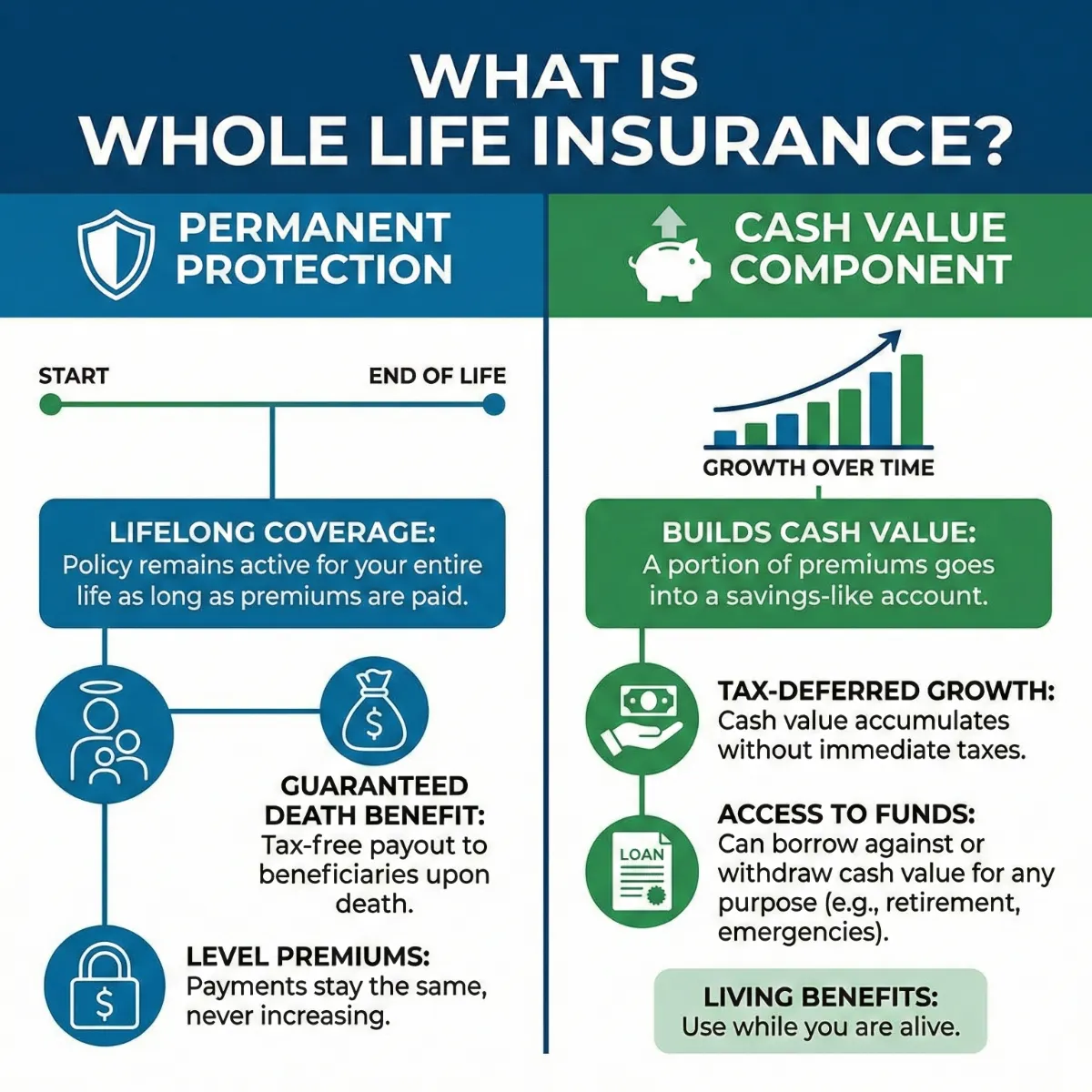
Whole life insurance is a type of permanent life insurance that covers you for your entire lifetime, as long as you pay premiums. Term insurance is like renting coverage for 10, 20, or 30 years. Whole life is closer to owning it.
Every traditional whole life policy rests on three contractual guarantees, all backed by the claims-paying ability of the insurer:
- Guaranteed death benefit. Your beneficiaries receive the face amount whenever you die, at 45 or 105.
- Guaranteed level premium. Your premium is set at issue and never increases because of age or health changes.
- Guaranteed cash value. Part of each premium builds a cash value that grows at a minimum rate written into the contract.
What is not guaranteed: dividends. More on that below.
How Whole Life Works: The Three Building Blocks
1. The death benefit
The death benefit is the core reason to own any life insurance. Because whole life never expires, it meets needs that don’t end on a schedule: keeping a surviving spouse in the family home in Safety Harbor, funding final expenses, equalizing an inheritance among children, or leaving a gift to a charity or a school such as the University of South Florida. Death benefits paid to a named beneficiary are generally free of federal income tax, and Florida has no state income tax.
2. The cash value
A portion of each premium builds cash value inside the policy. In the early years, most of the premium goes to insurance costs and commissions, so cash value grows slowly. Over 10 to 20 years, it becomes meaningful.
- Tax-deferred growth. You owe no income tax on cash value growth while it stays in the policy.
- Policy loans. You can borrow against cash value without a credit check, for a car, a kitchen renovation in South Tampa, or a business opportunity. Loans accrue interest, and any unpaid balance reduces the death benefit.
- Tax caution. Loans are generally not taxable while the policy stays in force. If the policy lapses or is surrendered with an outstanding loan, the gain can become taxable. A policy funded too quickly can also become a Modified Endowment Contract (MEC), which changes how loans and withdrawals are taxed.
3. Dividends
Whole life from a mutual insurer is usually “participating,” meaning policyowners can share in the company’s surplus through annual dividends. Dividends are never guaranteed, but the major mutuals have long records:
- Northwestern Mutual announced a record expected $10.4 billion dividend payout for 2027, with about 85% going to whole life policyowners.
- New York Life paid its 172nd consecutive annual dividend in 2026.
Most policyowners use dividends to buy paid-up additions, which increase both cash value and the death benefit. Dividends can also reduce premiums, be taken in cash, or repay policy loans.
Pros and Cons of Whole Life Insurance for Florida Residents
Advantages
- Coverage you cannot outlive. Useful for final expenses, estate liquidity, or a lifelong dependent.
- Strong Florida creditor protection. Under Florida Statute 222.14, the cash surrender value of a policy on the life of a Florida resident is generally exempt from creditors, with no dollar cap. Section 222.13 separately protects death benefits paid to named beneficiaries. Exceptions exist, including IRS tax levies and transfers made to defraud creditors, so business owners should confirm their situation with an asset-protection attorney.
- Predictable costs. The premium is fixed for life, which makes budgeting easy in retirement.
- Disciplined saving. The premium works like a bill you pay to yourself.
- Income-tax-free death benefit for named beneficiaries in most cases.
Disadvantages
- High cost. Expect roughly 10 to 15 times the premium of term coverage with the same death benefit.
- Slow early growth. Surrendering in the first several years usually returns less than you paid in.
- Complexity. Dividend scales, loan provisions, and riders need careful explanation before you sign.
- Lower long-run growth than stocks. Whole life is a conservative asset, not a growth engine.
Who should probably not buy whole life?
Be wary if you haven’t maxed out your 401(k) or IRA, carry high-interest debt, have no emergency fund, or only need coverage until a mortgage is paid or children are grown. In those cases, term life usually serves you better.
How Much Does Whole Life Insurance Cost in 2027?
A healthy 40-year-old in Tampa Bay can expect roughly $245 to $330 a month for a $250,000 whole life policy. Your actual rate depends on age, sex, health class, tobacco use, carrier, and how many years you choose to pay premiums.
Illustrative monthly premiums, $250,000 whole life, preferred non-tobacco, premiums payable for life
| Issue age | Male | Female |
|---|---|---|
| 30 | $185 – $210 | $155 – $180 |
| 40 | $295 – $330 | $245 – $280 |
| 50 | $480 – $550 | $390 – $440 |
| 60 | $850 – $975 | $690 – $790 |
These ranges are illustrative estimates for comparison, not quotes. Where you live in Hillsborough or Pinellas County doesn’t change your life insurance rate; your health and age do. The premium stays level for life, so a policy bought at 30 for $185 a month still costs $185 at 80, unless you choose a limited-pay design such as “paid up at 65.”
Whole Life vs. Term Life: Which Is Better for You?
The right choice comes down to one question: how long do you need the money to be there?
| Term life | Whole life | |
|---|---|---|
| Length of coverage | 10–30 years | Lifetime |
| Premium | Lowest; rises sharply if renewed | 10–15x term; level for life |
| Cash value | None | Guaranteed, grows tax-deferred |
| Dividends | No | Possible with mutual carriers |
| Best for | Mortgage, income replacement, kids at home | Estate liquidity, final expenses, lifelong dependents, conservative savings |
Choose term if you need to cover a 30-year mortgage or protect your children until they finish school in Largo.
Choose whole life if you have a lifelong need, such as a child with special needs, want guaranteed money for estate costs, or want a conservative, creditor-protected asset alongside your investments.
Many families do both: a large term policy for the working years plus a smaller whole life policy for permanent needs.
Advanced Uses for High-Net-Worth Tampa Bay Residents
In neighborhoods like Snell Isle, Davis Islands, and Belleair, whole life is often a planning tool rather than simple protection.
Estate tax liquidity
Florida has no state estate tax, but the federal estate tax still applies above the exemption. The One Big Beautiful Bill Act set the federal exemption at $15 million per person for 2026, with inflation indexing starting in 2027 (Mondaq). The IRS publishes the official 2027 figure each fall. For estates above that line, a policy owned by an irrevocable life insurance trust (ILIT) can provide cash for the tax so heirs don’t have to sell waterfront property or a family business quickly.
Private financing (“infinite banking”)
Some owners fund high-cash-value policies, then borrow against them for large purchases like a boat or rental property and repay the loan on their own schedule. This can work, but it is not free money. You pay loan interest, results depend on non-guaranteed dividends, and the strategy needs years of funding before it is useful. Ask to see an illustration that shows guaranteed values, not just projected ones.
Retirement income supplement
You can access cash value through withdrawals up to your cost basis and then policy loans, generally without income tax if the policy is structured to avoid MEC status and stays in force. That gives retirees a buffer to draw from in a down market instead of selling investments at a loss.
What Does Whole Life Actually Return?
A carrier’s dividend interest rate is not your return. Over 20 to 30 years, well-structured policies from top mutual insurers have historically produced cash value internal rates of return of roughly 3% to 5% (ParityPoint).
Because policy growth and properly structured loans are not taxed, compare that return to a taxable investment using the tax-equivalent yield:
For a Tampa resident in the 32% federal bracket, a 4% tax-free return equals about 5.9% taxable (4% ÷ 0.68). Florida has no state income tax, so only the federal rate applies. That is competitive with bonds, not with stocks, which is why I treat whole life as a replacement for part of the conservative side of a portfolio.
Top Whole Life Insurance Companies for 2027
The first four carriers below are participating mutual insurers, and all hold A++ (Superior) financial strength ratings from AM Best. Dividend interest rates are one input to each company’s dividend formula and are not guaranteed.
| Company | Latest dividend news | Dividend interest rate | Known for |
|---|---|---|---|
| Northwestern Mutual | Record $10.4B expected for 2027 | 6.10% (2027) | Largest payout; dividends every year since 1872 |
| MassMutual | Record $3.3B estimated for 2027 | 6.60% (2026) | Strong cash value accumulation |
| New York Life | $2.78B for 2026; 2027 not yet announced | 6.40% (2026, reported) | Flexible “Custom Whole Life” premium periods |
| Guardian Life | $1.7B for 2026; 2027 not yet announced | 6.25% (2026) | Dividends every year since 1868 |
| Mutual of Omaha | Non-participating final expense plans | N/A | Small simplified-issue policies for seniors, no medical exam |
Rates as of November 5, 2026. I will update this table when Guardian and New York Life announce 2027 dividends.
Frequently Asked Questions
Is whole life insurance worth it in 2027?
It is worth it if you have a permanent need, such as estate costs, final expenses, or a lifelong dependent, and you can comfortably afford the premium for decades. It is usually not worth it if you need maximum coverage on a tight budget; term is better there.
Can I keep my policy if I move out of Florida?
Yes. The policy is your property and goes with you. Keep in mind that Florida’s unlimited creditor protection for cash value applies to Florida residents; other states have different rules.
Can whole life help pay for long-term care?
Many policies offer chronic illness or long-term care riders that let you access part of the death benefit early to pay for care, such as an assisted living facility in Clearwater. Rider terms, costs, and qualification rules vary widely by carrier.
What happens if I stop paying premiums?
You usually have options besides lapsing: use cash value to cover premiums, convert to a smaller paid-up policy with no further premiums, or take the cash surrender value. Surrendering early often means getting back less than you paid.
Is whole life a good investment?
I describe it as a conservative savings alternative with an attached death benefit. It is not meant to compete with stocks. It can replace part of the bond or cash portion of a portfolio with something that is guaranteed, tax-advantaged, and protected from creditors in Florida.
Is Whole Life Right for You?
If you want the lowest-cost protection, buy term. If you want a guaranteed lifetime death benefit, a tax-advantaged and creditor-protected savings vehicle, and certainty for your family, whole life deserves a serious look, ideally as part of a mix with term coverage.
Work with an independent agent. I am appointed with multiple carriers, so I can compare whole life designs side by side rather than pushing one company’s product. My help is free to you: like all agents, I am paid a commission by the insurance company you choose, and life insurance premiums are the same whether you buy through an agent or directly. I will show you guaranteed and non-guaranteed values and tell you plainly if term is the better fit.
Whether you live in Dunedin, Brandon, or St. Pete Beach, I would be glad to run a side-by-side comparison of a “paid-up at 65” whole life plan and a term policy for your family. Contact me at SteveTurnerInsuranceSpecialist.com.
About the Author
Steve Turner is a Florida-licensed life and health insurance agent and independent broker serving Hillsborough, Pinellas, and Pasco counties. He has helped Tampa Bay residents for 10+ years with life insurance, Medicare, and health coverage.
Disclosures
This article is for educational purposes and is not tax, legal, or investment advice. Consult a qualified tax professional or attorney about your situation. Guarantees depend on the issuing insurer’s claims-paying ability. Dividends are not guaranteed. Premium figures are illustrative estimates, not offers of coverage. Policy loans and withdrawals reduce cash value and death benefit and may have tax consequences.
Sources
- Florida Statute 222.14, cash surrender value exemption
- Northwestern Mutual: 2027 dividend announcement
- Guardian: 2026 dividend announcement
- New York Life: 2026 dividend announcement
- ParityPoint: whole life dividend rates for 2027
- ParityPoint: whole life rate of return
- Mondaq: estate planning outlook and OBBBA exemption
OUR CLIENT REVIEWS


CONTACT STEVE TURNER, LICENSED INSURANCE AGENT & BROKER
Questions? Call, text, or book a time below; I answer calls and emails 7 Days a week from 7:00 a.m. to 8:00 p.m., excluding posted holidays.
EMAIL ME: 24×7
OFFICE LOCATION
Address: 14502 N Dale Mabry Hwy, Suite 200, Tampa, FL 33618
Website: steveturnerinsurancespecialist.com
Email: [email protected]
Phone and Text: +1-813-388-8373
Business Hours:
Monday: 7:00 a.m. / 8:00 p.m.
Tuesday: 7:00 a.m. / 8:00 p.m.
Wednesday: 7:00 a.m. / 8:00 p.m.
Thursday: 7:00 a.m. / 8:00 p.m.
Friday: 7:00 a.m. / 8:00 p.m.
Saturday: 7:00 a.m. / 8:00 p.m.
Sunday: 7:00 a.m. / 8:00 p.m.
LIFE INSURANCE POSTS





MEDICARE STATEMENT
We do not offer every plan available in your area. Currently, we represent 7 organizations that offer 70 products in your area. Please get in touch with Medicare.gov or 1-800-MEDICARE for information on all your options.
Steve Turner is a licensed insurance agent and is not connected with or endorsed by the United States Government or the Federal Medicare Program. The Medicare Annual Enrollment Period is October 15 to December 7.
There’s no one-size-fits-all answer. Carefully consider your health status, expected medical needs, prescription drugs, budget, preferred doctors and hospitals, and how comfortable you are with network rules. During the Annual Enrollment Period, you can use the Medicare Plan Finder at Medicare.gov to research plans available in your Florida county, compare costs and benefits, and get free, unbiased counseling from Florida’s SHINE (Serving Health Insurance Needs of Elders) program at floridashine.org or 1-800-963-5337. You can also call 1-800-MEDICARE (1-800-633-4227; TTY 1-877-486-2048), 24 hours a day, 7 days a week.
Steve Turner

Steve Turner, CLU®, REBC® Licensed Florida health insurance agent · License W333468
Steve Turner is a licensed agent and broker and a long-standing member of the National Association of Benefits and Insurance Professionals NABIP®, the preeminent organization for health insurance and employee benefits professionals, and works diligently to ensure all Americans have access to high-quality, affordable healthcare and related services. Steve also holds the prestigious Registered Employee Benefits Consultant® (REBC®) designation. Steve also holds the “Chartered Life Underwriter” designation (CLU®), a professional credential for individuals specializing in life insurance and estate planning. The American College of Financial Services confers it. For over 10 years, Steve has helped individuals, families, Medicare beneficiaries, and small businesses find the right coverage to meet their needs. Steve has earned 180+ Google reviews from happy clients.
Steve Turner is a licensed agent appointed by Florida Blue.