


Can Life Insurance Be Denied? What Tampa Bay Families Need to Know in 2027
Can Life Insurance Be Denied? What Tampa Bay Families Need to Know in 2027
By Steve Turner, Licensed Insurance Agent and Broker, Tampa Bay, Florida
The short answer: Yes. Life insurance can be denied at two points: when you apply, and when your beneficiary files a claim. Most claims are paid without a problem. The denials that do happen usually trace back to three things: an inaccurate application, a death during the first two years of coverage, or a policy that lapsed for nonpayment. All three are largely preventable.
I’ve helped families in Tampa, St. Petersburg, Clearwater, and the surrounding counties buy coverage, and I’ve sat with beneficiaries after a claim went sideways. This guide explains how insurers decide, what Florida law actually says, and the specific steps I take with clients so their policies pay when it matters.
About the author: Steve Turner is an independent life and health insurance agent licensed by the Florida Department of Financial Services (license #[ADD LICENSE NUMBER]). He has 10+ years of experience and is appointed with key carriers. You can verify any Florida agent’s license at the Florida DFS licensee search.
Important: This article is general education, not legal advice. Policy terms vary by carrier. If a claim has been denied, consider speaking with a Florida attorney who handles life insurance disputes.
Part 1: Denial at the Application Stage
When you apply, the insurer runs underwriting: a review of your health, habits, and finances to decide whether to insure you and at what price. In 2027, much of that review is automated. Carriers commonly check:
- Your answers on the application and any phone or online interview
- Prescription history databases, which show medications filled in recent years
- The MIB (Medical Information Bureau), which flags conditions reported on prior insurance applications
- Your motor vehicle report, including DUIs and major violations
- Electronic health records and lab results, when you authorize access
Common reasons applications are declined
- Serious or uncontrolled health conditions. Recent cancer treatment, heart failure, poorly controlled diabetes, or organ disease can lead to a decline or a postponement until treatment ends.
- Hazardous work. Commercial fishing in the Gulf, line work, roofing, and similar jobs may push some carriers to decline or add a surcharge.
- High-risk activities. Private piloting, deep or cave diving in Florida’s springs, and motor racing usually require a questionnaire and may carry a flat extra charge or an exclusion.
- Driving record. Multiple DUIs or reckless-driving convictions in recent years are a frequent cause of declines.
- No financial justification. Coverage must roughly match your income and obligations. Someone earning $50,000 a year who applies for $5 million will usually be cut back or declined.
A decline from one company is not a decline from every company. Underwriting rules differ widely between carriers, which is why working with an independent agent helps.
Three ways to apply, compared
| Feature | Fully underwritten | Simplified issue (no exam) | Guaranteed issue |
|---|---|---|---|
| Medical exam | Usually required (or replaced by data review) | No exam; health questions only | No exam, no health questions |
| Chance of being declined | Higher with health issues | Moderate | None for eligible ages |
| Premium | Lowest for healthy applicants | Moderate | Highest per dollar of coverage |
| Typical coverage | Up to several million dollars | Often up to $500,000 or less | Usually $5,000 to $25,000 |
| Time to approval | Days to several weeks | Minutes to days | Immediate |
| Watch out for | Accuracy of every answer | Same: misstatements can void it | A graded benefit in the first 2 years |
Figures are typical ranges; each carrier sets its own limits.
Part 2: Denial at the Claim Stage
A claim denial after a death is the outcome every family fears. It is uncommon, but when it happens, it usually falls into one of the categories below.
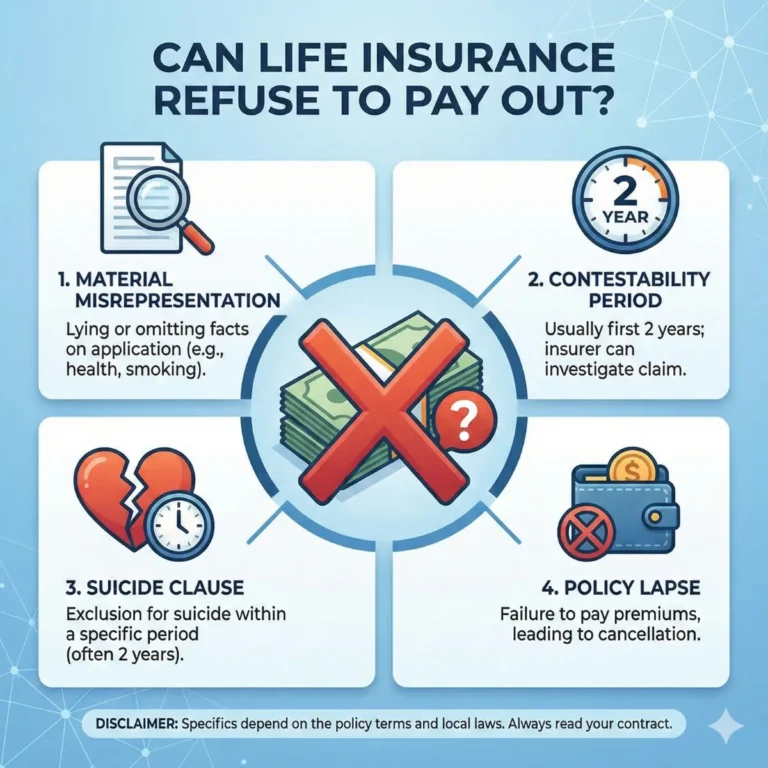
1. The two-year contestability period (Fla. Stat. § 627.455)
Florida law requires life insurance policies to become incontestable after they have been in force for two years during the insured’s lifetime. Until then, if the insured dies, the insurer may review the original application against medical, pharmacy, and other records. If it finds a qualifying misstatement, it can rescind the policy and refund premiums instead of paying the death benefit.
A death in the first two years does not mean the claim will be denied. It means the claim will be reviewed more closely, which can add weeks to the process.
2. Misrepresentation on the application (Fla. Stat. § 627.409)
This is the most common reason a claim is contested. Under Florida’s statute, a misstatement or omission can block recovery if it was fraudulent, material to the risk the insurer took on, or if the insurer would not have issued the policy on the same terms had it known the truth.
Two points surprise most people:
- The mistake doesn’t have to be intentional. Florida courts have generally held that an honest omission can still justify rescission if it was material. Forgetting a cardiology visit or a prescription can matter.
- The wording of the question counts. Some courts have refused rescission where the application question was ambiguous, or where the policy asked only for answers “to the best of your knowledge and belief.”
One related rule works in your favor: under § 627.456, a misstated age or sex typically leads to an adjusted benefit, not a denial.
3. Policy exclusions
Exclusions are listed in the policy itself, so read yours. Common ones include:
- Suicide clause. Most policies exclude suicide during the first two years, refunding premiums instead of paying the benefit.
- Death while committing a felony or other illegal act, depending on the policy wording.
- Aviation or hazardous activities, when excluded by rider because they weren’t rated at issue.
- War or acts of war, mostly in older or specialized policies.
4. Policy lapse for nonpayment
In my experience, more families lose coverage because of a missed payment than because of an exclusion. Florida requires a grace period of at least 30 days for premiums after the first payment is due (§ 627.453). If the insured dies during the grace period, the claim is paid minus the overdue premium. After the grace period ends, the policy can lapse.
Protection for older policyholders (§ 627.4555): When the insured is 64 or older, and the policy has been in force for at least a year, the insurer generally may not lapse it for nonpayment without first mailing notice to the policyowner and to a secondary addressee, if one was designated. Insurers must offer you the chance to name that person at application and at any time while the policy is in force. If you or a parent is a senior, naming a trusted adult child or advisor is one of the simplest safeguards available.
A lapsed policy can often be reinstated within a set period by paying back premiums and showing continued good health. Still, reinstatement may restart a contestability period on the reinstatement application.
Can a Claim Be Denied After Two Years?
It’s much harder, but a few situations still cause problems after the contestability period ends:
- Nonpayment. Incontestability protects the application, not unpaid premiums. A lapsed policy pays nothing.
- Exclusions. The two-year rule limits challenges to the application. It doesn’t erase exclusions written into the policy.
- Impostor fraud or no insurable interest. If someone else took the medical exam, or a stranger bought the policy with no legitimate interest in the insured’s life, courts may treat the policy as void from the start.
- Beneficiary disputes. Sometimes the insurer will pay but can’t tell who should receive the money. It may file an interpleader, depositing the funds with a court to decide.
A Florida-specific note on divorce: Under Fla. Stat. § 732.703, a designation naming a former spouse as beneficiary is generally treated as void after a divorce, with exceptions such as a court order or a new designation after the divorce. Employer group plans governed by federal ERISA law may follow different rules. The safest move is still to update your beneficiary form yourself.
Comparing Policy Types by Denial Risk
| Policy type | Main advantages | Main denial risks |
|---|---|---|
| Term life | Lowest cost per dollar; good for mortgages and young families | Misstatements during the first 2 years; coverage ends at term’s end, and a new policy starts a new contestability clock |
| Whole or other permanent life | Lifetime coverage; cash value; many offer an automatic premium loan that can prevent an accidental lapse | Same 2-year review; higher premiums can lead to lapse if budgets tighten |
| Guaranteed issue | Cannot be declined at application (within eligible ages) | Graded benefit: a death from natural causes in the first 2 years typically pays premiums back plus interest, not the full benefit |
If you have a policy that converts from term to permanent without new medical underwriting, ask whether the conversion keeps your original contestability dates. Many do.
How to Protect Your Family’s Payout
- Disclose everything. List every diagnosis, medication, specialist visit, and test from the look-back period the application asks about. A higher rate today beats a denied claim later.
- Pull your own records first. Before applying, I review clients’ medication lists and recent visits with them so the application matches what the insurer will find.
- Read your application before signing. If an agent or interviewer filled it in, confirm every answer is accurate. You are responsible for its contents.
- Automate premiums from an account you check regularly, and update the payment method when you change banks or cards.
- Name a secondary addressee for lapse notices, especially at age 64 or older.
- Review beneficiaries after any marriage, divorce, birth, adoption, or death in the family.
- Tell your beneficiaries the policy exists, which company issued it, and where you keep the documents.
What to Do If a Claim Is Denied
- Get the reason in writing and ask for a copy of the application, the policy, and the records the insurer relied on.
- Check the dates. Confirm when the policy was issued and whether the death fell inside the two-year contestability period.
- Compare the alleged misstatement with the actual application question. Ambiguous questions and “knowledge and belief” wording can matter.
- File a complaint with the Florida Department of Financial Services, Division of Consumer Services, if you believe the denial is improper. Their helpline is 1-877-693-5236.
- Talk to a Florida attorney who handles life insurance disputes, particularly for larger policies or rescission cases.
Frequently Asked Questions
Can life insurance be denied for a pre-existing condition? Yes, at the application stage. But many well-controlled conditions, such as treated high blood pressure or managed type 2 diabetes, are often approved at standard or slightly higher rates. Shopping several carriers improves your odds.
Can a claim be denied if the insured dies within two years? It can, but only if the insurer finds a material misstatement or an exclusion applies. Accurate applications filed in the first two years are paid like any other claim.
What happens if I forgot to list something on my application? Contact your agent or the insurer now. Correcting the record while you’re alive is far better than leaving it for your family to contest.
Does guaranteed issue life insurance ever deny claims? It won’t decline you at application, but most policies pay only a return of premium (often with interest) for a natural-causes death in the first two years.
How long does an insurer have to pay a life insurance claim in Florida? Florida law sets claim-handling standards and requires interest on death benefits that aren’t paid promptly. Ask the insurer for its expected timeline when you file.
Get a Second Set of Eyes on Your Policy
Most denials I’ve seen were preventable with an accurate application, an automated payment, and an up-to-date beneficiary. If you live in Hillsborough, Pinellas, or Pasco County, I can review your existing coverage for contestability, lapse, and beneficiary risks, or compare new options across the carriers I’m appointed with.
Contact Steve Turner at SteveTurnerInsuranceSpecialist.com.
How I’m paid: My review is free. As an independent agent, I receive a commission from the insurance company you choose. The carrier sets premiums and files them with Florida regulators, so you pay the same price whether you buy through me or directly.
Sources
- Fla. Stat. § 627.453, Grace period
- Fla. Stat. § 627.4555, Secondary notice
- Fla. Stat. § 627.409, Representations in applications
- Index of Florida life insurance statutes, Chapter 627 Part III (includes § 627.455 Incontestability and § 627.456 Misstatement of age or sex)
- Florida DFS licensee search
OUR CLIENT REVIEWS


CONTACT STEVE TURNER, LICENSED INSURANCE AGENT & BROKER
Questions? Call, text, or book a time below; I answer calls and emails 7 Days a week from 7:00 a.m. to 8:00 p.m., excluding posted holidays.
EMAIL ME: 24×7
OFFICE LOCATION
Address: 14502 N Dale Mabry Hwy, Suite 200, Tampa, FL 33618
Website: steveturnerinsurancespecialist.com
Email: [email protected]
Phone and Text: +1-813-388-8373
Business Hours:
Monday: 7:00 a.m. / 8:00 p.m.
Tuesday: 7:00 a.m. / 8:00 p.m.
Wednesday: 7:00 a.m. / 8:00 p.m.
Thursday: 7:00 a.m. / 8:00 p.m.
Friday: 7:00 a.m. / 8:00 p.m.
Saturday: 7:00 a.m. / 8:00 p.m.
Sunday: 7:00 a.m. / 8:00 p.m.
LIFE INSURANCE POSTS






MEDICARE STATEMENT
We do not offer every plan available in your area. Currently, we represent 7 organizations that offer 70 products in your area. Please get in touch with Medicare.gov or 1-800-MEDICARE for information on all your options.
Steve Turner is a licensed insurance agent and is not connected with or endorsed by the United States Government or the Federal Medicare Program. The Medicare Annual Enrollment Period is October 15 to December 7.
There’s no one-size-fits-all answer. Carefully consider your health status, expected medical needs, prescription drugs, budget, preferred doctors and hospitals, and how comfortable you are with network rules. During the Annual Enrollment Period, you can use the Medicare Plan Finder at Medicare.gov to research plans available in your Florida county, compare costs and benefits, and get free, unbiased counseling from Florida’s SHINE (Serving Health Insurance Needs of Elders) program at floridashine.org or 1-800-963-5337. You can also call 1-800-MEDICARE (1-800-633-4227; TTY 1-877-486-2048), 24 hours a day, 7 days a week.
Steve Turner

Steve Turner, CLU®, REBC® Licensed Florida health insurance agent · License W333468
Steve Turner is a licensed agent and broker and a long-standing member of the National Association of Benefits and Insurance Professionals NABIP®, the preeminent organization for health insurance and employee benefits professionals, and works diligently to ensure all Americans have access to high-quality, affordable healthcare and related services. Steve also holds the prestigious Registered Employee Benefits Consultant® (REBC®) designation. Steve also holds the “Chartered Life Underwriter” designation (CLU®), a professional credential for individuals specializing in life insurance and estate planning. The American College of Financial Services confers it. For over 10 years, Steve has helped individuals, families, Medicare beneficiaries, and small businesses find the right coverage to meet their needs. Steve has earned 180+ Google reviews from happy clients.
Steve Turner is a licensed agent appointed by Florida Blue.