

When Does Open Enrollment Start in 2026
When Does Open Enrollment Start in 2026
When Does Open Enrollment Start in 2026?
I. Introduction: Preparing for Medicare in 2026 Amidst a Shifting Cost Landscape
For Florida’s substantial population of seniors and other eligible individuals, Medicare is the cornerstone of health security. Understanding the timelines and financial obligations associated with this federal program is not merely an administrative task; it is a critical component of effective healthcare and financial planning. As the 2026 coverage year approaches, beneficiaries face the perennial challenge of navigating a complex system of enrollment deadlines, coverage choices, and out-of-pocket costs. This challenge is amplified by a shifting economic landscape, with projections indicating notable increases in Medicare costs for 2026.
Key financial benchmarks, such as the standard premium and annual deductible for Medicare Part B (Medical Insurance), are expected to rise significantly. This upward trend in beneficiary costs underscores the importance of proactive planning and informed decision-making. Failing to understand the enrollment rules can lead to gaps in coverage and lifelong financial penalties, while a passive approach to plan selection can result in unnecessarily high out-of-pocket expenses.
This report serves as an exhaustive guide for Florida residents preparing for the 2026 Medicare year. It will provide a definitive roadmap through the system’s complexities, beginning with a detailed decoding of the 2026 enrollment calendar, explaining the purpose and strategic use of each distinct period. Following this, the report will demystify the mechanics of out-of-pocket costs, defining and illustrating how premiums, deductibles, copayments, and coinsurance function in concert. The analysis will then focus specifically on the Florida market, projecting typical 2026 costs for individuals, couples, and families, and clarifying common misconceptions about family coverage. Finally, the report will conclude with practical, step-by-step instructions on how to enroll in Medicare, outlining both the direct government pathway and the guided pathway of working with a licensed local insurance agent.
II. Decoding the 2026 Medicare Enrollment Calendar: Your Definitive Guide to Key Deadlines
The Medicare system is governed by a series of distinct enrollment periods, each with a specific purpose, timeframe, and set of rules. This structure is designed to maintain market stability for insurers by concentrating most plan changes into a single annual window. However, this rigidity is balanced by a web of exceptions designed to accommodate the varied life circumstances of millions of beneficiaries. Understanding which period applies is the first step toward securing appropriate and timely coverage.
A. The Initial Enrollment Period (IEP): Your First and Most Critical Window
The Initial Enrollment Period (IEP) is the primary, seven-month window for individuals to sign up for Medicare when they first become eligible. For most, eligibility begins at age 65. The IEP starts three months before the month of an individual’s 65th birthday, includes their birthday month, and extends for three months after. For example, an individual turning 65 on June 7th has an IEP that runs from March 1 to September 30.
There are important exceptions to this timing. If an individual’s birthday falls on the first of the month, their IEP is calculated as if they were born the month prior, effectively shifting the entire seven-month window one month earlier. Eligibility can also be triggered by disability. Individuals under 65 generally become eligible for Medicare after receiving Social Security or Railroad Retirement Board disability benefits for 24 months. Those with specific conditions, such as Amyotrophic Lateral Sclerosis (ALS) or End-Stage Renal Disease (ESRD), may qualify sooner.
The strategic importance of the IEP cannot be overstated. To avoid any gap in health coverage, it is crucial to enroll during the three months before the 65th birthday month. Doing so ensures that Medicare coverage begins on the first day of the birthday month. If an individual waits to enroll during their birthday month or in the three months following, their coverage start date will be delayed until the first of the month after they sign up. Missing the IEP entirely without having other creditable health coverage (such as from an active employer) can trigger a lifelong late enrollment penalty for Part B, a costly and avoidable consequence. This penalty functions as a powerful financial incentive to ensure that healthier individuals enroll when first eligible, which is essential for balancing the insurance risk pool against those who may have more immediate and costly health needs.
B. The Annual Election Period (AEP) / Open Enrollment: Your Yearly Opportunity to Optimize
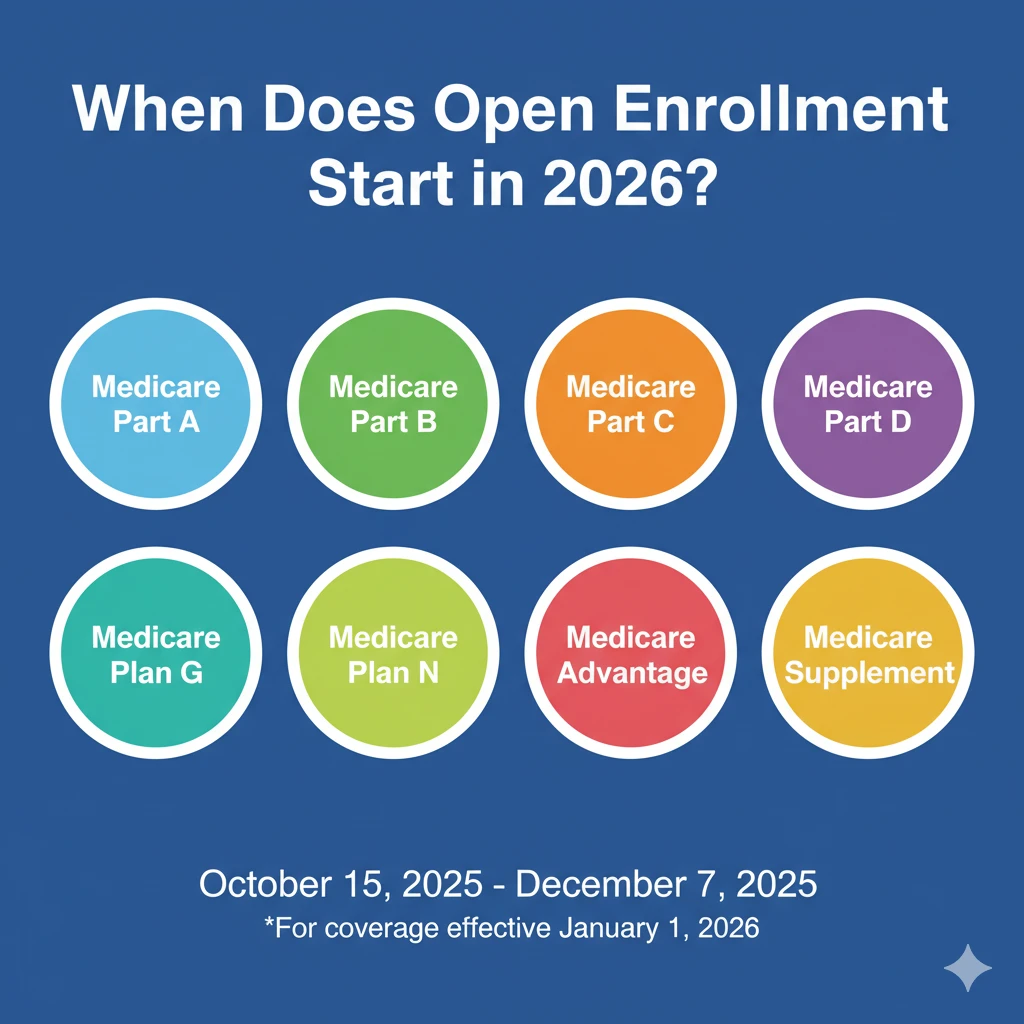
For those already enrolled in Medicare, the Annual Election Period (AEP), commonly known as Open Enrollment, is the most important time of the year. For 2026 coverage, the AEP runs from October 15, 2025, to December 7, 2025. Any changes made during this period will take effect on January 1, 2026.
This nearly eight-week window allows beneficiaries to reevaluate their existing coverage and make a wide range of changes. During the AEP, an individual can:
- Switch from Original Medicare (Parts A and B) to a Medicare Advantage (Part C) plan.
- Switch from a Medicare Advantage plan back to Original Medicare.
- Switch from one Medicare Advantage plan to another.
- Join a Medicare Part D prescription drug plan.
- Switch from one Part D plan to another.
- Drop Part D coverage completely.
A critical rule governing the AEP is the “last-in” provision. A beneficiary can change their mind and select a different plan multiple times between October 15 and December 7. The final choice submitted before the deadline is the one that will become effective in the new year, overriding any previous selections made during that period.
C. Medicare Advantage Open Enrollment Period (MAOEP): The “Do-Over” Window
The Medicare Advantage Open Enrollment Period (MAOEP) offers a “do-over” opportunity for beneficiaries who are unhappy with a Medicare Advantage (MA) plan they chose during the AEP. This period runs annually from January 1 to March 31.
Eligibility for the MAOEP is strictly limited to individuals who are already enrolled in a Medicare Advantage plan as of January 1. During this time, an eligible individual can make one of the following changes, and this change can only be made once during the period:
- Switch to a different Medicare Advantage plan.
- Disenroll from their current MA plan and return to Original Medicare. If they make this change, they will also be able to join a standalone Part D prescription drug plan.
It is essential to understand the limitations of this period. The MAOEP cannot be used by individuals enrolled in Original Medicare to switch to a Medicare Advantage plan for the first time. It is exclusively a “cooling-off” period for existing MA plan members.
D. Special Enrollment Periods (SEPs): Navigating Life’s Changes
Special Enrollment Periods (SEPs) are a crucial safety net within the Medicare framework. They provide opportunities to change coverage outside of the standard enrollment windows in response to specific qualifying life events. Most SEPs last for a limited time, often 60 days, following the event.
Common events that can trigger an SEP include:
- Loss of Creditable Coverage: Losing health coverage from an employer or union, either through retirement or other circumstances, triggers an eight-month SEP to sign up for Part B without penalty.
- Change in Residence: Moving to a new address that is outside the service area of a current Medicare Advantage or Part D plan allows an individual to choose a new plan available in their new location.
- Change in Medicaid Eligibility: Gaining or losing eligibility for Medicaid can trigger an SEP to change Medicare coverage.
- 5-Star Plan Enrollment: Medicare rates MA and Part D plans on a five-star quality scale. An individual has a special, once-per-year opportunity to switch to a plan with a 5-star overall rating that is available in their area. This SEP can be used anytime between December 8 and November 30 of the following year.
- Exceptional Circumstances: The Centers for Medicare & Medicaid Services (CMS) may grant SEPs for situations like natural disasters, federal emergencies, or significant errors made by a plan or federal employee.
E. Other Key Periods: The General Enrollment Period (GEP)
For individuals who did not sign up for Medicare Part A (if they have to pay a premium) or Part B during their IEP and do not qualify for an SEP, the General Enrollment Period (GEP) is their next opportunity. The GEP runs from January 1 to March 31 each year.
There are significant consequences for using this period. Coverage for those who enroll during the GEP does not begin until the month after they sign up. Furthermore, enrolling in Part B during the GEP will almost certainly result in a permanent late enrollment penalty, which is added to the monthly Part B premium for as long as the beneficiary has the coverage.
| 2026 Medicare Enrollment Periods at a Glance | ||||
| Period Name | Dates for 2026 Coverage | Who is Eligible? | Permitted Actions | Key Considerations |
| Initial Enrollment Period (IEP) | 7-month period based on 65th birthday or disability eligibility. | Individuals newly eligible for Medicare. | Enroll in Part A, Part B, Part C (MA), and/or Part D. | Critical to enroll early to avoid coverage gaps and lifelong penalties. |
| Annual Election Period (AEP) | Oct. 15, 2025 – Dec. 7, 2025 | Current Medicare beneficiaries. | Switch, join, or drop MA or Part D plans. Switch between Original Medicare and MA. | Primary time for all beneficiaries to review and change coverage for the upcoming year. Changes are effective Jan. 1. |
| Medicare Advantage Open Enrollment Period (MAOEP) | Jan. 1, 2026 – Mar. 31, 2026 | Beneficiaries already enrolled in a Medicare Advantage plan. | Make one change: switch to another MA plan or return to Original Medicare (and add a Part D plan). | Cannot be used to switch from Original Medicare to MA. |
| General Enrollment Period (GEP) | Jan. 1, 2026 – Mar. 31, 2026 | Individuals who missed their IEP and do not qualify for an SEP. | Enroll in Part A and/or Part B. | Coverage starts the month after enrollment. Late enrollment penalties will likely apply. |
| Special Enrollment Periods (SEPs) | Varies based on life event. | Individuals with a qualifying life event (e.g., moving, losing other coverage). | Varies based on the specific SEP. Generally allows for changes to MA and Part D plans. | Provides a safety net to change plans outside of standard periods. Documentation is required. |
III. The Anatomy of Medicare Costs: A Practical Guide to Your Financial Responsibility
Navigating Medicare successfully requires a clear understanding of its cost structure. A beneficiary’s total financial responsibility is determined by the interplay of four distinct types of out-of-pocket costs. These components are not independent; they work in a sequence to determine who pays for what, and when.
A. Defining the Four Pillars of Your Out-of-Pocket Costs
- Premium: This is the fixed monthly amount paid to Medicare or a private insurance company to maintain health coverage. It is akin to a subscription fee that must be paid every month, regardless of whether medical services are used. The premium grants access to the plan’s benefits.
- Deductible: This is the amount a beneficiary must pay out-of-pocket for covered healthcare services before their plan begins to share the costs. For Medicare Part B and most private plans (Part C and Part D), this is an annual amount that resets each calendar year. For Part A, the deductible applies to each “benefit period” for an inpatient stay, meaning it could be paid more than once in a year. The deductible acts as a gatekeeper to the plan’s primary insurance benefit. The relationship between a plan’s premium and its deductible often reveals its underlying financial strategy; plans with low monthly premiums frequently have higher deductibles, shifting more of the initial financial risk to the beneficiary. This structure is appealing to healthier individuals who want to minimize fixed costs, whereas a higher premium with a low deductible is better suited for those who anticipate needing regular care.
- Coinsurance: This is the beneficiary’s share of the cost for a covered service, calculated as a percentage of the Medicare-approved amount. For example, under standard Part B, after the deductible is met, Medicare typically pays 80% of the approved amount, and the beneficiary is responsible for a 20% coinsurance.
- Copayment (Copay): This is a fixed, predetermined dollar amount paid for a specific service, such as a doctor’s visit or a prescription fill. For instance, a plan might require a $30 copay for a specialist visit. Copays are typically paid at the time of service, after the plan’s deductible has been met.
The functional difference between a copay and coinsurance lies in its predictability. A copay offers a fixed, predictable cost for a service, which aids in budgeting for routine care. Coinsurance, being a percentage, introduces variability; the amount owed is directly proportional to the total cost of the service. This exposes the beneficiary to greater financial risk for expensive procedures, making the plan’s annual out-of-pocket maximum a much more critical feature for protection.
B. How Costs Work Together: A Step-by-Step Scenario
To illustrate how these components interact, consider the following sequence of events for a beneficiary enrolled in a Medicare Advantage plan:
- Step 1: The Constant Premium. Each month, the beneficiary pays their required premiums to remain enrolled. This includes the monthly Part B premium paid to the government and any additional premium required by their specific Medicare Advantage plan. This payment is due whether they see a doctor or not.
- Step 2: Meeting the Deductible. Early in the year, the beneficiary has a diagnostic imaging test with a Medicare-approved cost of $500. If their plan has a $1,000 annual medical deductible, they are responsible for paying the full $500 for this service. This $500 payment is then credited toward their annual deductible. They continue to pay the full cost of covered services until their total payments reach the $1,000 deductible threshold.
- Step 3: Entering the Cost-Sharing Phase. After subsequent services, the beneficiary’s out-of-pocket payments have now met the $1,000 deductible. For their next doctor’s visit, they no longer pay the full cost. Instead, the plan’s cost-sharing structure takes effect. They will now pay either a fixed copay (e.g., $20 for the visit) or a coinsurance percentage for the service.
- Step 4: Reaching the Out-of-Pocket Maximum. As the year progresses, the beneficiary continues to pay their copays and coinsurance for various services. These payments (along with their deductible payments) are tallied toward the plan’s annual out-of-pocket maximum. For Medicare Advantage plans in 2026, this limit for in-network services is projected to be $9,250, though many plans set a lower limit. Once the beneficiary’s total spending on deductibles, copays, and coinsurance reaches this limit, the plan pays 100% of the cost for all covered services for the remainder of the calendar year. This maximum out-of-pocket protection is a key feature of Medicare Advantage plans and is not present in Original Medicare.
IV. Projecting Your 2026 Medicare Costs in Florida: An In-Depth Analysis
While official 2026 Medicare costs will be finalized by CMS in late 2025, projections based on the Medicare Trustees Report and other analyses provide a strong indication of the financial landscape beneficiaries will face. This section outlines these projected costs and applies them to the unique Florida market, providing scenarios for different household structures.
A. The National Baseline: Projected 2026 Costs for Original Medicare (Parts A & B)
These figures represent the foundational costs for beneficiaries nationwide who are enrolled in Original Medicare.
Part A (Hospital Insurance):
- Premium: The vast majority of beneficiaries (approximately 99%) qualify for premium-free Part A based on their or a spouse’s work history.
- Deductible: The Part A inpatient hospital deductible is applied per benefit period. The 2025 deductible is $1,676, and this amount is expected to increase for 2026.
- Coinsurance: For 2025, daily hospital coinsurance is $419 for days 61-90 and $838 for lifetime reserve days. For a skilled nursing facility, the daily coinsurance is $209.50 for days 21-100. These figures are also projected to rise in 2026.
Part B (Medical Insurance):
- Premium: The standard monthly Part B premium is projected to increase to $206.50 in 2026, up from $185 in 2025. Individuals with higher incomes pay a larger monthly premium through an adjustment known as the Income-Related Monthly Adjustment Amount (IRMAA).
- Deductible: The annual Part B deductible is projected to rise to $288 in 2026, up from $257 in 2025.
- Coinsurance: After the annual deductible is met, beneficiaries are typically responsible for a 20% coinsurance for most medical services and durable medical equipment.
B. The Florida Advantage: Analyzing the State’s Unique Medicare Market
Florida’s Medicare market is characterized by a hyper-competitive landscape for private plans, which directly impacts beneficiary costs.
- Robust Plan Availability: For 2026, there are 611 Medicare Advantage (MA) plans available across Florida, providing beneficiaries with a wide array of choices.
- Exceptionally Low Premiums: This competition has driven MA plan premiums to historic lows. The average monthly premium for an MA plan in Florida is projected to be just $2.11 in 2026. Furthermore, every Medicare beneficiary in Florida has access to at least one MA plan with a $0 monthly premium.
- The Cost-Sharing Trade-Off: The benefit of these low or $0 premiums is balanced by the plan’s cost-sharing structure and network limitations. Beneficiaries in MA plans pay for services through copays and coinsurance as they use them, up to the plan’s annual maximum out-of-pocket (MOOP) limit. For 2026, the federally set MOOP for in-network services is projected to be $9,250, although many plans offer a lower limit.
C. Typical 2026 Coinsurance Costs in Florida: Scenarios by Household
The following scenarios illustrate how these cost structures apply to different household situations in Florida.
Scenario 1: A Single Person in Florida
A single individual has two primary pathways for structuring their Medicare coverage.
- Path 1: Original Medicare with a Medicare Supplement (Medigap) Plan. To manage the unpredictable 20% coinsurance of Original Medicare, many beneficiaries purchase a Medigap plan. A popular option, Plan G, covers the 20% coinsurance for all Medicare-approved services. Using 2025 premium ranges as a guide, a Plan G in Florida might cost between $160-$240 per month.
- Total Monthly Premium: $206.50 (Part B) + ~$200 (Plan G) = ~$406.50
- Annual Out-of-Pocket: The projected $288 Part B deductible. After that, nearly all medical costs are covered.
- Path 2: Medicare Advantage Plan. A single person could opt for a $0-premium MA plan.
- Total Monthly Premium: $206.50 (Part B) + $0 (MA Plan) = $206.50
- Annual Out-of-Pocket: Costs are incurred on a per-service basis. Based on sample Florida plans, this could look like: $0 copay for primary care visits, $30 copay for specialist visits, a $320 per day copay for the first 6 days of a hospital stay, and 20% coinsurance for durable medical equipment. These costs accumulate until the plan’s out-of-pocket maximum is reached.
Scenario 2: A Couple in Florida
It is a fundamental rule that Medicare provides individual coverage only; there are no “couple” or “family” plans. Therefore, a couple’s total cost is the sum of their two individual plans.
- If Both Choose MA Plans: Their combined monthly premium would likely be two Part B premiums ($206.50 x 2 = $413), assuming they each select a $0-premium MA plan. Each person would have their own set of copays and coinsurance and their own separate out-of-pocket maximum.
- If Both Choose Original Medicare + Medigap Plan G: Their combined monthly premium would be approximately $813 ($406.50 x 2). Their total out-of-pocket medical cost for the year would be two Part B deductibles ($288 x 2 = $576).
Scenario 3: A “Family of Four” in Florida
This scenario requires a significant clarification: Medicare does not cover non-eligible spouses or dependent children. When one member of a family becomes eligible for Medicare, the remaining family members must secure coverage through other means, creating a hybrid insurance strategy for the household.
- Coverage for Non-Medicare Members: The primary options for the rest of the family include:
- Spouse’s Employer Coverage: If the non-Medicare spouse works for a company that offers family health benefits, this is often the most straightforward option.
- Health Insurance Marketplace: The family can purchase a plan through the Affordable Care Act (ACA) Marketplace. Eligibility for financial assistance (premium tax credits) is based on the total household income, which includes the income of the Medicare-eligible family member. This is a critical point for financial planning, as the Medicare member’s income can impact the subsidies available to the rest of the family.
- COBRA: The family may be able to temporarily continue their prior employer’s coverage through COBRA. This option maintains continuity of care but is typically very expensive, as the family must pay the full premium plus an administrative fee.
| Sample 2026 Out-of-Pocket Cost Comparison in Florida | |||
| Service/Cost | Original Medicare (Beneficiary Pays) | Original Medicare + Medigap Plan G (Beneficiary Pays) | Sample Florida $0-Premium MA Plan (Beneficiary Pays) |
| Total Monthly Premium | ~$206.50 (Part B only) | ~$406.50 (Part B + Plan G) | ~$206.50 (Part B only) |
| Annual Medical Deductible | $288 (Part B) | $288 (Part B) | $0 (Plan may have separate drug deductible) |
| Primary Care Visit | 20% coinsurance (after deductible) | $0 (after deductible) | $0 copay |
| Specialist Visit | 20% coinsurance (after deductible) | $0 (after deductible) | $30 copay |
| Inpatient Hospital Stay (5 days) | $1,676 (Part A deductible) + 20% for doctor services | $0 (after Part B deductible) | $1,600 ($320/day copay for days 1-5) |
| Durable Medical Equipment | 20% coinsurance (after deductible) | $0 (after deductible) | 20% coinsurance |
| Annual Out-of-Pocket Maximum | None | None | ~$5,100 – $9,250 |
Note: Figures for 2026 are projections. Medigap and MA plan costs are illustrative examples based on 2025 data and can vary significantly by plan and location.
V. The Enrollment Process: Securing Your 2026 Medicare Coverage
Once an individual understands the enrollment timelines and cost structures, the final step is the enrollment itself. There are two primary pathways to secure coverage: a direct pathway using government resources and a guided pathway working with a licensed professional. The choice between them depends on an individual’s comfort level with independent research and complex decision-making.
A. The Direct Pathway: Using Government Resources
This self-directed approach involves interacting directly with federal agencies to secure coverage.
- Enrolling in Original Medicare (Parts A & B): The Social Security Administration (SSA) handles enrollment for Original Medicare. The most efficient method is the online application at SSA.gov. The process involves:
- Navigating to the Medicare application section on the SSA website.
- Creating a secure my Social Security account, which requires a valid email address and identity verification.
- Starting a new application and providing necessary personal information, including Social Security number, date of birth, and details about any other group health plan coverage.
- Reviewing the application summary and submitting it electronically.Individuals can also apply for Parts A and B by calling the SSA toll-free or by visiting a local Social Security office.
- Choosing and Enrolling in Part C & D Plans: After successfully enrolling in Parts A and B, beneficiaries who wish to add a Medicare Advantage (Part C) or a standalone Prescription Drug (Part D) plan must use the official Medicare Plan Finder tool at Medicare.gov. This tool allows users to enter their ZIP code, medications, and preferred pharmacies to compare all available plans in their area and enroll directly through the website.
B. The Guided Pathway: Partnering with a Licensed Florida Insurance Agent
For those who find the array of choices overwhelming or prefer personalized guidance, working with a licensed insurance agent offers a structured alternative.
- The Agent’s Role and Value: A licensed, independent insurance agent acts as a professional advisor, specializing in the complexities of Medicare. Their role is not merely transactional but strategic. They provide personalized plan comparisons, explain the nuances of local provider networks, and offer enrollment assistance. A key benefit is that these services are provided at no direct cost to the beneficiary; agents are compensated by the insurance carriers they represent when they help a client enroll in a plan. The value of a local agent is particularly pronounced in the context of MA plans, which are built around local healthcare ecosystems. An agent’s on-the-ground knowledge of which hospital systems are in-network with which plans, or the reputation of specific medical groups, provides a layer of strategic intelligence that a national website cannot.
- Case Study: Engaging with Steve Turner of Steve Turner Insurance SpecialistFor a resident of the Tampa area, as specified in the query, engaging with a local agent like Steve Turner of Steve Turner Insurance Specialist would follow a distinct process. Research distinguishes this Medicare-focused specialist from other agencies in Florida with similar names that concentrate on property and casualty insurance. Based on available information, a typical client engagement would include the following steps:
- Initial Contact and Consultation: The process begins when the client schedules a consultation, which can be done online or by phone. This initial advisory service is provided at no cost.
- Needs Assessment: The agent conducts a thorough assessment of the client’s unique situation. This includes discussing their specific healthcare needs, listing their preferred doctors and hospitals in the Tampa area, reviewing their current prescription drugs, and establishing a budget for out-of-pocket costs.
- Plan Comparison and Education: Leveraging deep knowledge of the local Florida market, the agent compares various Medicare Advantage, Medigap, and Part D plans from multiple carriers (such as Humana, UnitedHealthcare, Aetna, etc.). The agent explains the benefits and trade-offs of the most suitable options, translating complex insurance terms into clear, understandable language to ensure the client is well-informed.
- Enrollment Assistance: Once the client makes an informed decision, the agent guides them through the entire enrollment process. This includes helping to complete the application accurately and ensuring it is submitted correctly and on time to the chosen insurance carrier.
VI. Conclusion: Taking Control of Your 2026 Medicare Coverage
Successfully navigating the transition to or continuation of Medicare coverage in 2026 requires a proactive and informed approach. The analysis reveals several critical takeaways for Florida residents. First, the Initial Enrollment Period remains the single most important deadline for new beneficiaries to avoid lifelong penalties and ensure continuous coverage. Second, for current enrollees, the Annual Election Period from October 15 to December 7, 2025, is the essential window to optimize coverage in response to both changing personal health needs and shifts in the insurance market.
The projected increases in 2026 Part B premiums and deductibles make this annual review more crucial than ever. Beneficiaries must look beyond the monthly premium to scrutinize a plan’s total potential out-of-pocket exposure, including its deductible, copays, coinsurance, and annual spending limit. Furthermore, it is essential to understand that Medicare is fundamentally an individual insurance program. It does not offer family plans, necessitating a separate and carefully considered coverage strategy for non-eligible spouses and dependents, often through an employer or the ACA Marketplace.
The path forward is clear. Beneficiaries should use the fall AEP to carefully review the Annual Notice of Change (ANOC) letter from their current plan provider, which details any modifications for the coming year. They must then assess their anticipated healthcare needs for 2026 and actively compare their current plan against the other options available in their specific Florida county. While the Medicare system is undeniably complex, a wealth of resources—from the official government websites at SSA.gov and Medicare.gov to the personalized expertise of licensed local agents—is available to empower every individual. By leveraging these tools, Florida residents can make confident, well-informed decisions that protect both their health and their financial well-being in the year ahead.
Finding Your Trusted Advisor in the Florida Medicare Market
We have taken a very detailed look at Medicare for 2026. We’ve seen how its clever design offers a modern solution for today’s retirees. We’ve also seen that while the plan’s benefits are stable and reliable, its monthly cost can vary significantly from one insurance company to another. Choosing the right company at the right price is the key to maximizing the value of Medicare in 2026.
This is where the guidance of an independent, licensed insurance agent becomes invaluable. A Medicare specialist acts as your personal shopper and advocate. They can instantly compare the rates for the same Medicare plan options from all the different carriers in your state. They can also provide insight into a company’s history of rate increases, which is a crucial factor in your long-term satisfaction.
It is essential to understand that this expert guidance is provided to you at absolutely no extra cost. The insurance industry is regulated so that the price of a plan is the same whether you buy it through an agent or directly from the company. When you enroll with an agent’s help, the insurance company pays them a commission. This system allows you to get free, unbiased, and professional advice to help you make the best possible choice.
To ensure you get the best value, it is usually best to use a licensed insurance agent, such as Steve Turner at SteveTurnerInsuranceSpecialist.com. Steve Turner is a licensed Agent/Broker contracted with most Medicare Insurance Carriers. An expert like Steve can help you navigate the 2026 Medicare market, find the most competitively priced Medicare plans for you, and ensure you have a Medicare plan that provides both financial security and true peace of mind.
OUR CLIENT REVIEWS
CONTACT STEVE TURNER INSURANCE AGENT & BROKER
I’m here to take your calls and emails and answer your questions 7 Days a week from 7:00 a.m. to 8:00 p.m., excluding posted holidays.
Steve Turner is a licensed agent, broker, and a longstanding member of the National Association of Benefits and Insurance Professionals®. Steve holds the prestigious designation of Registered Employee Benefits Consultant®. NABIP® is the preeminent organization for health insurance and employee benefits professionals and works diligently to ensure all Americans have access to high-quality, affordable Healthcare, and related services.
Steve Turner is a licensed agent appointed by Florida Blue.
EMAIL ME: 24×7
OFFICE LOCATION
Website: steveturnerinsurancespecialist.com
Email: [email protected]
Phone and Text: +1-813-388-8373
Business Hours:
Monday: 7 am to 8 pm
Tuesday: 7 am to 8 pm
Wednesday: 7 am to 8 pm
Thursday: 7 am to 8 pm
Friday: 7 am to 8 pm
Saturday: 7 am to 8 pm
Sunday: 7 am to 8 pm
SOCIAL FOLLOW + SHARE
MEDICare INSURANCE POSTS

INSURANCE OFFERINGS
When Does Open Enrollment Start in 2026?
HEALTH INSURANCE

MEDICARE ADVANTAGE

MEDICARE SUPPLEMENT

PRESCRIPTION DRUGS

LIFE INSURANCE

DISABILITY INSURANCE

DENTAL INSURANCE

GROUP HEALTH INSURANCE

ACCIDENT INSURANCE

LONG TERM CARE INSURANCE

MEDICAID INSURANCE

MEDICARE INSURANCE

MEDICARE PART A INSURANCE

MEDICARE PART B INSURANCE

MEDICARE PART C INSURANCE

MEDICARE PART D INSURANCE

MEDICARE PLAN G INSURANCE

MEDICARE PLAN N INSURANCE

SERVICE AREA
MEDICARE STATEMENT
The Medicare Annual Enrollment Period is October 15th to December 7th. Steve Turner is not connected with or endorsed by the United States Government or the Federal Medicare Program. Some plans may not be available in your area, and any information I provide is limited to those offered. Please contact Medicare.gov or 1-800-MEDICARE to get information on all of your options.
There’s no one-size-fits-all answer. Carefully evaluate your health status, anticipated medical needs, prescription drug usage, budget, preferred doctors and hospitals, and tolerance for network rules. During the Medicare Annual Enrollment Period (October 15th to December 7th), thoroughly research the specific plans available in your Florida county using the Medicare Plan Finder on Medicare.gov, compare their costs and benefits, and consider seeking free, personalized counseling from Florida’s SHINE (Serving Health Insurance Needs of Elders) program.