

Can Medicare Patients Use GoodRX
Can Medicare Patients Use GoodRX
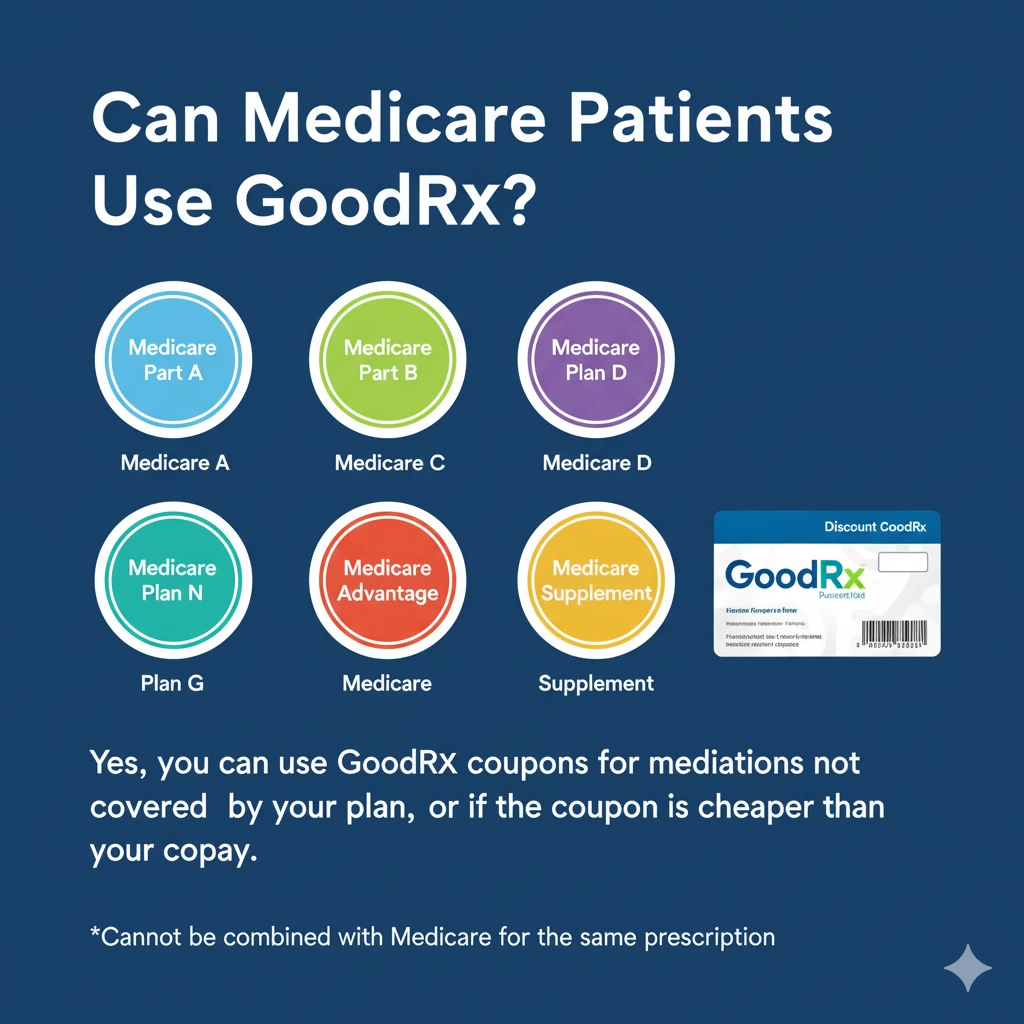
Can Medicare Patients Use GoodRx?
A complete, plain-English guide for 2025—what’s allowed, what isn’t, and how to decide on a fill-by-fill basis
The short answer
Yes—Medicare beneficiaries can use GoodRx (and other prescription-discount cards)—but not together with Medicare on the same fill. You must choose one or the other at the register for each prescription: either run the claim through your Medicare drug coverage (Part D or an MA-PD plan) or pay the cash price using a GoodRx coupon/membership. When you choose the coupon/cash route, that purchase won’t count toward your Part D deductible or your new 2025 $2,000 out-of-pocket cap.
That one paragraph captures the core rule. The rest of this guide shows you when using GoodRx can be smart, when it can backfire, and exactly how to make the call each time you fill a prescription.
Key 2025 background (why this year is different)
- Part D out-of-pocket costs are capped at $2,000 in 2025 (the “donut hole” structure was retired at the end of 2024). Once you spend $2,000 out of pocket on covered Part D drugs, your plan pays 100% for the rest of the year. Choosing a GoodRx cash price for covered meds generally doesn’t move you toward that $2,000 cap.
- Monthly payment option (“Medicare Prescription Payment Plan”) lets you spread what you owe for covered Part D drugs across the calendar year. It helps with cash flow—but it doesn’t lower your total cost. If a GoodRx cash price is lower than your Part D cost share, the plan’s payment program doesn’t beat a lower cash price; you’re just paying the plan amount over time.
- You can’t stack discounts. CMS and GoodRx both state you can use a discount instead of Medicare coverage—but not together. Pharmacies are expected to bill Part D first when you present your insurance for a covered drug; if you prefer a discount price, you must ask the pharmacy to not run your insurance and to process as a cash transaction with the coupon.
The big question (and all the smaller ones people ask)
1) Can I use GoodRx if I have Medicare?
Yes, but not with Medicare on the same fill. Think of GoodRx as a way to buy a prescription outside your insurance when that’s cheaper or when the drug isn’t covered.
2) Can I use GoodRx and Medicare together to lower my copay?
No. Drug discount cards/coupons do not coordinate with Part D. It’s either the plan or the coupon—never both.
3) If I pay with GoodRx, does it count toward my Part D deductible or the $2,000 cap?
No. Cash purchases with discount cards generally do not count toward your Part D deductible or your out-of-pocket tracking (TrOOP). Those dollars won’t get you closer to the new $2,000 cap.
4) Can I submit a receipt later and make it count?
In practice, no for most discount-card cash transactions. Part D plans track TrOOP from covered claims processed through the plan or allowed exceptions; coupon cash purchases aren’t designed to be retro-credited. (Plans have limited out-of-network paper-claim processes, but they are for covered fills where the plan is billed—not for third-party coupon prices.)
5) Is GoodRx considered insurance?
No. It’s a negotiated cash price program (and optional membership) accepted at many pharmacies. Using it means you’re paying cash, outside your insurance.
6) Can I use GoodRx for drugs my Part D plan doesn’t cover?
Yes. That’s one of the most common, legitimate uses—especially for excluded drugs or non-formulary prescriptions.
7) What about insulin and ACIP-recommended vaccines that Part D covers at $35/$0?
If you use a coupon instead of Part D, you give up those statutory protections for that fill. For capped-cost insulin and $0 vaccines, running the claim through Part D is usually smarter. (The $35 insulin cap and $0 vaccines apply when the drug is billed under Part D coverage.)
8) Does GoodRx work with Medicare Advantage (MA-PD) the same way as stand-alone Part D?
Functionally, yes. If your MA plan includes Part D, the same “either/or” rule applies. Use the plan or use a coupon as cash; you can’t combine them.
9) How do anti-kickback rules play into this?
Federal guidance warns about manufacturer copay coupons on drugs paid by federal programs, but independent discount card programs that operate as cash-price tools (i.e., not subsidizing a Part D copay) are treated differently. The bottom line for you as a beneficiary: don’t try to apply a coupon to a Part D claim; if you use a coupon, you’re paying cash outside Medicare.
10) Does GoodRx always save me money?
No. GoodRx prices vary by pharmacy and by day; sometimes your Part D copay is lower—especially after you’ve met the deductible or once the plan’s negotiated rate beats the coupon. Price-shop every time for chronic meds.
11) Are there privacy or acceptance concerns?
News coverage has flagged privacy issues from past enforcement actions and noted that some pharmacies (often independents) may not accept certain discount cards due to reimbursement rates. It’s worth confirming acceptance and reading privacy policies.
The “Yes” path: Pros & cons when Medicare patients do use GoodRx
Pros
- You can beat your plan copay on some generics. For many low-cost generics, a GoodRx coupon or membership price can undercut your plan’s tiered copay—especially early in the year before you’ve met a deductible.
- You can buy excluded or non-formulary drugs. If your plan won’t cover a medication (or requires extensive prior authorization), a coupon may be the fastest way to fill it while you appeal or talk to your prescriber about alternatives.
- No network restrictions. Discounts are tied to participating pharmacies—not your plan’s network—so sometimes a non-network store offers a better cash price.
- Immediate, no paperwork. Present the coupon; pay the cash price. No prior auth, no step therapy hoops for that particular fill.
- Flexible strategy. You can decide fill-by-fill. Use Part D when it’s cheaper or when you need protections (like insulin caps), and use a coupon when it clearly saves more.
Cons
- Doesn’t count toward the 2025 $2,000 cap. If you expect to hit $2,000 on covered drugs, paying cash with coupons slows you down and could cost more overall.
- You forgo Part D protections on that fill. No $35 insulin cap, no $0 recommended vaccines, no plan exceptions/appeals leverage on that cash purchase.
- Price volatility. GoodRx prices can change; the “best” pharmacy today may not be best next month.
- Limited acceptance. Some pharmacies—especially independents—may decline certain discount card transactions.
- Privacy trade-offs. Past regulatory actions criticized data sharing practices; review the current policy and consider whether you’re comfortable.
The “No” path: Pros & cons when Medicare patients do not use GoodRx (i.e., always run Part D)
Pros
- Every covered dollar counts toward $2,000. In 2025, getting to the cap faster can make the rest of your year $0 for covered meds—huge for people on multiple chronic drugs.
- Statutory protections apply. $35 insulin cap and $0 ACIP-recommended vaccines only apply when the plan pays.
- Price predictability & safety checks. Plans use formularies, DUR edits, and preferred pharmacies; you get more consistent pricing and drug-interaction oversight.
- Access to exceptions & appeals. When a drug is denied, you can pursue your prescriber’s exception/appeal—something you don’t get with a cash coupon purchase.
- Monthly smoothing option. The 2025 payment plan helps cash-flow without foregoing credit toward the cap (again, only for covered Part D drugs).
Cons
- Sometimes the plan price is higher than a coupon. Especially for generics in non-preferred pharmacies or before meeting a deductible.
- Formulary/PA hassles. You might wait for prior authorization or step therapy before the plan will pay.
- Network constraints. A convenient non-network pharmacy might be pricier under the plan than as a cash coupon purchase.
When using GoodRx is usually smart (rules of thumb)
- Drug not covered by your plan (or categorically excluded). Example: a weight-loss medication not on your formulary—use a coupon while discussing alternatives with your prescriber.
- One-off, short-term meds where you’re unlikely to hit the $2,000 cap anyway (e.g., a 7-day antibiotic that’s cheaper with a coupon than your plan copay).
- Early-year generics when you have a deductible and the coupon price is obviously lower than paying toward that deductible—but only if you truly don’t expect to reach the cap this year.
When sticking with Part D is usually smart
- Insulin and ACIP-recommended vaccines (keep the protections).
- High total drug spend where you’ll realistically hit $2,000—every covered dollar speeds you to $0 meds for the rest of the year.
- Brand-name medications with manufacturer discounts inside Part D’s benefit phases—coordination exists only within the plan, not with third-party coupons.
How to decide at the counter (step-by-step)
- Check your plan’s price first. Use your plan’s member portal or ask your pharmacy to run the claim.
- Check a GoodRx price. Look up the exact drug name, strength, and quantity for your chosen pharmacy.
- Compare total annual math, not just today’s price. Will you likely reach $2,000 in 2025 on covered drugs? If yes, favor running through Part D to hit the cap sooner. If no, pick the cheaper option today.
- If choosing GoodRx: Tell the pharmacist “Please do not run this through my insurance; I want the cash price with this coupon.”
- Document your fills. Keep receipts and a simple log. Even though coupon fills don’t count toward the Part D cap, your record helps your doctor reconcile med lists and spot interactions.
Real-world scenarios (with the 2025 cap in mind)
Scenario A: Multiple chronic meds, likely to hit $2,000
Run everything through Part D. The $4 savings on a generic isn’t worth delaying your path to $2,000; after you hit it, every covered refill is $0 for the rest of the year.
Scenario B: One inexpensive generic, otherwise healthy
Use the GoodRx price. You’re unlikely to hit $2,000 this year; the coupon saves real money now.
Scenario C: Insulin user
Stick with Part D to keep the statutory $35 cap and ensure all spending counts toward the $2,000 limit.
Scenario D: Non-formulary or PA-delayed drug you need now
Use GoodRx for a short supply while your prescriber requests a coverage exception or switches to a covered alternative.
What about GoodRx Gold (membership)?
Membership pricing still counts as a cash transaction; it doesn’t combine with Medicare and won’t count toward deductibles or the $2,000 cap. Treat it the same way you’d treat a standard GoodRx coupon in your decision tree.
Pharmacy etiquette (to avoid denial and delays)
- Present only one option. If you want the coupon price, don’t hand over your Medicare card for that fill.
- Be clear and courteous. Say “I’d like to use this GoodRx price as a cash transaction.” Pharmacies are expected to bill Part D if you present insurance for a covered drug; clarity saves time.
- Ask about store discount lists. Some chains have $4–$10 lists that can beat both the plan and coupons for common generics. (These are also cash prices and don’t count toward Part D.)
Advanced: Why coupons can’t be applied to Part D claims
Medicare prohibits stacking coupons onto federally paid prescriptions because of anti-kickback and coordination-of-benefits rules. Manufacturer copay coupons on federally reimbursed drugs raise anti-kickback concerns; third-party discount cards function as separate cash prices outside the Part D transaction. The practical effect is the rule you feel at the counter: either run Part D or pay cash with a coupon—not both.
The 2025 Medicare math that matters
- $2,000 cap makes it more valuable than ever to let covered-drug spending flow through the plan when you’re on multiple or pricey meds. After $2,000, you pay $0 for the rest of the year on covered drugs.
- Monthly smoothing (no interest) is available for covered drugs if your issue is cash flow rather than price. It doesn’t lower total cost—but it may remove the temptation to use a coupon that undercuts your progress to the cap.
- Manufacturer Discount Program (MDP) rules now affect how brands are priced inside Part D phases, another reason to check your plan’s price first in 2025.
A pocket checklist to use every time you fill
- Covered under Part D?
- Yes → Compare plan price vs coupon, but remember the $2,000 cap; favor Part D if you’ll hit it.
- No → Coupon may be best for a bridge fill or when no covered alternative exists.
- Special protections apply? (Insulin $35, vaccines $0)
- If yes, use Part D.
- Annual outlook: Will your covered drug spend likely reach $2,000?
- If yes, use Part D to get to $0 sooner. If no, choose the cheaper price for today’s fill.
- Cash-flow problem only?
- Consider the Part D monthly payment plan instead of a coupon, so the spend still counts toward $2,000.
Frequently asked edge cases
Q: The pharmacist says they “must” use my Part D. Is that true?
If you hand over your plan card for a covered drug, pharmacies are expected to bill Part D first. If you want a discount price, ask them to not use insurance and to process it as cash with your coupon. Some pharmacies may have store-level policies about which discount networks they accept.
Q: Can my doctor decide for me?
Your prescriber can help you choose a clinically equivalent, covered alternative (often the best move). But at the register, it’s your financial choice: plan vs. coupon.
Q: What about safety and interactions if I pay cash?
Always keep all your meds at one pharmacy when possible. Even for cash purchases, ask the pharmacist to add the fill to your medication profile for interaction screening.
Q: Is GoodRx the only option?
No. Pharmacies’ own discount lists, nonprofit assistance, manufacturer patient-assistance programs, and transparent-pricing pharmacies (e.g., online cash pharmacies) may compete with or beat GoodRx—just remember cash options don’t count toward Part D limits.
Putting it all together (decision framework for 2025)
- Start with your plan—know the covered price.
- Compare a reputable discount price—same drug, same quantity, same pharmacy.
- Forecast your year. If you’re on multiple meds or any pricey therapy, chances are good you’ll cross $2,000 → stay inside Part D. If you’re on one or two inexpensive generics and rarely see the pharmacy, coupons may make sense for those specific fills.
- Re-check every refill. Formularies and cash prices move; your best option this quarter may change next quarter.
Bottom line
- You can use GoodRx if you have Medicare—as an alternative, not together with Part D on the same fill.
- Coupon/cash fills don’t count toward your deductible or 2025 cap. For high-spenders, that can prove costly over the year.
- For excluded meds or one-off generics, a GoodRx price may be the easy win. For chronic or expensive therapies—especially insulin and vaccines—Part D is usually best in 2025.
Need help optimizing your Medicare and drug costs in Florida?
You have two solid ways to enroll and manage coverage:
- Buy Medicare drug coverage directly. You can enroll in Medicare Part D (stand-alone) or a Medicare Advantage plan with drug coverage during the appropriate enrollment periods. As you shop, compare: premium, deductible, pharmacy network, and—critically—your drugs’ copays under 2025’s $2,000 cap design. Medicare’s official site also details programs like Extra Help if you have limited income and resources.
- Work with a licensed Florida Medicare specialist. If you prefer hands-on guidance, a local, licensed agent can model your specific medication list against Florida plans’ 2025 formularies and pharmacies, estimate your odds of reaching the $2,000 cap, and map out when GoodRx-style cash pricing makes sense (and when it doesn’t).
Recommended local help:
Steve Turner, Steve Turner Insurance Specialist (Florida-licensed). Steve can compare Florida’s stand-alone Part D and Medicare Advantage options, explain how the 2025 $2,000 cap changes your out-of-pocket math, and help you set a simple fill-by-fill strategy that balances GoodRx opportunities with Part D protections.
What Steve (or any licensed Florida agent) will do for you:
- Review your full medication list and preferred pharmacies.
- Run plan comparisons that show your monthly costs under Part D vs. known cash prices.
- Flag drugs where Part D yields statutory protections (e.g., insulin, vaccines) you shouldn’t give up.
- Set up alerts for formulary changes and preferred pharmacy shifts that can change your best choice mid-year.
- Make enrollment changes at the right time, and show you how to use the 2025 monthly payment program if cash-flow is tight.
Finding Your Trusted Advisor in the Florida Medicare Market
We have taken a very detailed look at Medicare for 2026. We’ve seen how its clever design offers a modern solution for today’s retirees. We’ve also seen that while the plan’s benefits are stable and reliable, its monthly cost can vary significantly from one insurance company to another. Choosing the right company at the right price is the key to maximizing the value of Medicare in 2026.
This is where the guidance of an independent, licensed insurance agent becomes invaluable. A Medicare specialist acts as your personal shopper and advocate. They can instantly compare the rates for the same Medicare plan options from all the different carriers in your state. They can also provide insight into a company’s history of rate increases, which is a crucial factor in your long-term satisfaction.
It is essential to understand that this expert guidance is provided to you at absolutely no extra cost. The insurance industry is regulated so that the price of a plan is the same whether you buy it through an agent or directly from the company. When you enroll with an agent’s help, the insurance company pays them a commission. This system allows you to get free, unbiased, and professional advice to help you make the best possible choice.
To ensure you get the best value, it is usually best to use a licensed insurance agent, such as Steve Turner at SteveTurnerInsuranceSpecialist.com. Steve Turner is a licensed Agent/Broker contracted with most Medicare Insurance Carriers. An expert like Steve can help you navigate the 2026 Medicare market, find the most competitively priced Medicare plans for you, and ensure you have a Medicare plan that provides both financial security and true peace of mind.
OUR CLIENT REVIEWS
CONTACT STEVE TURNER INSURANCE AGENT & BROKER
I’m here to take your calls and emails and answer your questions 7 Days a week from 7:00 a.m. to 8:00 p.m., excluding posted holidays.
Steve Turner is a licensed agent, broker, and a longstanding member of the National Association of Benefits and Insurance Professionals®. Steve holds the prestigious designation of Registered Employee Benefits Consultant®. NABIP® is the preeminent organization for health insurance and employee benefits professionals and works diligently to ensure all Americans have access to high-quality, affordable Healthcare, and related services.
Steve Turner is a licensed agent appointed by Florida Blue.
EMAIL ME: 24×7
OFFICE LOCATION
Website: steveturnerinsurancespecialist.com
Email: [email protected]
Phone and Text: +1-813-388-8373
Business Hours:
Monday: 7 am to 8 pm
Tuesday: 7 am to 8 pm
Wednesday: 7 am to 8 pm
Thursday: 7 am to 8 pm
Friday: 7 am to 8 pm
Saturday: 7 am to 8 pm
Sunday: 7 am to 8 pm
SOCIAL FOLLOW + SHARE
MEDICare INSURANCE POSTS
INSURANCE OFFERINGS
Can Medicare Patients Use GoodRX?
HEALTH INSURANCE

MEDICARE ADVANTAGE

MEDICARE SUPPLEMENT

PRESCRIPTION DRUGS

LIFE INSURANCE

DISABILITY INSURANCE

DENTAL INSURANCE

GROUP HEALTH INSURANCE

ACCIDENT INSURANCE

LONG TERM CARE INSURANCE

MEDICAID INSURANCE

MEDICARE INSURANCE

MEDICARE PART A INSURANCE

MEDICARE PART B INSURANCE

MEDICARE PART C INSURANCE

MEDICARE PART D INSURANCE

MEDICARE PLAN G INSURANCE

MEDICARE PLAN N INSURANCE

SERVICE AREA
MEDICARE STATEMENT
The Medicare Annual Enrollment Period is October 15th to December 7th. Steve Turner is not connected with or endorsed by the United States Government or the Federal Medicare Program. Some plans may not be available in your area, and any information I provide is limited to those offered. Please contact Medicare.gov or 1-800-MEDICARE to get information on all of your options.
There’s no one-size-fits-all answer. Carefully evaluate your health status, anticipated medical needs, prescription drug usage, budget, preferred doctors and hospitals, and tolerance for network rules. During the Medicare Annual Enrollment Period (October 15th to December 7th), thoroughly research the specific plans available in your Florida county using the Medicare Plan Finder on Medicare.gov, compare their costs and benefits, and consider seeking free, personalized counseling from Florida’s SHINE (Serving Health Insurance Needs of Elders) program.