

2026 Medicare Part D Changes
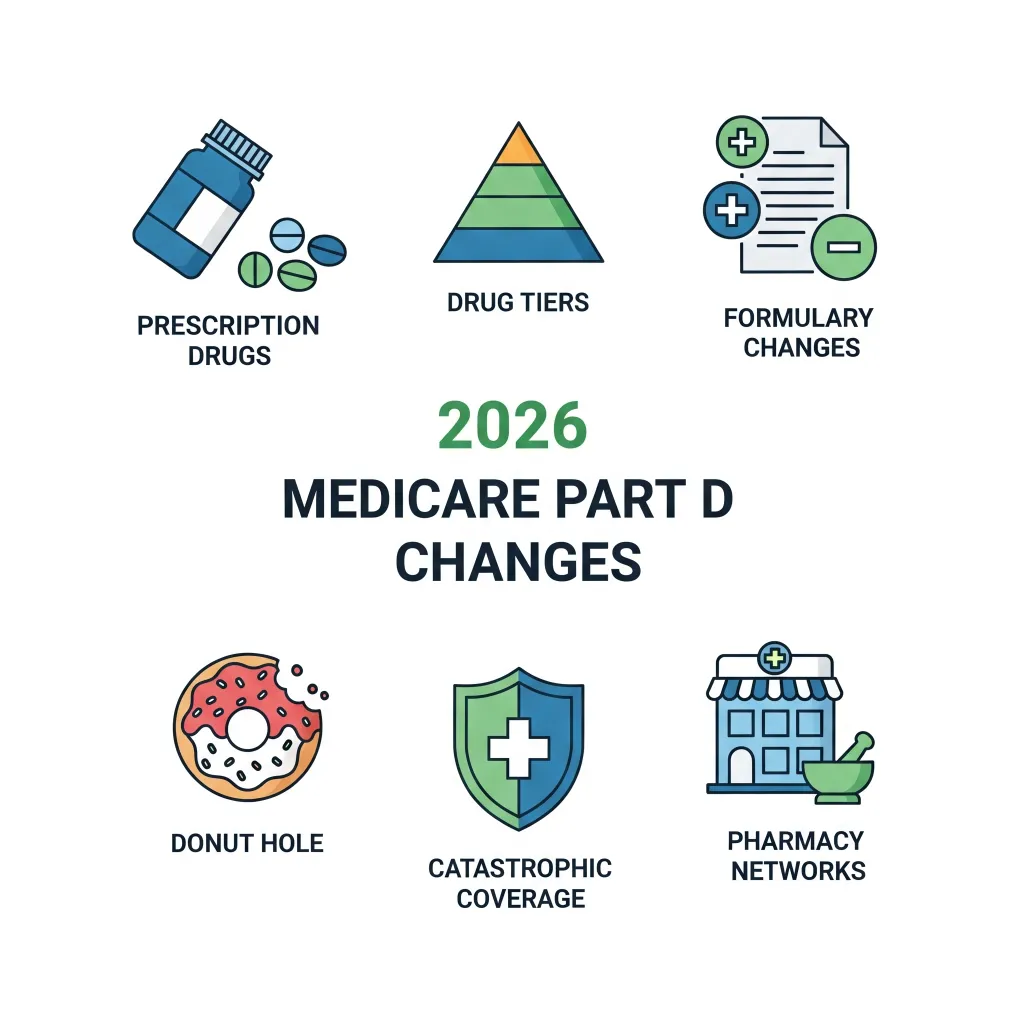
2026 Medicare Part D Changes
2026 Medicare Part D Changes
Welcome to your complete guide to Medicare Part D for 2026. If you’re getting ready to join Medicare or are already a member, understanding your prescription drug coverage is one of the most important things you can do for your health and your budget. The world of Part D is filled with unique terms like “formularies,” “tiers,” and the famous “donut hole.” It can feel like a confusing maze. [2026 Medicare Part D Changes]
But here’s the good news: big, positive changes have been happening, and 2026 is set to continue that trend, making prescription drugs more affordable and predictable than ever before. This article is designed to be your friendly, easy-to-read map for navigating that maze. We will break down everything about Part D into simple concepts. We’ll cover what it is, who needs it, how to sign up, and the critical deadlines you can’t afford to miss. Most importantly, we will take a deep dive into the specific changes you can expect in 2026, highlighting how they build upon the revolutionary updates from 2025. Our goal is to empower you with knowledge so you can confidently choose the perfect drug plan for your needs. [2026 Medicare Part D Changes]
Let’s start at the beginning. What exactly is Medicare Part D? At its heart, Medicare Part D is the part of Medicare that helps you pay for your prescription medications. Think of it as a special membership card for the pharmacy. It’s an optional insurance program offered by private companies that Medicare approves. You choose a specific plan, pay a monthly premium, and in return, the plan helps cover the cost of your medications. [2026 Medicare Part D Changes]
Who qualifies for a Part D plan? The rules are simple: to join a Medicare Part D plan, you must be enrolled in either Medicare Part A or Medicare Part B. You must also live in the service area of the Part D plan you want to join. [2026 Medicare Part D Changes]
While Part D is technically optional, for most people, it is an absolute necessity. Enrolling at the right time is crucial. Your first and best chance to sign up is during your Initial Enrollment Period (IEP). This is your personal 7-month window that starts 3 months before your 65th birthday month, includes your birthday month, and ends 3 months after. [2026 Medicare Part D Changes]
Why is this deadline so important? Because if you miss it and decide to sign up for a drug plan later, you will likely face a lifelong Late Enrollment Penalty (LEP). This isn’t a one-time fee; it’s a permanent surcharge that gets added to your monthly Part D premium for as long as you have coverage. The penalty is calculated as 1% of the “national base beneficiary premium” for every full month you were eligible but didn’t enroll. This can add up quickly and cost you a significant amount of money over your lifetime. For this reason, even if you don’t currently take any prescriptions, it is strongly recommended that you enroll in a low-cost Part D plan during your IEP to lock in your spot and avoid any future penalties. [2026 Medicare Part D Changes]
How Part D Works: The Four Stages of Coverage
Before we dive into the specific changes for 2026, it’s essential to understand the basic structure of a Part D plan. Your journey through a Part D plan each year is typically broken down into four stages. Your progress through these stages is based on how much you and your plan spend on your medications. [2026 Medicare Part D Changes]
Let’s walk through this journey with a fictional example. Meet Mary, who is new to Medicare in 2026. She takes a few generic drugs and one more expensive brand-name medication for her cholesterol. [2026 Medicare Part D Changes]
Stage 1: The Annual Deductible
The deductible is the amount of money you must pay out-of-pocket for your medications before your plan starts to share the costs. [2026 Medicare Part D Changes]
- How it works: At the beginning of the year, Mary will pay 100% of the cost of her drugs at the pharmacy until the total amount she has spent equals her plan’s deductible.
- 2026 Projected Cost: Each year, Medicare sets a maximum allowable deductible for Part D plans. In 2025, this maximum was $590. Due to inflation, for 2026, the maximum deductible is projected to increase to approximately $615.
- Important Note: Not all plans have a deductible. Many plans, especially those with slightly higher monthly premiums, will have a $0 deductible, meaning the plan starts sharing costs on day one. Other plans may have a deductible that only applies to brand-name drugs (Tiers 3-5) but not to generic drugs (Tiers 1-2).
Stage 2: The Initial Coverage Phase
Once Mary has met her deductible, she enters the Initial Coverage Phase. This is where she and her plan will share the cost of her medications. [2026 Medicare Part D Changes]
- How it works: In this stage, Mary will pay a copayment (a fixed dollar amount, like $5 for a generic drug) or coinsurance (a percentage of the drug’s cost, like 25% for a brand-name drug) for each prescription she fills. The insurance company pays the rest. [2026 Medicare Part D Changes]
- The Tier System: Every Part D plan organizes its covered drugs into different levels, or “tiers.” The tier your drug is on determines how much you will pay for it. A typical tier structure looks like this: [2026 Medicare Part D Changes]
- Tier 1: Preferred Generic: The lowest-cost generic drugs. (e.g., $1-$5 copay)
- Tier 2: Generic: Other generic drugs. (e.g., $10-$20 copay)
- Tier 3: Preferred Brand: Common brand-name drugs. (e.g., $40-$50 copay)
- Tier 4: Non-Preferred Brand: More expensive brand-name drugs. (e.g., 25%-40% coinsurance)
- Tier 5: Specialty Tier: The highest-cost drugs for complex conditions. (e.g., 25%-33% coinsurance)
Mary will stay in this phase, paying her copayments, as long as the total retail cost of her drugs (the amount she has paid plus the amount her plan has paid) stays below a certain limit. [2026 Medicare Part D Changes]
Stage 3: The Coverage Gap (The “Donut Hole”)
The Coverage Gap, famously known as the “donut hole,” used to be a period where beneficiaries were suddenly responsible for a much higher portion of their drug costs. However, thanks to the Inflation Reduction Act (IRA), the financial pain of the donut hole has been eliminated. [2026 Medicare Part D Changes]
- How it works now: In 2026, you will continue to pay your normal copayments and coinsurance even after you enter the Coverage Gap. You will no longer see a sudden jump in your costs. Think of this stage now as simply a tracker. When the total retail cost of your drugs reaches a certain threshold, you have officially “entered” the gap, which means you are on your way to the final, most protective stage of coverage. [2026 Medicare Part D Changes]
Stage 4: Catastrophic Coverage & The $2,000 Cap
This is where the most revolutionary changes have taken place, providing incredible financial protection for seniors. [2026 Medicare Part D Changes]
- The Old Way (Before 2024): In the past, even in the Catastrophic Coverage stage, beneficiaries still had to pay 5% of the cost of their drugs, which could be a lot for very expensive medications.
- The New Way (2025 and 2026): Starting in 2025, a $2,000 out-of-pocket cap was put in place. This means that once the total amount of money you have personally spent on deductibles, copayments, and coinsurance reaches $2,000 for the year, you are done paying for your medications. For the rest of the calendar year, your copay for all of your covered drugs will be $0. [2026 Medicare Part D Changes]
This annual cap is a true safety net. For Mary, if the total she has paid for her medications reaches $2,000 in September, any prescription she fills in October, November, or December will cost her nothing at the pharmacy counter. This protection continues unchanged as a core feature of all Part D plans in 2026. [2026 Medicare Part D Changes]
The Headline News: Your Part D Changes for 2026
While the $2,000 cap was the blockbuster change for 2025, the evolution of Part D continues into 2026 with another major, first-of-its-kind feature designed to make your costs even more manageable. [2026 Medicare Part D Changes]
Medicare Part D in 2026: Understanding Your New Out-of-Pocket Protections
For millions of Americans relying on Medicare Part D for their prescription drug coverage, significant changes implemented by the Inflation Reduction Act (IRA) have dramatically reshaped how they pay for medications. While some key provisions began in 2025, the year 2026 brings further evolution, particularly around two major reforms: the annual out-of-pocket spending cap and the Medicare Prescription Payment Plan. These changes are designed to provide unprecedented financial predictability and relief for beneficiaries, especially those with high drug costs.
The Game-Changer: An Annual Out-of-Pocket Spending Cap
Before 2025, there was no limit to how much a Medicare Part D beneficiary might pay out-of-pocket for their prescription drugs in a year. While catastrophic coverage existed, it still required a percentage of costs, leaving many vulnerable to exorbitant bills for expensive medications. The IRA changed this fundamentally.
What it is: The annual out-of-pocket spending cap is the maximum amount you will pay for covered Part D prescription drugs within a calendar year. Once your total out-of-pocket spending (including your deductible, copayments, and coinsurance) reaches this cap, your costs for all covered Part D drugs drop to $0 for the rest of that year.
Timeline and Amounts:
- In 2025: The out-of-pocket cap was initially set at $2,000. [2026 Medicare Part D Changes]
- For 2026: The cap has been officially adjusted for inflation and will increase to $2,100.
This cap offers immense peace of mind, transforming an open-ended financial risk into a defined, manageable annual maximum.
Smoothing the Costs: The Medicare Prescription Payment Plan
While the out-of-pocket cap addresses the total annual spending, it doesn’t entirely solve the problem of “too much, too soon.” Someone on a high-cost specialty drug could still hit the cap very early in the year, facing a bill of $2,000 (or $2,100 in 2026) all at once. This upfront cost can be a devastating financial shock for individuals on a fixed income.
To tackle this, the IRA introduced the Medicare Prescription Payment Plan, a voluntary program designed to smooth out these lump-sum payments.
What it is: Think of it like an installment plan for your prescription drugs, or a budget billing program for your utility bills. It allows beneficiaries to spread their out-of-pocket drug costs (up to the annual cap) over the course of the year through predictable monthly payments.
How it Works (Beginning in 2025 and Continuing in 2026):
- Voluntary Opt-In: All Medicare Part D plans are required to offer this payment option. You must choose to participate by notifying your plan, either at the beginning of the year or at any point when you anticipate or incur high drug costs.
- Costs are “Smoothed”: Once enrolled, your plan will calculate your monthly payment based on your total accumulated out-of-pocket costs and the number of months remaining in the year. It’s important to note that this isn’t necessarily a fixed payment for the entire year; your monthly installment might fluctuate if you incur new, high drug costs later in the year, as the remaining balance will be re-divided over fewer months.
- No Surprise Pharmacy Bills: Instead of paying a large sum at the pharmacy counter, your bill for covered drugs will be $0. You will then receive a separate, calculated bill directly from your insurance plan for your monthly payment.
Looking Ahead to 2026 and Beyond
The combination of the annual out-of-pocket cap and the Medicare Prescription Payment Plan represents a monumental shift in beneficiary protections under Part D. For 2026, the cap slightly increases to $2,100, but the core benefits of financial predictability and manageable payments remain strong.
These reforms mean that beneficiaries can budget more effectively for their medication costs, knowing their maximum annual spending and having the option to avoid overwhelming upfront payments. It’s a significant step toward making prescription drugs more affordable and accessible for all Medicare enrollees.
Let’s walk through an example:
Let’s meet Bob. In February 2026, his doctor prescribes a new specialty drug. When he goes to the pharmacy, he is told the copay is $1,950. [2026 Medicare Part D Changes]
- Bob Opts-In to the Payment Plan: He contacts his Part D plan and tells them he wants to enroll in the Medicare Prescription Payment Plan. [2026 Medicare Part D Changes]
- The Plan Calculates His Payments: The plan knows his total spending for the year will be capped at $2,100. It divides this amount by the 11 months remaining in the year (February through December). $2,100 / 11 = approximately $190 per month. [2026 Medicare Part D Changes]
- Bob’s New Cost: Bob can now pick up his $1,950 medication from the pharmacy for $0. His insurance plan will then bill him $190 for his February payment. He will continue to be billed $190 each month for the rest of the year. Any other medications he takes will also be covered, and his total payments will not exceed $2,100 for the year. [2026 Medicare Part D Changes]
This new “cost smoothing” feature is a landmark change that will provide enormous relief and financial predictability to millions of Medicare beneficiaries starting in 2026. [2026 Medicare Part D Changes]
Continued Drug Price Negotiation
Another major change from the Inflation Reduction Act is that, for the first time, Medicare has the authority to negotiate prices directly with drug manufacturers for certain high-cost medications. [2026 Medicare Part D Changes]
- The First 10 Drugs: The first 10 drugs selected for negotiation went through the process in 2024 and 2025, and their new, lower negotiated prices will take effect in 2026. This means that if you take one of these medications (which include common drugs for blood clots, diabetes, and heart failure), you and your plan will pay less for it, which could lead to lower premiums and costs overall.
- The Next 15 Drugs: During 2026, Medicare will be in the process of negotiating prices for an additional 15 high-cost drugs. These new prices will then take effect in 2027. This is an ongoing process that will continue to bring down the cost of the most expensive drugs in the coming years.
Projected 2026 Part D Costs
While the new benefits provide more protection, the underlying costs of the Part D program are still subject to inflation. [2026 Medicare Part D Changes]
- Monthly Premiums: The “national base beneficiary premium” for 2025 was $34.70. For 2026, this is expected to see a slight increase. However, your actual premium will depend on the specific plan you choose, with many plans available for under $20 per month. [2026 Medicare Part D Changes]
- IRMAA Surcharge: Just like with Part B, high-income earners will pay an extra amount on top of their regular Part D premium. These income brackets are adjusted annually, so they will be slightly higher in 2026. [2026 Medicare Part D Changes]
Choosing Your 2026 Plan: A Practical Guide
The introduction of the new payment plan and the $2,000 cap makes Part D more protective than ever, but it does not change the most important part of choosing a plan: you must pick the plan that best covers your specific medications. Here is how to do it. [2026 Medicare Part D Changes]
Two Ways to Get Part D
- A Stand-Alone Prescription Drug Plan (PDP): You buy this plan to work alongside your Original Medicare (Part A and B). This is the choice for people who also have a Medigap plan.
- A Medicare Advantage Plan with Drug Coverage (MAPD): Most Medicare Advantage (Part C) plans include Part D coverage as part of their bundled package.
The Formulary is King
The single most important part of any Part D plan is its formulary, which is simply the list of drugs that the plan covers. [2026 Medicare Part D Changes]
- Why it Matters: A plan can have a $5 monthly premium, but if it doesn’t cover your essential brand-name medication, it’s the wrong plan for you. You could end up paying 100% of the cost of that drug out-of-pocket.
- How to Check: Before enrolling, you must look up every single one of your medications on the plan’s formulary to ensure it is covered. You also need to check which “tier” it is on, as this will determine your copay.
Pharmacy Networks Matter Too
Every Part D plan has a network of pharmacies. Many plans also have “preferred” pharmacies within that network. [2026 Medicare Part D Changes]
- Why it Matters: You will always pay the lowest copayments when you fill your prescriptions at a preferred pharmacy. Your copay for the exact same drug could be $5 at a preferred pharmacy and $15 at a standard, in-network pharmacy. Over a year, using preferred pharmacies can save you hundreds of dollars. [2026 Medicare Part D Changes]
The Best Tool: The Medicare Plan Finder
The official Medicare website (Medicare.gov) has a fantastic Plan Finder tool. You can enter your zip code, your list of medications (including dosages), and your preferred pharmacy. The tool will then show you all the plans available in your area and estimate your total annual costs—including premiums, deductibles, and copayments—for each one. This allows you to do a true “apples-to-apples” comparison to find the most cost-effective plan for your unique needs. [2026 Medicare Part D Changes]
Making the Right Part D Choice for Your Life
The best plan is always a personal choice. Let’s look at a few examples. [2026 Medicare Part D Changes]
- Meet “Generic Gina”: Gina takes two common generic medications for blood pressure and thyroid. For her, the best plan in 2026 will likely be one with the lowest monthly premium, even if it has the full $570 deductible, because her drug costs are so low that she will never meet it anyway. [2026 Medicare Part D Changes]
- Meet “Brand-Name Bill”: Bill takes two expensive, brand-name drugs for diabetes and a heart condition. For him, the monthly premium is less important than the plan’s formulary and tiering. He needs to find a plan that covers both of his drugs on the lowest possible tier (e.g., Tier 3 instead of Tier 4). The new $2,000 cap and the 2026 payment plan will be a huge benefit for him, making his costs predictable and manageable. [2026 Medicare Part D Changes]
- Meet “Diabetic Dave”: Dave uses insulin. Thanks to the Inflation Reduction Act, all Part D plans must cap the monthly copay for covered insulins at $35. This powerful benefit continues in 2026. Dave should look for a plan that covers his specific type of insulin and may even have a $0 deductible, so he can get his $35 insulin on day one. [2026 Medicare Part D Changes]
Finding Your Personal Medicare Advisor
We have journeyed deep into the world of Medicare Part D. We’ve explored the new 2026 payment plan, the revolutionary $2,000 cap, the ongoing drug price negotiations, and the critical importance of checking formularies and networks. It’s a lot to take in, and trying to navigate the Medicare Plan Finder tool and compare dozens of plans on your own can be an intimidating and stressful experience.
A small mistake in choosing a plan can cost you hundreds or even thousands of dollars over the course of a year. You do not have to do this alone. The smartest and safest way to choose your Part D coverage is to work with an experienced, independent, licensed insurance agent who specializes in Medicare.
Think of an agent as your personal expert guide. They live and breathe this information every day. They can help you create your medication list, use the Plan Finder tool to analyze all your options, and explain the differences between the plans in simple, easy-to-understand terms.
It is also vital to understand that this expert help is provided to you at absolutely no extra cost. When you find the right plan and enroll with an agent’s assistance, the insurance company pays them a commission. The price you pay for your Part D plan is legally required to be the exact same whether you use an agent’s help or sign up by yourself. This system is designed to ensure that everyone has access to free, unbiased, and professional guidance.
The world of prescription drugs is complex, but the changes coming in 2026 are making it more affordable and secure than ever before. To ensure you take full advantage of these new benefits, it is usually best to use a licensed insurance agent, such as Steve Turner of SteveTurnerInsuranceSpecialist.com. Steve Turner is a licensed Agent/Broker contracted with most Medicare Insurance Carriers. An expert like Steve can help you understand all the 2026 Part D changes, find the plan that best covers your unique medication needs, and give you the peace of mind that comes with knowing you’ve made the perfect choice.
OUR CLIENT REVIEWS
CONTACT STEVE TURNER INSURANCE AGENT & BROKER
I’m here to take your calls and emails and answer your questions 7 Days a week from 7:00 a.m. to 8:00 p.m., excluding posted holidays.
Steve Turner is a licensed agent, broker, and a longstanding member of the National Association of Benefits and Insurance Professionals®. Steve holds the prestigious designation of Registered Employee Benefits Consultant®. NABIP® is the preeminent organization for health insurance and employee benefits professionals and works diligently to ensure all Americans have access to high-quality, affordable Healthcare, and related services.
Steve Turner is a licensed agent appointed by Florida Blue.
EMAIL ME: 24×7
OFFICE LOCATION
Website: steveturnerinsurancespecialist.com
Email: [email protected]
Phone and Text: +1-813-388-8373
Business Hours:
Monday: 7 am to 8 pm
Tuesday: 7 am to 8 pm
Wednesday: 7 am to 8 pm
Thursday: 7 am to 8 pm
Friday: 7 am to 8 pm
Saturday: 7 am to 8 pm
Sunday: 7 am to 8 pm
SOCIAL FOLLOW + SHARE
MEDICare INSURANCE POSTS
INSURANCE OFFERINGS
2026 Medicare Part D Changes
HEALTH INSURANCE

MEDICARE ADVANTAGE

MEDICARE SUPPLEMENT

PRESCRIPTION DRUGS

LIFE INSURANCE

DISABILITY INSURANCE

DENTAL INSURANCE

GROUP HEALTH INSURANCE

ACCIDENT INSURANCE

LONG TERM CARE INSURANCE

MEDICAID INSURANCE

MEDICARE INSURANCE

MEDICARE PART A INSURANCE

MEDICARE PART B INSURANCE

MEDICARE PART C INSURANCE

MEDICARE PART D INSURANCE

MEDICARE PLAN G INSURANCE

MEDICARE PLAN N INSURANCE

SERVICE AREA
MEDICARE STATEMENT
The Medicare Annual Enrollment Period is October 15th to December 7th. Steve Turner is not connected with or endorsed by the United States Government or the Federal Medicare Program. Some plans may not be available in your area, and any information I provide is limited to those offered. Please contact Medicare.gov or 1-800-MEDICARE to get information on all of your options.
There’s no one-size-fits-all answer. Carefully evaluate your health status, anticipated medical needs, prescription drug usage, budget, preferred doctors and hospitals, and tolerance for network rules. During the Medicare Annual Enrollment Period (October 15th to December 7th), thoroughly research the specific plans available in your Florida county using the Medicare Plan Finder on Medicare.gov, compare their costs and benefits, and consider seeking free, personalized counseling from Florida’s SHINE (Serving Health Insurance Needs of Elders) program.