

What to Ask When Getting Medicare Insurance

What to Ask When Getting Medicare Insurance. Preparing Questions for Medicare Coverage Selection
The best time to ask questions about Medicare is before I sign anything. Medicare insurance has many parts, and a plan that looks cheap today can cost me more later. So I made a list of what to ask when getting Medicare insurance.
This guide has 30 questions. I grouped them by topic, like timing, cost, doctors, and medicines. After each question, I explain in plain words why it matters.
One note before I start. This guide is for learning, not personal advice. Rules and prices change every year, so I always check the final details at Medicare.gov or with a free counselor.
What to Ask When Getting Medicare Insurance: The Short List
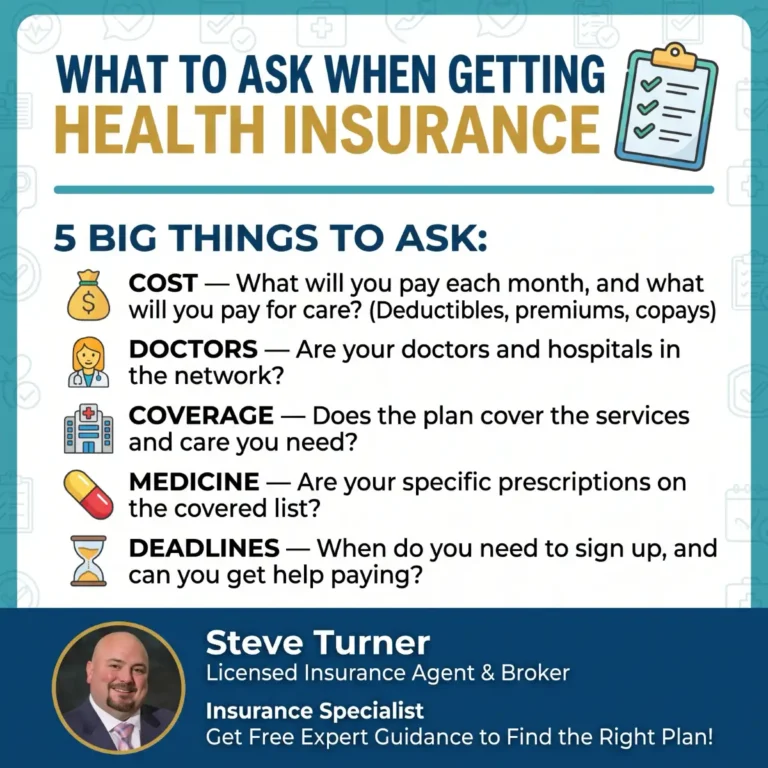
If I only had ten minutes, I would ask these seven questions first.
- Do I want Original Medicare or a Medicare Advantage plan?
- What will I pay each month, and what is the most I could pay in a year?
- Are my doctors and hospitals in-network?
- Are my medicines covered, and what will they cost?
- When do I have to sign up to avoid a late fee?
- Can I switch plans later if I change my mind?
- Who is giving me advice, and how do they get paid?
The rest of this guide goes deeper on each one.
Medicare Basics in Plain Words
Before I ask good questions, I need to know the parts of Medicare. Here they are in one table.
| Part | What it is | What it covers | Who runs it |
|---|---|---|---|
| Part A | Hospital insurance | Hospital stays, skilled nursing care, hospice | The government |
| Part B | Medical insurance | Doctor visits, tests, outpatient care, medical equipment | The government |
| Part C (Medicare Advantage) | An all-in-one plan | Everything in Parts A and B, often with drugs and extras | Private companies approved by Medicare |
| Part D | Drug coverage | Prescription medicines | Private companies approved by Medicare |
| Medigap (Medicare Supplement) | Extra insurance | Helps pay my share of costs in Parts A and B | Private companies |
There are two main paths.
- Path 1: Original Medicare. This is Part A plus Part B. I can add a Part D drug plan and a Medigap policy. I can see any doctor in the country who takes Medicare.
- Path 2: Medicare Advantage. This is one plan from a private company. It often has a low monthly price. It usually has a list of doctors I must use.
I can’t have Medigap and Medicare Advantage at the same time. So my first big question is simple. Which path fits my life?
Medicare Enrollment Questions: When Do I Sign Up?
Timing is the first thing I ask about, because a missed date can cost me money for life.
1. When does my first sign-up window open and close?
Most people get a 7-month window around their 65th birthday. It starts 3 months before my birthday month. It ends 3 months after my birthday month.
I would mark both dates on my calendar. I would sign up early so my coverage starts on time.
2. Will I pay a late fee if I wait?
I might. These late fees are not one-time fees. They are added to my bill every month.
- Part B: I pay an extra 10% for each full year I could have signed up but didn’t. Most people pay it for as long as they have Part B.
- Part D: I pay an extra 1% for each month I go without good drug coverage. A gap of 63 days or more can trigger it.
3. I still have insurance from a job. Do I need Medicare now?
Maybe not. If the plan comes from my job or my spouse’s job, I may be able to wait. I would ask the benefits office these three things:
- Does my plan change when I turn 65?
- Is my drug coverage as good as Medicare’s? The word for this is “creditable.”
- Does the company have fewer than 20 workers? If so, I may need Medicare right away.
When the job ends, I get 8 months to sign up for Part B with no late fee. COBRA does not stretch that window.
4. When can I change plans later?
I am not stuck forever. Here are the main times I can switch.
- October 15 to December 7: Medicare Open Enrollment. I can join, drop, or switch plans. My new plan starts January 1.
- January 1 to March 31: If I am already in a Medicare Advantage plan, I can switch plans or go back to Original Medicare.
- After a big life change: If I move or lose my coverage, I may get a Special Enrollment Period.
Medicare Cost Questions: What Will I Really Pay?
The monthly price is only one piece of what Medicare costs me. I ask about all five pieces below.
5. What is the monthly premium?
A premium is what I pay each month to keep my coverage. Most people pay the Part B premium no matter which path they pick. A Medicare Advantage, Part D, or Medigap plan may add its own premium on top.
I also ask, “How much did this price go up last year?” People with higher incomes pay more for Part B and Part D.
6. What is the deductible?
A deductible is what I pay first, before my plan starts to pay. Part A, Part B, and most drug plans each have one.
I ask for each number. Then I add them up.
7. What are the copays and coinsurance?
A copay is a set fee, like $20 for a visit. Coinsurance is a share of the bill. With Original Medicare, I usually pay 20% of most doctor bills after the Part B deductible.
I ask what I would pay for these four things:
- A visit to a specialist
- A trip to the emergency room
- A stay in the hospital
- An ambulance ride
8. What is the most I could pay in one year?
This may be the most important money question. Every Medicare Advantage plan has a yearly limit on what I pay for covered care. Many plans set a limit lower than the highest one Medicare allows.
Original Medicare has no yearly limit. That is the main reason people buy a Medigap policy.
9. Can I get help paying?
If money is tight, I ask about two programs. Medicare Savings Programs can help pay my premiums. Extra Help can lower my drug costs.
Medicare costs at a glance
| Cost | 2026 | 2027 |
|---|---|---|
| Part B monthly premium (standard) | $202.90 | Not final yet (about $209.50 projected) |
| Part B yearly deductible | $283 | Not final yet (about $292 projected) |
| Part A hospital deductible | $1,736 | Not final yet |
| Part D deductible (highest allowed) | $615 | $700 |
| Part D yearly cap on covered drug costs | $2,100 | $2,400 |
| Medicare Advantage yearly limit, in-network (highest allowed) | $9,250 | $9,850 |
Medicare usually shares the final Part A and Part B numbers in the fall.
Questions to Ask About Doctors and Hospitals
A plan is only good if I can use it with the doctors I trust. These five questions matter most for Medicare Advantage plans.
10. Are my doctors and hospitals in the network?
A network is the list of doctors and hospitals that work with a plan. I write down every doctor I see. Then I check each name.
I also call each doctor’s office. I ask, “Will you take this exact plan next year?”
11. Is this plan an HMO or a PPO?
These are the two most common kinds of Medicare Advantage plans.
- HMO: I must use doctors in the network, except in an emergency.
- PPO: I can go outside the network, but I pay more when I do.
12. Do I need a referral to see a specialist?
Some plans require me to see my primary doctor first. That doctor then sends me to a specialist. I ask how long that step takes.
13. Does the plan have to approve my care first?
This is called prior authorization. It means the plan must say yes before I get some tests, treatments, or hospital stays.
I ask which services need approval. I also ask how long an answer takes and how I can appeal a “no.”
14. Am I covered when I travel?
Original Medicare works with any doctor in the country who takes Medicare. Medicare Advantage plans cover emergencies anywhere in the United States. Routine care away from home may not be covered.
If I spend winters in another state, I ask about that state by name. I also ask about care outside the country, because Medicare rarely pays for it.
Questions to Ask About Medicare Prescription Drug Coverage
Drug plans change every year, so I check my medicines every fall. I start by writing down each drug I take, the dose, and how often I take it.
15. Is every medicine I take on the plan’s drug list?
Every plan has a drug list. The fancy word for it is a formulary. If my drug is not on the list, I may pay the full price.
16. What tier is each drug on?
Plans sort drugs into levels called tiers. Low tiers cost less. High tiers cost more. I ask for the tier and the price of each drug I take.
17. Are there rules I must follow to get my drugs?
Some plans add steps before they pay. I ask about these three:
- Prior authorization: The plan must approve the drug first.
- Step therapy: I must try a cheaper drug first.
- Quantity limits: I can only get so much at one time.
18. Which pharmacies cost the least?
Many plans have “preferred” pharmacies with lower prices. I ask if my drugstore is one of them. I also ask if mail order saves money.
19. What is the drug deductible, and how does the yearly cap work?
Part D now has a yearly cap on what I pay for covered drugs. Once I reach the cap, I pay $0 for covered drugs for the rest of the year. The cost table above shows the cap for each year.
Two things do not count toward the cap. One is my monthly premium. The other is any drug that is not on my plan’s list.
I also ask about the Medicare Prescription Payment Plan. It lets me spread my drug costs across the year.
My tip: The plan finder at Medicare.gov lets me type in my drugs. Then it shows what each plan would cost me for the year.
Questions to Ask About Dental, Vision, and Hearing
Original Medicare does not pay for most dental care, eye exams for glasses, or hearing aids. Many Medicare Advantage plans add these extras, so I ask what each one actually covers.
20. What do the dental, vision, and hearing benefits cover?
A plan may say it “includes dental.” That can mean two cleanings a year and nothing else. I ask these questions:
- What is the yearly dollar limit?
- Does it cover crowns, dentures, or root canals?
- Which dentists and eye doctors can I use?
- How much does it pay toward hearing aids?
21. What other extras come with the plan?
Some plans offer a gym membership, rides to the doctor, or a card for drugstore items. I ask how much each one is worth. I also ask if unused money goes away at the end of the month.
22. Are the extras worth what I would give up?
Extras are nice, but they are not the main thing. I would not trade a doctor I trust for a free gym pass. I choose the plan for my health care first, then look at the extras.
Questions to Ask About Medigap (Medicare Supplement) Plans
If I choose Original Medicare, a Medigap policy can help pay the bills that Medicare leaves behind. I ask these four questions before I buy one.
23. Which lettered plan fits me?
Medigap plans have letter names, like Plan G and Plan N. In most states, there are 10 kinds. Plans with the same letter give the same basic benefits, no matter which company sells them.
That makes shopping easier. I pick a letter first. Then I compare prices for that letter. Plans C and F are only for people who could get Medicare before 2020.
24. Am I still in my Medigap Open Enrollment Period?
This is a big one. I get 6 months to buy any Medigap policy sold in my state. The clock starts the first month I am 65 or older and have Part B.
During those 6 months, a company can’t turn me down because of health problems. This window comes only once. Later, they could turn me down or charge more.
25. How does this company set and raise its price?
Two companies can charge very different prices for the same letter plan. I ask these three things:
- Will my price go up as I get older?
- How much did prices rise in each of the last three years?
- Are there discounts, like one for two people in the same home?
26. Do I still need a drug plan?
Yes. Medigap policies sold today do not cover prescription drugs. I would add a Part D plan, so I don’t get a late fee.
Questions to Ask a Medicare Insurance Agent or Broker
A good agent can save me hours, but I still need to know who I am talking to. I ask these four questions at the start of the first call.
27. Are you licensed in my state, and which companies do you work with?
Some agents sell plans from many companies. Others sell plans from only one or two. I want to know that up front, so I know what I am not seeing.
28. How do you get paid?
Most agents are paid by the insurance company when I sign up. That is normal, and it should not cost me extra. Still, I ask if some plans pay them more than others.
29. Can you show me all my choices?
I ask to see both paths side by side. One is Original Medicare with Medigap and a drug plan. The other is Medicare Advantage. A fair agent will explain both.
30. Can I have it in writing?
I ask for the plan’s Summary of Benefits. I read it at home before I say yes. If a promise isn’t in writing, I don’t count on it.
Red flags I watch for
I stop the talk if I notice any of these warning signs:
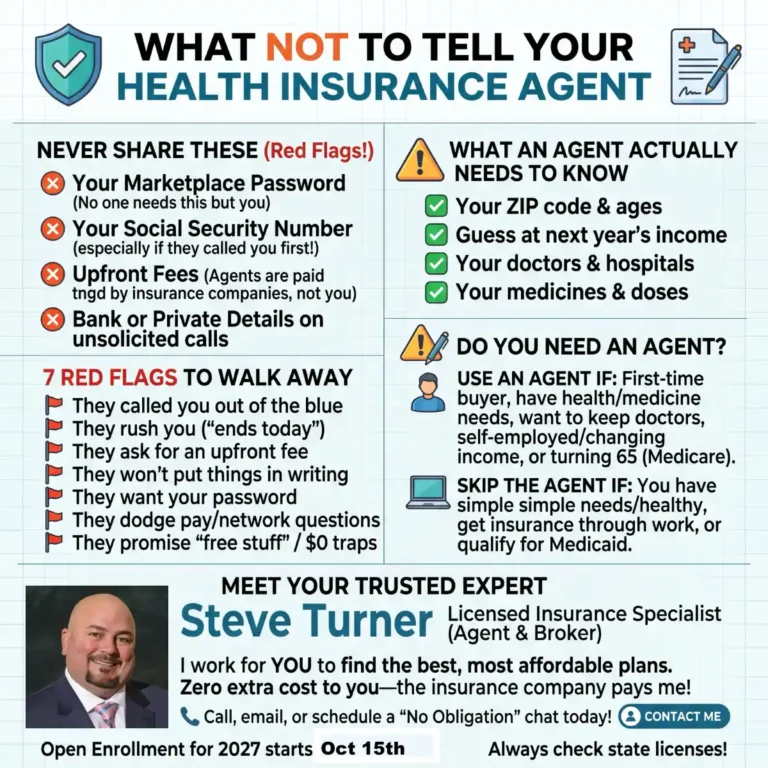
- Someone calls me out of the blue to sell a plan.
- The caller says they are “from Medicare” and asks for my Medicare number.
- I am told I must sign up today.
- They offer me cash or a big gift to join.
- The plan is called “free,” but no one will explain the other costs.
Medicare will never call me to sell me anything.
Common Medicare Mistakes I Would Avoid
Most Medicare mistakes come from rushing or from skipping a question. These are the six I see as the easiest to make.
- Picking a plan by the monthly price alone. A $0 plan can still cost a lot when I get sick.
- Not checking my doctors and drugs each year. Plans change every January. I read the Annual Notice of Change my plan mails me each fall.
- Missing my sign-up window. Late fees can last for life.
- Thinking I can buy Medigap anytime. After my first 6 months, a company may ask health questions.
- Trusting a TV ad. Ads show the best parts. They skip the limits.
- Signing up in a hurry. If I feel pushed, I hang up and take a day to think.
Medicare Insurance FAQ
Here are quick answers to the questions I hear most often.
Q: What is the difference between Medicare Advantage and Medigap?
A: Medicare Advantage replaces Original Medicare with one private plan. Medigap works with Original Medicare and helps pay my share of the bills. I can’t have both at once.
Q: Is Medicare free?
A: No. Most people pay no premium for Part A if they or a spouse worked and paid Medicare taxes for about 10 years. But Part B has a monthly premium. I also pay deductibles and copays.
Q: Can a plan turn me down because I am sick?
A: Medicare Advantage and Part D plans must take me during a sign-up period, even if I am sick. Medigap is different. Outside my first 6 months, a Medigap company in most states can ask about my health.
Q: How often can I change my plan?
A: Most people can change once a year, from October 15 to December 7. The new plan starts on January 1.
Q: Does Medicare pay for long-term care?
A: No. Medicare does not pay for most long-term care, like help with bathing and dressing in a nursing home. I would plan for that cost on its own.
Q: Do my spouse and I get one plan together?
A: No. Medicare has no family plans. Each of us signs up alone, and each of us can pick a different plan.
Q: Where can I compare plans for free?
A: I use the plan finder at Medicare.gov. I can also call 1-800-MEDICARE (1-800-633-4227) anytime.
My Last Check Before I Sign Up for Medicare Insurance
Before I say yes to any plan, I make sure I can check every box on this list.
- I know which path I am on: Original Medicare or Medicare Advantage.
- I called my doctors, and they take the plan.
- I priced every medicine I take.
- I know the most I could pay in one year.
- I know my sign-up dates and my deadline.
- I have the plan details in writing.
If I get stuck, I ask for free help. Every state has a State Health Insurance Assistance Program, called SHIP for short. SHIP counselors do not work for any insurance company. I can find mine at shiphelp.org.
Now I know what to ask when getting Medicare insurance. Good questions cost nothing, and they can save me a lot. So I take my time, write down the answers, and choose the plan that fits my health and my budget.
Why choose Steve Turner Insurance Specialist?
Because I’m an “Insurance Specialist.” An “insurance specialist” is a broad term that includes insurance agents and insurance brokers, but the key difference is who the agent represents versus who the broker represents.
An “insurance agent” works directly for an insurance company and sells its specific policies to clients.
An “insurance broker” acts as an independent intermediary, comparing policies from multiple companies to find the best fit for their client’s needs, essentially representing the client rather than the insurance company.
I am both a licensed Insurance Agent and a licensed Insurance Broker.
My number one goal in life is to help people and ensure, without a shadow of a doubt, that you and your family are secure and protected. I will always be by your side, helping you mitigate risk by providing the industry’s best and most affordable insurance solutions.
I will find insurance plans for the entire family to help cover whatever life throws at you. I can help you save on severe medical emergencies, find a health insurance plan with low- or no-cost doctor visits and affordable prescription medications, and protect your family in the event of an unexpected accident or illness.
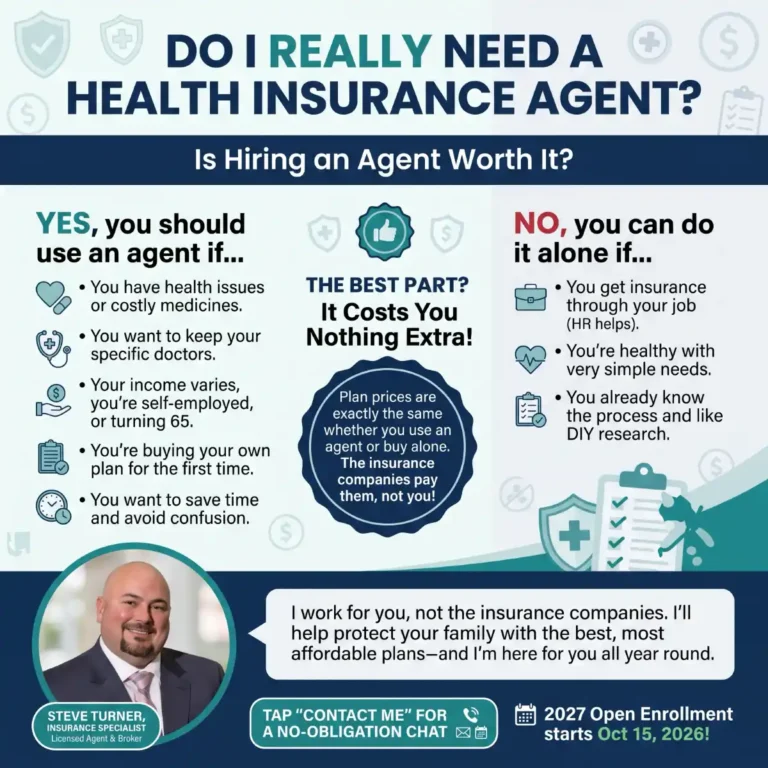
Best of all, it doesn’t cost you anything extra to use an experienced Insurance Agent and Broker like me to help you find the Insurance Plans that fit your individual, family, or business needs.
The companies that sell the insurance plans “you choose“ pay me – you don’t pay me. Calling any big insurance company directly won’t get you a lower price, as they will forward your call to the next available insurance agent on their list. You won’t have had any opportunity to learn about the insurance agent you’re speaking with in advance, understand their qualifications or experience level, or make an informed choice about who you want to work with.
Tap the Contact Me text or icon and get in touch by phone or email, or schedule a “No Obligation” chat through my calendar. I look forward to speaking with you!
OUR CLIENT REVIEWS


CONTACT STEVE TURNER INSURANCE AGENT & BROKER
I’m here to take your calls and emails and answer your questions 7 Days a week from 7:00 a.m. to 8:00 p.m., excluding posted holidays.
Steve Turner is a licensed agent and broker and a longstanding member of the National Association of Benefits and Insurance Professionals®. Steve holds the prestigious Registered Employee Benefits Consultant® designation. NABIP® is the preeminent organization for health insurance and employee benefits professionals and works diligently to ensure all Americans have access to high-quality, affordable Healthcare and related services.
Steve Turner is a licensed agent appointed by Florida Blue.
EMAIL ME: 24×7
OFFICE LOCATION
Website: steveturnerinsurancespecialist.com
Email: [email protected]
Phone and Text: +1-813-388-8373
Business Hours:
Monday: 7 a.m. to 8 p.m.
Tuesday: 7 a.m. to 8 p.m.
Wednesday: 7 a.m. to 8 p.m.
Thursday: 7 a.m. to 8 p.m.
Friday: 7 a.m. to 8 p.m.
Saturday: 7 a.m. to 8 p.m.
Sunday: 7 a.m. to 8 p.m.
SOCIAL FOLLOW + SHARE
Insurance Agent
MEDICARE STATEMENT
The Medicare Annual Enrollment Period is October 15th to December 7th. Steve Turner is not connected with or endorsed by the United States Government or the Federal Medicare Program. Some plans may not be available in your area, and any information I provide is limited to those offered. Please contact Medicare.gov or 1-800-MEDICARE for information on all your options.
There’s no one-size-fits-all answer. Carefully evaluate your health status, anticipated medical needs, prescription drug usage, budget, preferred doctors and hospitals, and tolerance for network rules. During the Medicare Annual Enrollment Period (October 15th to December 7th), research the specific plans available in your Florida county using the Medicare Plan Finder on Medicare.gov, compare costs and benefits, and consider free, personalized counseling from Florida’s SHINE (Serving Health Insurance Needs of Elders) program.