

When Should I Contact a Health Insurance Agent?

When Should I Contact a Health Insurance Agent?
I should contact a health insurance agent whenever my coverage is about to change, my life is about to change, or I don’t understand my choices. That’s the short answer.
Health insurance can feel like a puzzle. There are deadlines. Plan names all sound the same. Words like “deductible” go by without explanation. So it’s fair to ask, “When should I contact a health insurance agent, and when can I handle it on my own?”
A health insurance agent is a licensed helper who knows the plans in my area. In most cases, that help costs me nothing extra. I still make the final choice. The agent makes sure I understand what I’m picking.
In this guide, I’ll cover:
- What a health insurance agent does and how they get paid
- 10 times I should pick up the phone
- The dates and deadlines I can’t miss
- How I find a good agent and what I ask
- Quick answers to common questions
What does a health insurance agent do?
A health insurance agent is a trained, licensed person who helps me pick a health plan and sign up for it. I think of an agent as a guide. I could hike the trail alone, but a guide knows where the holes are.
Here’s what a good agent does for me:
- Asks about my life. My doctors, my medicines, my budget, and my family all matter.
- Shows me plans that fit. Not just the cheapest plan. The one that works for how I use care.
- Explains the hard words. An agent turns insurance talk into plain talk.
- Checks if I can get help paying. Many people can get tax credits or low-cost coverage and don’t know it.
- Helps me with the forms. One wrong answer can slow things down or cost me money.
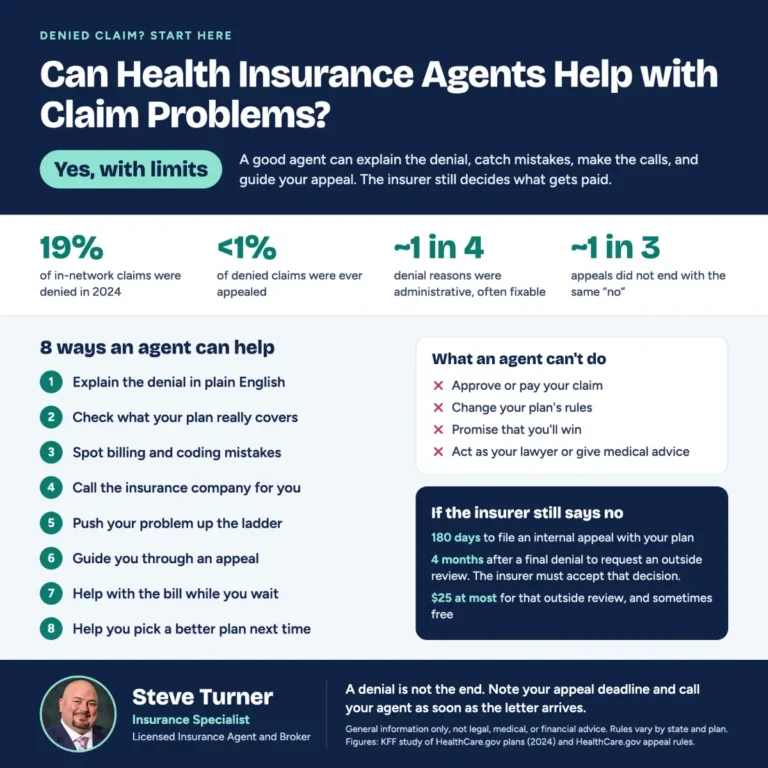
- Stays with me after I sign up. If a bill looks wrong or a claim gets denied, I have someone to call.
Five words an agent can explain
- Premium: what I pay each month to keep my plan.
- Deductible: what I pay for care before my plan starts to pay.
- Copay: a set price I pay for a visit or a medicine.
- Network: the doctors and hospitals my plan works with.
- Out-of-pocket maximum: the most I would pay for covered care in one year.
What’s the difference between an agent and a broker?
People use these two words as if they mean the same thing. They’re close, but they’re not the same.
- An agent may work for one insurance company. That agent can only show me plans from that company.
- A broker may work with several companies. A broker can show me plans from each one, side by side.
Some people use “independent agent” to describe a helper who works with many companies. So I always ask, “How many companies do you work with?” The answer tells me how many options I’ll have.
How much does a health insurance agent cost?
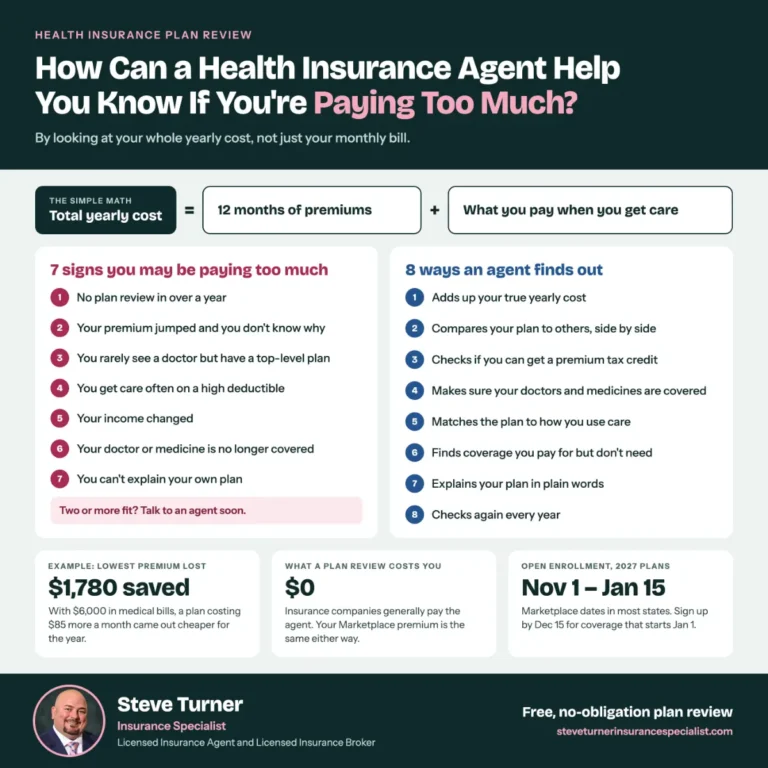
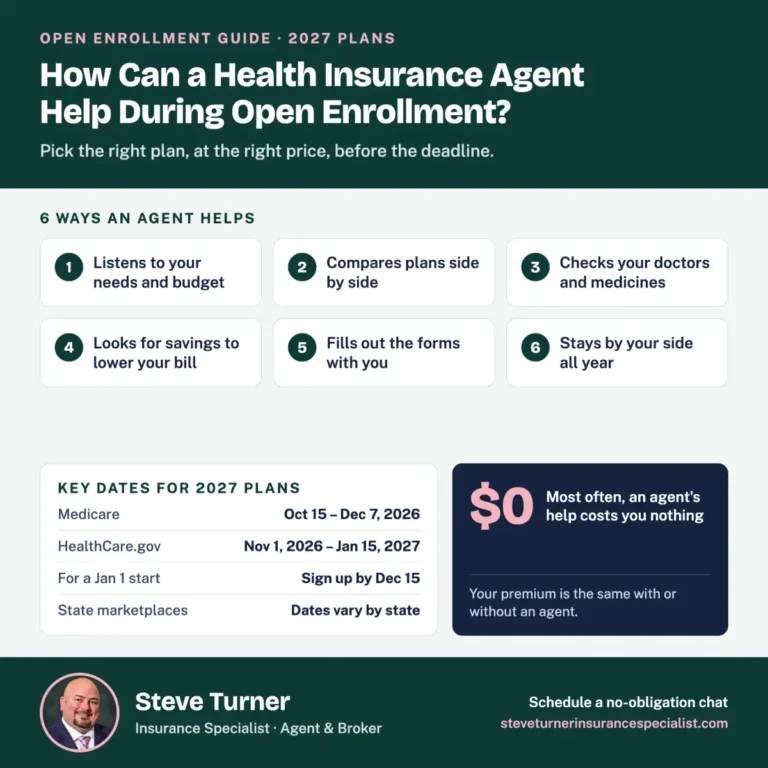
In most cases, nothing. HealthCare.gov says I won’t pay anything extra if I enroll with an agent or broker. The insurance company pays the agent a fee, called a commission, when I sign up. The plan price is the same whether I use an agent or go it alone.
So I get a guide, and my monthly bill stays the same. That’s a pretty good deal.
I keep one thing in mind. The insurance company pays the agent, not me. So I ask clear questions about which plans the agent can sell. A good agent is glad to answer.
10 times I should contact a health insurance agent
Here are the moments when one phone call can save me time, money, and stress.
1. Open enrollment is coming up
Open enrollment is the time each year when anyone can sign up for a health plan or switch to a new one. It only lasts a short while. If I miss it, I may have to wait a whole year.
I like to call an agent a few weeks before it starts. Agents get very busy near the deadline. When I call early, I get more time and better attention.
What I ask: “Is my plan still the best fit for next year?”
2. I lost my job, or I’m about to leave it
When my job goes away, my health plan often goes with it. That can be scary. But I have choices, and an agent can lay them out:
- COBRA. This lets me keep my work plan for a while. But I usually pay the full price myself, and that can be a lot.
- A Marketplace plan. I may get help paying for it, based on my income.
- Medicaid. If my income drops low enough, I may get free or low-cost coverage.
- A spouse’s plan. I may be able to join it.
Losing job coverage opens a special window to sign up for a Marketplace plan. I usually have 60 days. I can even start up to 60 days before my coverage ends. So I call an agent as soon as I know my last day.
3. I’m turning 26
I can stay on my parents’ health plan until I turn 26. After that, I need my own plan.
Turning 26 opens a special sign-up window. But it doesn’t stay open long. I call an agent a month or two before my birthday so there’s no gap in my coverage.
4. I got married or divorced
Getting married means two people may now share one plan. Sometimes that saves money. Sometimes two plans cost less. An agent can run the numbers both ways.
Divorce can mean losing the coverage I had through my spouse. If that happens, I may get a special window to sign up for a new plan. An agent can tell me whether I qualify and how quickly I need to act.
5. I’m having a baby or adopting a child
A new child is a big, happy change. It’s also a good reason to look at my plan again.
I ask an agent:
- How do I add my child to my plan?
- Is my child’s doctor in-network?
- Should I switch to a plan with lower costs for doctor visits?
With a Marketplace plan, coverage can go back to the day my child arrived, as long as I sign up within 60 days. I don’t want to miss that window.
6. I’m moving to a new area
Health plans are local. A plan that works in one ZIP code may not work in the next state, or even the next county.
If I move, I may need a new plan. I may also get a special window to pick one. I call an agent who is licensed in the place I’m moving to. That agent knows the local doctors, hospitals, and plans.
7. I’m turning 65, and Medicare is close
Medicare is the health program mostly for people 65 and older. It has several parts: Part A, Part B, Part C, and Part D. There are also extra plans called Medigap. It’s easy to get lost.
My first chance to sign up lasts seven months. It starts three months before the month I turn 65. It ends three months after that month. If I miss it, I could pay late fees for years, unless I still have coverage through a job.
I call a Medicare agent about six months before my 65th birthday. That gives me time to learn the parts and compare plans without a rush.
8. I work for myself or run a small business
When I’m my own boss, no HR office hands me a plan. I have to find one myself.
An agent can help me:
- Find a plan just for my family and me
- Set up a group plan if I have workers
- Learn other ways a small business can help workers pay for coverage
If I own a business, an agent can also handle sign-ups and questions from my team. That gives me more time to run the shop.
9. My income went up or down
My income can change how much help I get paying for a plan. A raise, a layoff, a new side job, or fewer hours can all matter.
If my income drops, I may get more help. I may even qualify for Medicaid. If my income goes up, I may get less help. And if I don’t report the change, I could owe money back at tax time.
An agent can help me update my information so there are no surprises.
10. My plan changed, or I feel lost
Each fall, my insurance company sends a letter about next year. I read it closely. I call an agent if I see any of these:
- My monthly price is going up a lot
- My doctor or hospital is leaving the network
- My medicine is no longer covered
- My plan is ending
I also call when I’m just plain confused. Maybe I got a bill I don’t understand. Maybe a claim was denied. Maybe I can’t tell two plans apart. I don’t need a big life event to ask for help. Feeling stuck is reason enough.
Key dates and deadlines I can’t miss
Timing matters a lot with health insurance. Here are the main sign-up windows as of October 2026.
| Type of coverage | When I can sign up | When I call an agent |
|---|---|---|
| Marketplace plans on HealthCare.gov | November 1, 2026 to January 15, 2027 | October |
| Marketplace plans that start January 1 | Sign up by December 15, 2026 | October or early November |
| Medicare yearly open enrollment | October 15 to December 7 | September or early October |
| Medicare Advantage open enrollment (if I’m already in one of these plans) | January 1 to March 31 | December |
| First-time Medicare | Seven months around my 65th birthday | Six months before I turn 65 |
| Marketplace plan after a life change | Usually within 60 days | Right away |
| Job-based plans | Set by my employer, often in the fall | When I get my benefits packet |
| Medicaid and CHIP | Any time of year | Any time |
A few things to know:
- Some states use different dates. States that run their own Marketplace can set their own start and end dates. A few end in December. Some run through the end of January. An agent in my state will know.
- Life-change windows close fast. If I wait too long, I may be stuck until the next open enrollment.
- Job plans can be even shorter. After a life change, a job plan may give me only 30 days to act.
- Dates can change from year to year. I check the official website or ask my agent each fall.
My rule is simple. When something changes, I call that same week.
Sources: HealthCare.gov dates and deadlines, HealthCare.gov Special Enrollment Periods, Medicare.gov enrollment periods, healthinsurance.org state deadlines.
When I may not need a health insurance agent
I want to be fair. I don’t always need an agent. I may be fine on my own if:
- My job offers one or two plans. My HR team or benefits office can answer my questions.
- I’m happy with my plan, and nothing changed. I still read my renewal letter each fall to be sure.
- I know what I want. I can sign up myself on HealthCare.gov or my state’s website.
- I only need Medicaid. I can apply through my state.
There are other free helpers too. Navigators are trained helpers for Marketplace plans. They can explain my choices and help with forms. But they can’t tell me which plan to pick. For Medicare, each state has a free counseling program called SHIP. It isn’t tied to any insurance company.
Still, a call to an agent costs me nothing. If I have any doubt, it doesn’t hurt to ask.
How I find a good health insurance agent near me
Not all agents are the same. Here’s how I find one I can trust.
- Ask people I know. Friends, family, and coworkers can tell me who treated them well.
- Use the official tool. HealthCare.gov has a Find Local Help page that lists agents and brokers near me.
- Check the license. Every agent must be licensed in my state. I can look up a license on my state insurance department’s website.
- Read reviews. I look for agents who answer questions and return calls.
- Have a short first talk. A good agent listens more than they talk.
7 questions I ask before I choose an agent
- Are you licensed in my state?
- How many insurance companies do you work with?
- Can you sign me up through the Marketplace so I can get tax credits?
- Does this plan cover my doctors and medicines?
- What will I pay in total for the year, not just each month?
- Will you help me after I sign up if I have a problem?
- How do you get paid?
Red flags I watch for
I walk away if an agent:
- Pushes me to sign up today
- Won’t answer my questions in plain words
- Asks me to pay a fee to enroll
- Tries to sell me a plan without asking about my health needs
- Signs me up or switches my plan without my clear OK
- Calls me out of the blue and asks for my Social Security number
A good agent wants me to understand my plan. A bad one wants a fast sale.
What I have ready before I call
A little homework makes the call quick. I gather these things first:
- My ZIP code. Plans depend on where I live.
- The ages of everyone who needs coverage. Age can change the price.
- A good guess of my household income for next year. A recent pay stub or tax return helps.
- A list of my doctors and hospitals. The agent can check which plans include them.
- A list of my medicines. I write down each name and dose.
- My insurance card or renewal letter. I bring it if I have one.
- My budget. I know how much I can pay each month and how much I could handle in a bad year.
- My questions. I write them down so I don’t forget.
With this list in hand, the call goes much faster. I also get better answers.
What happens on the first call?
The first call is easy. Most of the time, it goes like this:
- The agent asks about my health needs and my budget.
- The agent shows me two or three plans that fit.
- We compare the total cost of each plan for a full year.
- I ask my questions until the plan makes sense.
- I pick a plan, or I take a few days to think.
I never have to decide on the spot. A good agent will give me time.
Frequently asked questions
Do I need a health insurance agent, or can I do it myself?
It depends on how sure I feel. If my choices are simple, I can do it myself. If I have health needs, a tight budget, or a big life change, an agent can help me avoid a costly mistake. The help is usually free, so I lose nothing by asking.
Can a health insurance agent help me outside of open enrollment?
Yes. An agent can tell me if a life change gives me a special window to sign up. An agent can also help with Medicaid, Medicare, and questions about a plan I already have.
Do I pay more for my plan if I use an agent?
No. The plan price is the same either way. The insurance company pays the agent.
Can an agent help me lower my costs?
Yes. An agent can check if I qualify for tax credits or other savings. To get those savings, the agent has to sign me up through the Marketplace. I always ask about this up front.
How early should I contact an agent before open enrollment?
I aim to contact an agent three to four weeks before it starts. That gives the agent time to learn my needs. It also gives me time to think before I choose.
What if I missed open enrollment?
I call an agent anyway. I might qualify for a special window and not know it. If I don’t, the agent can explain my other options and help me prepare for next time.
Can I talk to an agent by phone or online?
Yes. Many agents work by phone, video, or email. I can also meet with a local agent in person if I prefer that. Either way, the agent must be licensed in my state.
Can I switch agents if I’m not happy?
Yes. I’m never stuck with one agent. I can choose a new one at any time.
Is a health insurance agent the same as a navigator?
No. A navigator can explain my choices and help with forms for Marketplace plans. But a navigator can’t tell me which plan to pick. An agent can.
The bottom line
So, when should I contact a health insurance agent? Any time my life changes, my plan changes, or I feel unsure.
Here’s my quick checklist. I call an agent when:
- Open enrollment is a few weeks away
- I lose a job, get married, have a baby, or move
- I’m about to turn 26 or 65
- My income changes
- My plan costs more or covers less
- I don’t understand my choices
The call is free. The advice can save me real money. And I get to stop guessing. If one of these moments is coming up for me, today is a good day to make the call.
Why choose Steve Turner Insurance Specialist?
Because I’m an “Insurance Specialist.” An “insurance specialist” is a broad term that includes insurance agents and insurance brokers, but the key difference is who the agent represents versus who the broker represents.
An “insurance agent” works directly for an insurance company and sells its specific policies to clients.
An “insurance broker” acts as an independent intermediary, comparing policies from multiple companies to find the best fit for their client’s needs, essentially representing the client rather than the insurance company.
I am both a licensed Insurance Agent and a licensed Insurance Broker.
My number one goal in life is to help people and ensure, without a shadow of a doubt, that you and your family are secure and protected. I will always be by your side, helping you mitigate risk by providing the industry’s best and most affordable insurance solutions.
I will find insurance plans for the entire family to help cover whatever life throws at you. I can help you save on severe medical emergencies, find a health insurance plan with low- or no-cost doctor visits and affordable prescription medications, and protect your family in the event of an unexpected accident or illness.
Best of all, it doesn’t cost you anything extra to use an experienced Insurance Agent and Broker like me to help you find the Insurance Plans that fit your individual, family, or business needs.
The companies that sell the insurance plans “you choose“ pay me – you don’t pay me. Calling any big insurance company directly won’t get you a lower price, as they will forward your call to the next available insurance agent on their list. You won’t have had any opportunity to learn about the insurance agent you’re speaking with in advance, understand their qualifications or experience level, or make an informed choice about who you want to work with.
Tap the Contact Me text or icon and get in touch by phone or email, or schedule a “No Obligation” chat through my calendar. I look forward to speaking with you!
OUR CLIENT REVIEWS


CONTACT STEVE TURNER INSURANCE AGENT & BROKER
I’m here to take your calls and emails and answer your questions 7 Days a week from 7:00 a.m. to 8:00 p.m., excluding posted holidays.
Steve Turner is a licensed agent and broker and a longstanding member of the National Association of Benefits and Insurance Professionals®. Steve holds the prestigious Registered Employee Benefits Consultant® designation. NABIP® is the preeminent organization for health insurance and employee benefits professionals and works diligently to ensure all Americans have access to high-quality, affordable Healthcare and related services.
Steve Turner is a licensed agent appointed by Florida Blue.
EMAIL ME: 24×7
OFFICE LOCATION
Website: steveturnerinsurancespecialist.com
Email: [email protected]
Phone and Text: +1-813-388-8373
Business Hours:
Monday: 7 a.m. to 8 p.m.
Tuesday: 7 a.m. to 8 p.m.
Wednesday: 7 a.m. to 8 p.m.
Thursday: 7 a.m. to 8 p.m.
Friday: 7 a.m. to 8 p.m.
Saturday: 7 a.m. to 8 p.m.
Sunday: 7 a.m. to 8 p.m.
SOCIAL FOLLOW + SHARE
Insurance Agent
MEDICARE STATEMENT
The Medicare Annual Enrollment Period is October 15th to December 7th. Steve Turner is not connected with or endorsed by the United States Government or the Federal Medicare Program. Some plans may not be available in your area, and any information I provide is limited to those offered. Please contact Medicare.gov or 1-800-MEDICARE for information on all your options.
There’s no one-size-fits-all answer. Carefully evaluate your health status, anticipated medical needs, prescription drug usage, budget, preferred doctors and hospitals, and tolerance for network rules. During the Medicare Annual Enrollment Period (October 15th to December 7th), research the specific plans available in your Florida county using the Medicare Plan Finder on Medicare.gov, compare costs and benefits, and consider free, personalized counseling from Florida’s SHINE (Serving Health Insurance Needs of Elders) program.