

What Questions Should I Ask My Insurance Agent?

What Questions Should I Ask My Health Insurance Agent? How to Interview and Evaluate an Agent
Choosing the right health insurance can feel completely overwhelming. I still remember the first time I had to pick my own plan. I was staring at my computer screen, and my brain felt like it was going to explode. Deductible? Coinsurance? Out-of-pocket maximum? It felt like I was reading a foreign language.
I almost just clicked on the cheapest plan and hoped for the best. But then, I decided to talk to a health insurance agent. Getting an agent was a game-changer. But here is the secret: sitting there and nodding while the agent talks isn’t enough. You have to ask the right questions.
If you are wondering, “What questions should I ask my health insurance agent?” you are in the right place. I will break down everything you need to know, without any confusing insurance jargon.
Part 1: Getting to Know Your Agent
Not all insurance agents are the same. Before you talk about health plans, you need to know who you are dealing with.
1. Are you an independent agent or a captive agent?
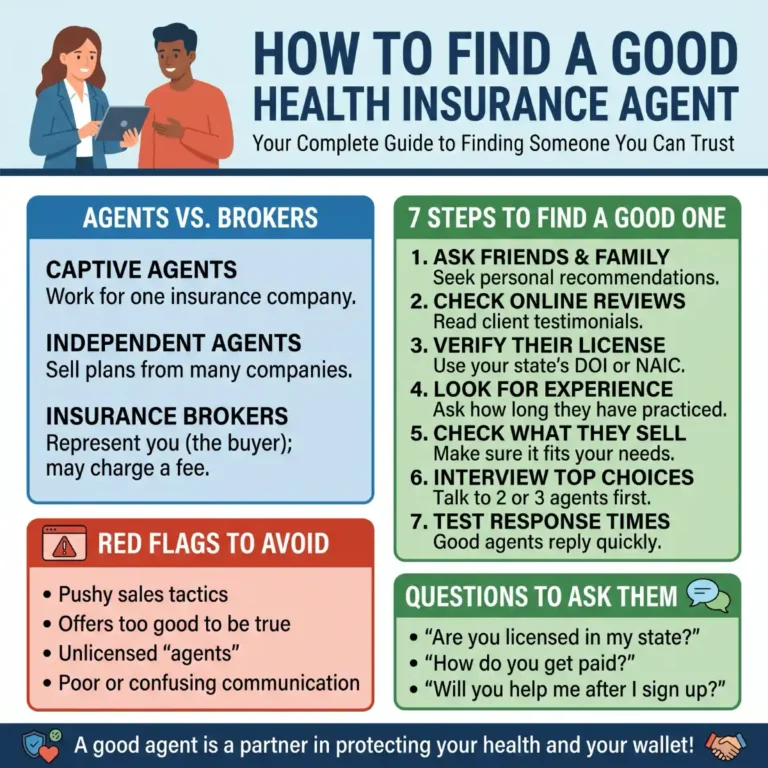
This is a huge question. A “captive agent” only sells plans from one single insurance company. If they work for Company A, they can only sell you Company A’s plans.
An “independent agent” or “independent broker” works with many different insurance companies. They can shop around to find the one that fits you best. I always prefer an independent agent because they give me more choices.
2. How do you get paid? (Does this cost me anything?)
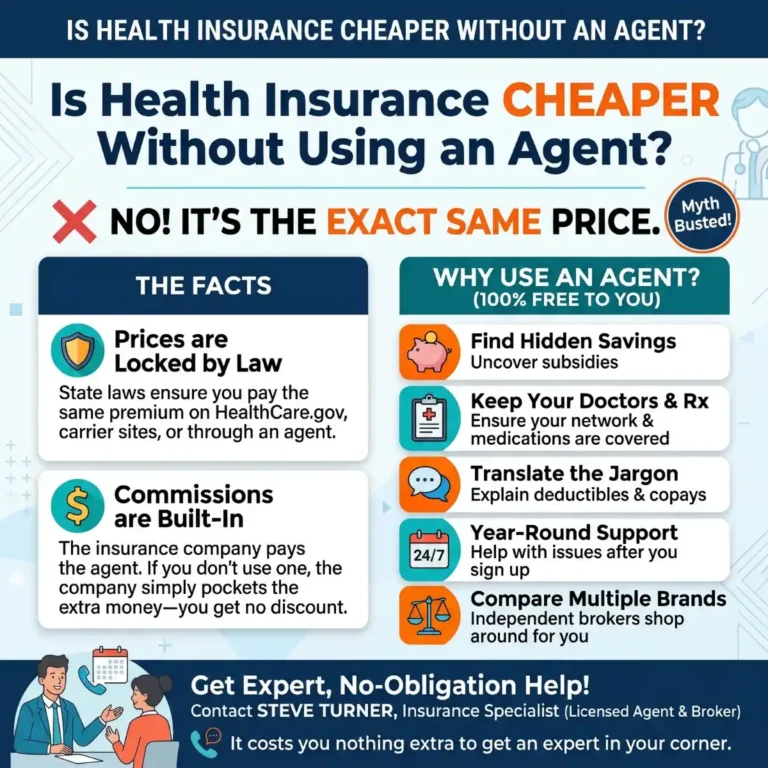
Using a health insurance agent usually doesn’t cost you a penny. Agents get paid a commission by the insurance company when you sign up. You pay the same monthly price for your health plan whether you use an agent or buy it yourself online.
3. Are you licensed to sell insurance in my state?
Health insurance rules change depending on where you live. Make sure your agent is legally licensed in your state. They should have a National Producer Number (NPN). You can easily check this number with your state’s insurance department.
Part 2: The Money Stuff (Understanding Your Costs)
Health insurance costs are tricky. The monthly bill is only one piece of the puzzle. Ask these questions so you don’t get a surprise medical bill later.
4. What is the monthly premium?
The premium is the amount you pay every month to have the insurance. Think of it like a monthly subscription. Ask your agent what the premium will be and make sure it fits comfortably in your budget.
5. What is the deductible?
The deductible is the amount of your own money you have to pay for medical care before your insurance steps in to help. Imagine your deductible is $2,000. If you get sick and the hospital bill is $5,000, you pay the first $2,000 out of pocket.
Usually, if a plan has a very low monthly premium, it will have a very high deductible. If a plan has a high monthly premium, the deductible is usually lower.
6. What are my copays and coinsurance?
Even after you pay your deductible, you still have to pay a little bit when you go to the doctor.
- Copay: This is a flat, set fee. For example, you might pay a $20 copay every time you visit your regular doctor.
- Coinsurance: This is a percentage of the bill. After you meet your deductible, your insurance might pay 80% of the bill, and you pay the remaining 20%.
7. What is the Out-of-Pocket Maximum?
This is your safety net. It is the absolute highest amount of your own money you will have to pay in a whole year for covered medical care. Let’s say your out-of-pocket maximum is $6,000. If you have an emergency and your medical bills are $100,000, you only have to pay $6,000. Ask your agent, “What is the most I will ever have to pay in a year?”
8. Do I qualify for a subsidy?
A subsidy is financial help from the government to lower your monthly premium. A good agent will automatically check whether your household income qualifies for this help. It takes just a few minutes, and it could save you hundreds of dollars every month.
Part 3: What Does The Plan Actually Cover?
A cheap plan is useless if it does not let you see your favorite doctor.
9. Will I be able to keep seeing my current doctor?
Health insurance plans have a “network” of doctors and hospitals. If your doctor is “in-network,” your insurance will help pay the bill. If your doctor is “out-of-network,” your insurance might pay very little, or absolutely nothing at all. Ask your agent to check if your specific doctors are in the plan’s network.
10. Are my daily prescription medications covered?
Insurance companies have a list of medicines they will pay for, called a “formulary”.The formulary breaks medicines down into different price levels, or “tiers”.If you take medicine every day, ask your agent whether your specific pills are on the formulary and which tier they are in.
11. Is it an HMO or a PPO plan?
- HMO (Health Maintenance Organization): You must stay in-network. You also usually need a referral from your regular doctor to see a specialist.
- PPO (Preferred Provider Organization): You have more freedom. You do not need a referral to see a specialist, and you can usually see out-of-network doctors (though it will cost more).
12. Are vision, hearing, and dental care included?
Most standard health insurance plans for adults do not cover dental or vision care. Ask your agent if these are included, or how much it would cost to add a separate dental or vision plan.
13. What happens if I go to the Emergency Room?
The emergency room is expensive. Some plans require you to meet your full deductible before they help with an ER bill. Other plans charge a high copay. Ask your agent exactly what a trip to the hospital will cost you.
Part 4: Planning For The Future
Life changes fast, and your insurance needs to keep up.
14. What happens if I have a big life change?
Usually, you can only buy health insurance during “Open Enrollment” in the winter. But if you lose your job, get married, or have a baby, you get a “Special Enrollment Period” to change your plan right away. Ask your agent if they will help you update your plan when your family changes.
15. What happens if my insurance denies a claim?
Sometimes, a doctor does a test, and the insurance company refuses to pay. Ask your agent, “If a claim gets denied, will you help me fight it?” A great agent does not disappear after they sell you the plan.
16. Will you contact me next year to review my plan?
Insurance plans change every single year. Doctors in the network might leave, or prices might go up. Ask your agent to proactively reach out before Open Enrollment next year to make sure you are still on the best plan.
Q&A: Common Worries When Picking a Plan
Q: Why shouldn’t I buy health insurance myself online?
A: The price of the plan is the same whether you use the website yourself or use an agent. But an agent does all the hard math and network checking for you, for free. It is like having a free math tutor taking your test for you.
Q: I am young and perfectly healthy. Shouldn’t I pick the absolute cheapest monthly premium?
A: Not always. A very cheap premium means a very high deductible. If you have absolutely no savings in the bank, a cheap plan can be dangerous in an emergency. You and your agent should review your budget before deciding.
Q: What is an HSA or an FSA?
A: These are special bank accounts just for medical bills. With an HSA (Health Savings Account), you put tax-free money in to pay for copays and deductibles, and the money stays there forever. With an FSA (Flexible Spending Account), you lose the money if you do not spend it by the end of the year.
Q: Is “Preventive Care” really free?
A: Yes! Under the law, most health plans must cover preventive care 100%. This includes your yearly check-up, certain vaccines, and important screenings.
Your “Getting Ready” Checklist
Before you call an agent, do some homework. Have these things written down on a piece of paper ready to go:
- A list of all your doctors: Write down the names of your primary doctor, your kids’ doctors, and any specialists.
- A list of your daily medications: Write down the exact names of your pills and the dosage.
- Your estimated yearly income: The agent needs to know how much money your household will make this year to check for discounts.
- Your family details: Write down the names, birth dates, and Social Security Numbers of everyone who needs insurance.
- Your budget: Figure out exactly how much money you can comfortably spend every month on a premium.
- Upcoming medical needs: Are you planning to have a baby this year? Do you need surgery soon? Tell your agent!
Your health insurance agent is there to work for you. Don’t be afraid to ask them to slow down, and if they push a plan that feels too expensive, tell them no. By using the questions in this guide, you help protect your health and keep your bank account safe.
Why choose Steve Turner Insurance Specialist?
Because I’m an “Insurance Specialist.” An “insurance specialist” is a broad term that includes insurance agents and insurance brokers, but the key difference is who the agent represents versus who the broker represents.
An “insurance agent” works directly for an insurance company and sells its specific policies to clients.
An “insurance broker” acts as an independent intermediary, comparing policies from multiple companies to find the best fit for their client’s needs, essentially representing the client rather than the insurance company.
I am both a licensed Insurance Agent and a licensed Insurance Broker.
My number one goal in life is to help people and ensure, without a shadow of a doubt, that you and your family are secure and protected. I will always be by your side, helping you mitigate risk by providing the industry’s best and most affordable insurance solutions.
I will find insurance plans for the entire family to help cover whatever life throws at you. I can help you save on severe medical emergencies, find a health insurance plan with low- or no-cost doctor visits and affordable prescription medications, and protect your family in the event of an unexpected accident or illness.
Best of all, it doesn’t cost you anything extra to use an experienced Insurance Agent and Broker like me to help you find the Insurance Plans that fit your individual, family, or business needs.
The companies that sell the insurance plans “you choose“ pay me – you don’t pay me. Calling any big insurance company directly won’t get you a lower price, as they will forward your call to the next available insurance agent on their list. You won’t have had any opportunity to learn about the insurance agent you’re speaking with in advance, understand their qualifications or experience level, or make an informed choice about who you want to work with.
Tap the Contact Me text or icon and get in touch by phone or email, or schedule a “No Obligation” chat through my calendar. I look forward to speaking with you!
OUR CLIENT REVIEWS


CONTACT STEVE TURNER INSURANCE AGENT & BROKER
I’m here to take your calls and emails and answer your questions 7 Days a week from 7:00 a.m. to 8:00 p.m., excluding posted holidays.
Steve Turner is a licensed agent and broker and a longstanding member of the National Association of Benefits and Insurance Professionals®. Steve holds the prestigious Registered Employee Benefits Consultant® designation. NABIP® is the preeminent organization for health insurance and employee benefits professionals and works diligently to ensure all Americans have access to high-quality, affordable Healthcare and related services.
Steve Turner is a licensed agent appointed by Florida Blue.
EMAIL ME: 24×7
OFFICE LOCATION
Website: steveturnerinsurancespecialist.com
Email: [email protected]
Phone and Text: +1-813-388-8373
Business Hours:
Monday: 7 a.m. to 8 p.m.
Tuesday: 7 a.m. to 8 p.m.
Wednesday: 7 a.m. to 8 p.m.
Thursday: 7 a.m. to 8 p.m.
Friday: 7 a.m. to 8 p.m.
Saturday: 7 a.m. to 8 p.m.
Sunday: 7 a.m. to 8 p.m.
SOCIAL FOLLOW + SHARE
Insurance Agent

MEDICARE STATEMENT
The Medicare Annual Enrollment Period is October 15th to December 7th. Steve Turner is not connected with or endorsed by the United States Government or the Federal Medicare Program. Some plans may not be available in your area, and any information I provide is limited to those offered. Please contact Medicare.gov or 1-800-MEDICARE for information on all your options.
There’s no one-size-fits-all answer. Carefully evaluate your health status, anticipated medical needs, prescription drug usage, budget, preferred doctors and hospitals, and tolerance for network rules. During the Medicare Annual Enrollment Period (October 15th to December 7th), research the specific plans available in your Florida county using the Medicare Plan Finder on Medicare.gov, compare costs and benefits, and consider free, personalized counseling from Florida’s SHINE (Serving Health Insurance Needs of Elders) program.