

Health Insurance Agent Qualifications for 2027: 22 Credentials to Check Before You Enroll in Florida

22 Health Insurance Agent Qualifications Every Floridian Should Verify in 2027
Health Insurance Agent Qualifications for 2027: 22 Credentials to Check Before You Enroll in Florida
By Steve Turner, Licensed Florida Health & Life Agent · Reviewed for accuracy against Florida DFS and CMS sources.
A qualified health insurance agent in Florida holds an active 2-15 (or 2-40) license, is appointed with the carriers they sell, completes annual CMS Marketplace registration for ACA plans and annual Medicare certification for Medicare plans, and stays current on continuing education. Everything else on this list, from product knowledge to responsiveness, separates a good agent from a great one.
Those checks matter more in 2027 than in any year before. On August 31, 2026, CMS canceled roughly 315,000 Marketplace policies covering more than 760,000 people that it found were enrolled through agents without proper verification. It also froze new agent registrations for the 2027 plan year and announced stricter consent and identity rules for agents. Meanwhile, the enhanced premium tax credits expired at the end of 2025, so plan choice now carries bigger price swings for Florida families.
Florida sits at the center of it all. It led the nation with about 4.47 million HealthCare.gov enrollees for 2026, even after a drop of more than 261,000 people from 2025. More enrollees and more scrutiny mean the agent you choose directly affects whether your coverage holds.
What a health insurance agent does (and how they are paid)
A health insurance agent helps you compare plans, check doctor networks and drug coverage, estimate your subsidy, and submit your enrollment. Independent agents (brokers) are appointed with several carriers; captive agents represent one company. In most cases, you pay nothing extra to use an agent, because carriers pay the commission and premiums are the same whether you enroll directly or through an agent.
From the field: [Add one or two sentences in the author’s own words about a real client situation from the 2026 enrollment season, for example a family that had to re-verify coverage after the August cancellations, or a client who saved money by switching metal tiers after subsidies changed. First-hand experience is the strongest E-E-A-T signal on this page.]
How to use this checklist
Items 1 to 10 are legal or regulatory requirements you can verify yourself in minutes. Items 11 to 22 are professional qualities you judge in conversation. If an agent fails any of the first ten, keep looking.
Part 1: Legal and licensing requirements
1. An active Florida health license (2-15 or 2-40)
The 2-15 Health & Life (Including Annuities & Variable Contracts) license is the standard credential for agents who sell health plans in Florida, and it also covers life insurance and annuities. The 2-40 Health license is a narrower option that covers health products only. Either one legally allows an agent to sell you a health plan.
Why it matters: A customer representative (4-40) license or a property and casualty license does not authorize health plan sales. Ask for the agent’s license number and check it on the Florida Department of Financial Services (DFS) licensee search. It takes about a minute.
2. State-approved pre-licensing education
Florida requires a 60-hour DFS-approved course for the 2-15 license, completed within four years before applying. The course covers Florida insurance law, ethics, and the core principles of life, health, and annuity products.
Worth knowing: DFS also accepts certain professional designations, such as the Chartered Healthcare Consultant (ChHC) and Registered Employee Benefits Consultant (REBC), in place of the health portion of pre-licensing. An agent with those designations has studied well beyond the minimum.
3. A passed Florida state licensing exam
Pearson VUE administers the 2-15 exam, has 150 scored questions, and requires a score of 70% to pass. Since February 2024, Florida licensing exams must be taken in person at a testing center.
What to look for: An agent who passed this exam should be able to explain, without notes, how an HMO differs from a PPO or how a deductible interacts with an out-of-pocket maximum.
4. A cleared fingerprint background check
Every license applicant is fingerprinted and screened by DFS. The license search also shows any public disciplinary actions, so check that section while you are there.
5. The right license for where they live
Resident 2-15 agents must be bona fide Florida residents and cannot hold a resident license in another state. Agents based elsewhere can still serve Floridians legally through a Florida non-resident license (for example, class 8-15).
What this means for you: An out-of-state agent is not automatically a red flag. What matters is that they hold a valid Florida license of either type. A local agent, though, is more likely to know your county’s provider networks and hospital systems.
6. Basic legal eligibility
DFS requires applicants to be at least 18 and to be a U.S. citizen or a legal alien with work authorization. These are verified at licensing, so a valid license confirms them.
7. Active carrier appointments, ideally several
A Florida license is valid only while the agent is appointed by at least one insurer, and it expires after 48 months without an appointment. Independent agents appointed with many carriers can compare more plans for you.
Question to ask: “Which carriers are you appointed with in my county for 2027?” If the answer is one, you are talking to a captive agent, which is fine, but you will only see that company’s plans.
8. Current continuing education (CE)
Florida 2-15 agents must complete 24 hours of CE every two years, due by the end of their birth month. Agents licensed six years or more need 20 hours. Every cycle includes a required law and ethics update course.
Why it matters: Health insurance rules changed sharply in 2025 and 2026. An agent who is behind on CE may be working from outdated subsidy or enrollment rules.
9. Current-year CMS Marketplace registration (for ACA plans)
Florida uses the federal HealthCare.gov Marketplace. Any agent who helps you enroll in an ACA plan must complete CMS registration and training for that specific plan year and sign the Marketplace agreements. Registration expires each year, and an agent may only assist with Marketplace enrollment while it is valid.
New for 2027: CMS imposed a temporary moratorium, effective September 22, 2026, on registrations from agents who did not hold an active 2026 Marketplace agreement. It is expected to last until February 1, 2027, unless CMS lifts or extends it. In practice, only returning agents can help with 2027 Marketplace enrollment during open enrollment.
CMS also announced 2027 system changes that will require agents to get your electronic authorization before accessing or updating your application, renew their identity proofing, and include your Social Security or immigration document number on applications.
How to verify: CMS publishes the Agent and Broker FFM Registration Completion List, which shows the National Producer Numbers (NPNs) of agents who completed registration for the current year. Ask for the agent’s NPN and check it. A legitimate agent will also ask for your consent before working on your application, never the other way around.
10. Annual Medicare certification (for Medicare Advantage and Part D)
Agents who sell Medicare Advantage or Part D plans must complete Medicare and fraud, waste, and abuse (FWA) training every plan year, plus each carrier’s own certification. AHIP’s course is the most widely accepted; NABIP offers an alternative many carriers accept. The 2027 training opened June 22, 2026.
Question to ask: “Are you certified for 2027 with the carriers you are recommending?” A 2026 certificate does not cover 2027 plans.
Part 2: Expertise and professional skills
11. Deep product knowledge
A strong agent can explain HMOs, PPOs, EPOs, and POS plans; high-deductible plans paired with HSAs; the four metal tiers; and every part of Medicare (A, B, C, D, and Medigap). They should also explain what a plan excludes, not just what it covers.
Test it: Ask, “If I see an out-of-network specialist on this plan, what happens?” A clear, specific answer is a good sign.
12. Subsidy and affordability expertise
With the enhanced premium tax credits gone since January 2026, the income limit for subsidies is back, and earning even slightly over it can eliminate help. Florida Marketplace enrollees paid an average of about $106 a month after tax credits during 2026 open enrollment, up from about $67 the year before.
What a good agent does: Carefully projects your 2027 income, explains how a raise or side income could change your tax credit, and compares bronze, silver, and gold plans on total yearly cost rather than premium alone.
13. Clear, jargon-free communication
The best agents listen first, then explain deductibles, coinsurance, and out-of-pocket maximums in plain language. You should leave the conversation able to explain your plan to someone else.
14. Analytical, needs-based recommendations
A qualified agent asks about your doctors, prescriptions, expected care, and budget before recommending anything. For someone on an expensive specialty drug, that means checking each plan’s formulary tier and prior-authorization rules, not just the premium.
15. A client-first, empathetic approach
Health coverage decisions often come during stressful moments: a job loss, a diagnosis, aging into Medicare. A good agent slows down, answers every question, and never rushes you to sign.
16. Ethics and integrity
An ethical agent never enrolls or switches you without your informed consent, never misstates your income to inflate a subsidy, and never moves a Medicare client to a new plan to earn a new commission. Unauthorized enrollments drove CMS’s 2026 crackdown: a July 2026 GAO report identified nearly 300,000 consumer complaints about unauthorized enrollments in 2025.
Red flag: Avoid any agent who offers “free” or $0 coverage without asking about your income, or who asks for your HealthCare.gov login.
17. Up-to-date regulatory knowledge
Rules shift every year. For 2027, that includes the new consent and identity requirements, the end of enhanced subsidies, and Florida-specific updates. Ask the agent what changed for 2027; a qualified agent will answer immediately.
18. Advanced professional designations
Designations such as the REBC (Registered Employee Benefits Consultant), ChHC (Chartered Healthcare Consultant), and RHU (Registered Health Underwriter) require extensive coursework beyond licensing. They are not required, but they show a long-term commitment to the field.
19. Organization and follow-through
Good agents send what they promise, track your renewal dates, and remind you before open enrollment. If an agent misses your first appointment, expect the same when a claim has a problem.
20. Technology and data security
Expect electronic quotes, secure document sharing, and e-signature. Because agents handle your Social Security number and income, ask how they protect your data. They should never request sensitive information by plain text message or unsecured email.
21. A verifiable reputation
Look for reviews on Google or the Better Business Bureau, and ask for referrals from current clients. A handful of detailed, recent reviews is more meaningful than many generic ones.
22. Availability year-round, not just during enrollment
The real test comes in March, when a claim is denied, or a prescription isn’t covered. Ask how quickly the agent returns calls outside open enrollment and whether they help with claims and billing issues.
How to verify an agent in 10 minutes
| What to check | Where to check it | What you need from the agent |
|---|---|---|
| Florida license and any disciplinary history | Florida DFS licensee search (myfloridacfo.com) | Full name or license number |
| 2027 Marketplace registration | CMS Agent and Broker FFM Registration Completion List | National Producer Number (NPN) |
| Terminated Marketplace agreements | CMS Agent and Broker FFM Registration Termination List | NPN |
| 2027 Medicare certification | Ask for the AHIP or NABIP certificate and carrier certifications | A copy or screenshot |
| Carrier appointments | Ask the agent; confirm with the carrier if unsure | List of carriers for your county |
| Reputation | Google reviews, Better Business Bureau | Business name |
Red flags that should end the conversation
- They can’t or won’t give you a license number or NPN.
- They offer a “$0 plan” or cash card before asking about your income or household.
- They ask for your HealthCare.gov username and password.
- They want to enroll you before you have reviewed the plan’s network and drug list.
- They pressure you to switch Medicare plans every year without a clear reason tied to your health or costs.
- They are not on the 2027 Registration Completion List but say they can enroll you in a Marketplace plan.
If you suspect you were enrolled or switched without your permission, contact the HealthCare.gov call center at 1-800-318-2596 and report the agent to Florida DFS.
Frequently asked questions
What license does a health insurance agent need in Florida? A 2-15 Health & Life license or a 2-40 Health license from the Florida Department of Financial Services. Out-of-state agents need a Florida non-resident license.
Does it cost more to use a health insurance agent? No. Premiums are the same whether you enroll directly or through an agent, and the carrier pays the agent’s commission.
Can a new agent help me with a 2027 Marketplace plan? Not through the federal Marketplace during the moratorium. Agents without an active 2026 agreement cannot register for 2027 until the pause ends, expected February 1, 2027.
How do I know an agent is certified to sell Medicare plans? Ask for proof of 2027 AHIP or NABIP training and the carrier certifications for the plans they recommend. Certification must be renewed every plan year.
How can I check an agent’s license? Use the Florida DFS licensee search with the agent’s name or license number. It shows license type, status, appointments, and any public disciplinary actions.
The bottom line
In 2027, a qualified agent is more than licensed. They are appointed, registered with CMS for the current year, certified for Medicare if they sell it, and transparent about consent. Verify the first ten items yourself, then judge the rest in conversation. The right agent saves you money, protects your coverage, and stays with you after enrollment ends.
Need help comparing 2027 plans? [Insert call to action with a link to the contact page at SteveTurnerInsuranceSpecialist.com, plus phone number and service area.]
About the author
Steve Turner is a licensed Florida Health & Life agent (2-15, license #[insert]) and the founder of SteveTurnerInsuranceSpecialist.com. He has helped countless Florida individuals, families, and Medicare beneficiaries choose coverage over 10+ years. He is registered with the CMS Marketplace for plan year 2027 and certified for 2027 Medicare sales. He also holds the Registered Employee Benefits Consultant (REBC) designation from The American College of Financial Services.
Sources
- Florida DFS: 2-15 Resident Health & Life Agent License requirements
- CMS: Registration and Training for Marketplace Agents and Brokers
- Morgan Lewis: CMS Cancels Marketplace Enrollments and Imposes Moratorium on New ACA Broker Registrations (Sept. 25, 2026)
- Florida Phoenix: Florida Obamacare enrollment dips by more than 5% (Jan. 16, 2026)
- NBC Miami: Florida ACA premiums after enhanced tax credits ended
- Tidewater: What agents need to know about 2027 Medicare certifications
- Open Exam Prep: Florida Life & Health exam overview
OUR CLIENT REVIEWS


CONTACT STEVE TURNER, LICENSED INSURANCE AGENT & BROKER
Questions? Call, text, or book a time below; I answer calls and emails 7 Days a week from 7:00 a.m. to 8:00 p.m., excluding posted holidays.
EMAIL STEVE
OFFICE LOCATION
Address: 14502 N Dale Mabry Hwy, Suite 200, Tampa, FL 33618
Website: steveturnerinsurancespecialist.com
Email: [email protected]
Phone and Text: +1-813-388-8373
Business Hours:
Monday: 7:00 a.m. / 8:00 p.m.
Tuesday: 7:00 a.m. / 8:00 p.m.
Wednesday: 7:00 a.m. / 8:00 p.m.
Thursday: 7:00 a.m. / 8:00 p.m.
Friday: 7:00 a.m. / 8:00 p.m.
Saturday: 7:00 a.m. / 8:00 p.m.
Sunday: 7:00 a.m. / 8:00 p.m.
HEALTH INSURANCE POSTS
-
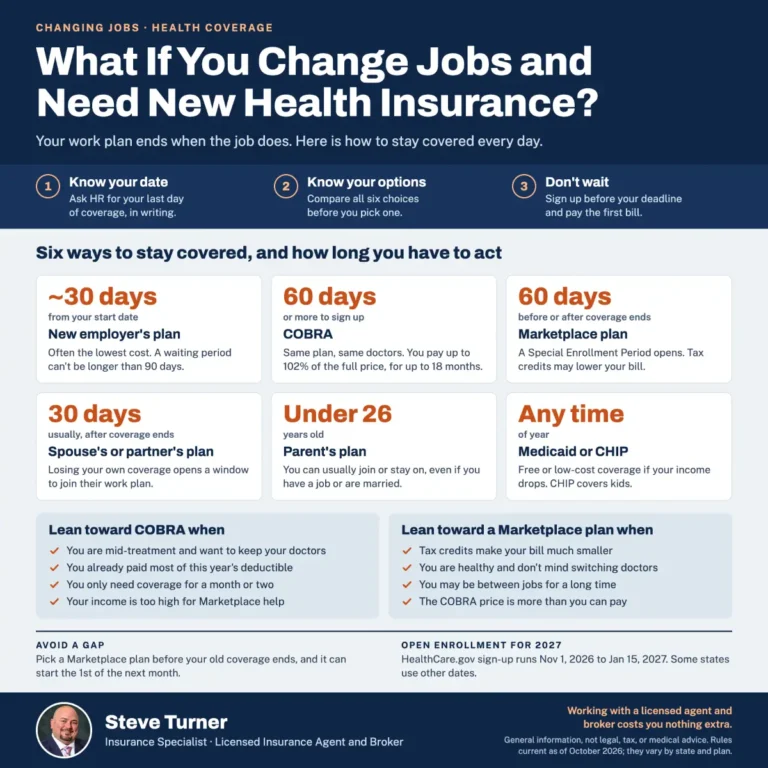
What If You Change Jobs and Need New Health Insurance?
By Steve Turner
• 2026-10-10
Changing jobs and need new health insurance? I explain COBRA, Marketplace plans, waiting periods, and the deadlines to hit so you never have a gap. -
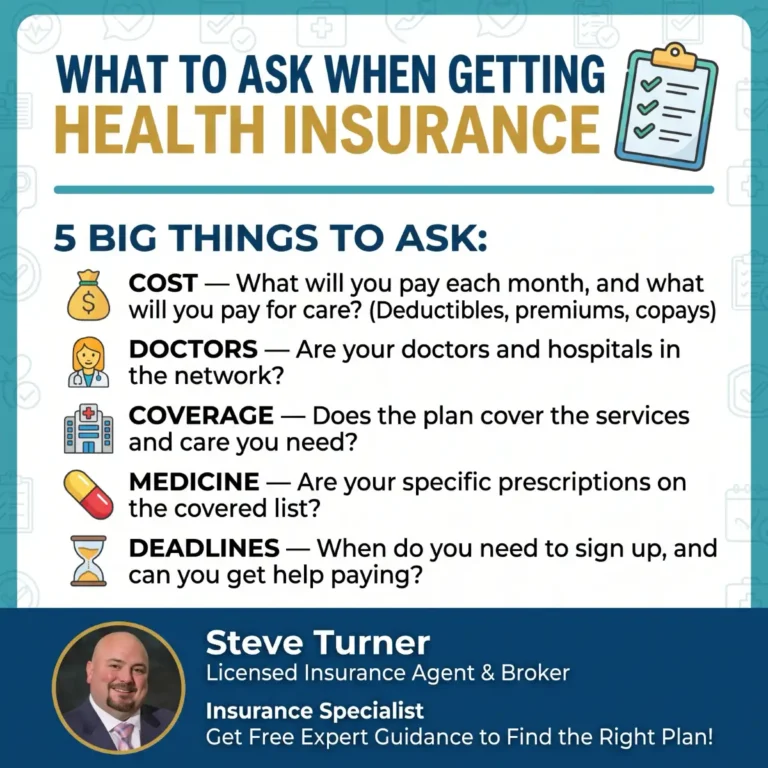
What to Ask When Getting Health Insurance
By Steve Turner
• 2026-10-08
30 questions to ask before buying health insurance, from deductibles to drug lists. Get free help from Tampa agent and broker Steve Turner. -

Does Insurance Cover Braces? | Floridians Learn Here!
By Steve Turner
• 2025-06-19
Does dental insurance pay for braces? Learn about orthodontic coverage, lifetime maximums, and plans for kids and adults. Tap to Learn Now! -

Save 10 Ways: Out-of-Pocket Maximum in Florida
By Steve Turner
• 2025-05-23
Stop overpaying! Learn 10 expert ways to reach your out-of-pocket maximum faster and lower your medical costs today with Steve Turner. Tap to Learn Now! -

Health Insurance Copay | Low Costs for Floridians!
By Steve Turner
• 2025-05-19
What is a health insurance copay? Learn how fixed costs for doctor visits and prescriptions affect your budget and plan choice. Tap to Learn Now! -

What is a Health Insurance Deductible for Floridians?
By Steve Turner
• 2025-05-16
Understand how health insurance deductibles impact your out-of-pocket costs and monthly premiums. Master your medical plan today. Tap to Learn Now! -

Health Insurance Premium: 2027 Florida Cost Guide
By Steve Turner
• 2025-05-14
Florida ACA premiums rose 10.4% for 2027 and enhanced subsidies are gone. A licensed agent explains what you’ll pay, who still gets help, and how to save. -
How Does Health Insurance Work in 2027?
By Steve Turner
• 2025-05-13
Learn how health insurance works in 2027: premiums, deductibles, the new $12,000 out-of-pocket cap, subsidies, and Florida options like Medicaid and KidCare. -

4 Common Health Insurance Plans
By Steve Turner
• 2025-01-29
Compare HMO, PPO, EPO, and POS health insurance plans. Find the best coverage, costs, and doctor networks for your needs. Tap to Learn Now! -

10 Ways the Affordable Care Act Can Help Me
By Steve Turner
• 2023-03-20
Maximize your healthcare with the Affordable Care Act. Explore 10 ways the ACA provides savings, free preventive care, and more. Tap to Learn Now! -

Top 25 Health Insurance Questions in Florida
By Steve Turner
• 2023-03-13
Choosing health insurance is complex. Get expert answers on premiums, deductibles, PPO vs. HMO, and how to lower your out-of-pocket costs. Tap to Learn Now! -

Major Medical Vs Supplemental Insurance in Florida
By Steve Turner
• 2021-08-18
Understand the key differences between Major Medical and Supplemental Insurance to bridge coverage gaps and save on costs. Tap to Learn Now!
Medicare plan availability differs by state and county. Steve Turner is licensed in AL, CO, FL, GA, NC, SC, TN, and TX.
Steve Turner is a licensed insurance agent and is not connected with or endorsed by the United States Government or the Federal Medicare Program. The Medicare Annual Enrollment Period is October 15 to December 7.
MEDICARE DISCLAIMER
We do not offer every plan available in your area. Any information we provide is limited to those plans we do offer in your area. Please contact Medicare.gov or 1-800-MEDICARE to get information on all of your options.
Steve Turner

Steve Turner, CLU®, REBC® is licensed in AL, CO, FL, GA, NC, SC, TN, and TX · NPN 18030539 · Florida License W333468
Steve Turner is a licensed agent and broker and a long-standing member of the National Association of Benefits and Insurance Professionals NABIP®. Steve holds the Registered Employee Benefits Consultant® (REBC®) designation. Steve also holds the “Chartered Life Underwriter” designation (CLU®), a professional credential for individuals specializing in life insurance and estate planning, conferred by the American College of Financial Services. Since 2016 (over 10 years), Steve has helped individuals, families, Medicare beneficiaries, and small businesses find the right coverage to meet their needs. Steve has earned 180+ Google reviews from happy clients.
Steve Turner is a licensed agent appointed by Florida Blue in Florida.