

How Do Health Insurance Agents Get Paid Explained

How Do Health Insurance Agents Get Paid Explained
Health insurance agents get paid by the insurance company, not by me or you. Most of that pay comes from commissions. A commission is a payment the company sends the agent when someone signs up for a plan.
I used to wonder about this every time an agent offered to help me “for free.” Nobody works for free. So where does the money come from? And does it make my plan cost more?
In this guide, I’ll walk you through how health insurance agents get paid, step by step. I’ll keep the words simple and the numbers real. By the end, you’ll know:
- Who pays the agent
- The six main ways agents earn money
- How pay changes for ACA, Medicare, and job-based plans
- Whether using an agent costs you extra
- What to ask an agent before you sign up
The Short Answer
Here is the quick version if you’re in a hurry:
- The insurance company pays the agent. The payment is called a commission.
- I pay the same price with or without an agent. The cost is already built into the plan.
- Agents get paid again when I keep my plan. This is called a renewal.
- Some agents also earn a salary, bonuses, or fees. It depends on where they work.
- Rules limit agent pay on some plans. Medicare Advantage is the best-known example.
That’s the big picture. Now let’s dig into the details.
Agent vs. Broker: What’s the Difference?
People use “agent” and “broker” like they mean the same thing. They are close, but not the same. The difference matters because it shapes how each one gets paid.
- Captive agent. Works for one insurance company and sells only that company’s plans. Often earns a salary plus commission.
- Independent agent. Sells plans from several companies. Usually paid by commission only.
- Broker. Works for me, the buyer, and shops many companies. Still paid mostly by commissions from the insurance company.
- Navigator. A trained helper for ACA plans. Paid by grants, not by commissions.
Agents and brokers both need a state license to sell health insurance. To keep things simple, I’ll say “agent” for the rest of this article. Almost everything here is true for brokers too.
6 Ways Health Insurance Agents Get Paid
Most agents earn money in more than one way. Here are the six I see most often.
1. First-Year Commissions
When I sign up for a new plan, the insurance company pays my agent a commission. This first payment is usually the biggest one. It pays the agent for the upfront work. That work includes learning what I need, comparing plans, and filling out forms.
Commissions come in two styles:
- A flat dollar amount for each person covered
- A percent of the premium (the premium is my monthly bill)
2. Renewal Commissions
If I keep my plan next year, my agent gets paid again. This is called a renewal commission. It is usually smaller than the first one. On a Medicare Advantage plan, the renewal is about half of the first-year amount.
Renewals are why good agents stay in touch. If I’m happy and I stay, they keep earning. That gives them a reason to help me long after I sign up.
3. Salary
Some agents are employees. They may work at a call center, an insurance company, or a big agency. These agents get a steady paycheck.
The U.S. Bureau of Labor Statistics says employee agents are paid in one of three ways:
- Salary only
- Salary plus commission
- Salary plus bonus
4. Bonuses
Insurance companies and agencies sometimes pay extra when an agent hits a goal. The goal might be a certain number of new sign-ups. It might be keeping most clients on their plans all year.
Bonuses are less common in Medicare. The rules there are much tighter.
5. Overrides
An override is a small extra payment that goes to the agency above the agent. The insurance company pays it on top of the agent’s commission. Think of it as pay for training and support.
An override does not come out of my pocket. It does not shrink my benefits either.
6. Fees
A few agents charge a fee straight to the client. This is most common with large business clients. It is rare when a person buys a plan for themselves.
Medicare has a firm rule here. An agent can’t charge me a fee for helping me pick a Medicare Advantage plan. The plan’s commission is their pay.
How Much Do Agents Get Paid for Each Type of Plan?
Agent pay depends a lot on the plan type. Here is a side-by-side look.
| Plan type | How the agent is paid | Typical amount |
|---|---|---|
| ACA Marketplace plan | Flat amount per person, each month | About $20 per person a month on average |
| Medicare Advantage | Flat amount per person, each year, with a cap | Up to $725 the first year and $363 after (2027, most states) |
| Medicare Part D drug plan | Flat amount per person, each year, with a cap | Up to $130 the first year and $65 after (2027) |
| Medicare Supplement (Medigap) | Percent of the premium, no federal cap | Example: 22% of a $2,000 yearly premium is $440 |
| Small business group plan | Percent of the total premium | Often 3% to 6% |
| Large business group plan | Percent that shrinks as the group grows | Can drop below 2% |
Now let me explain each one in plain words.
ACA Marketplace Plans
ACA plans are the ones sold on HealthCare.gov and state websites. Some people call them Obamacare plans.
The Marketplace does not pay agents. The insurance company does. Most companies pay a flat amount per person on the plan each month. The national average is close to $20 per person a month. Some states pay under $10. Others pay over $30.
Here is a quick example. Say my family of three signs up, and the agent earns $20 for each of us.
- $20 x 3 people = $60 a month
- $60 x 12 months = $720 a year
The agent only keeps getting paid while I keep paying my premium.
Medicare Advantage and Part D Plans
Medicare is different. The government sets a yearly cap on agent pay. For 2027, the limits for Medicare Advantage are:
- Most states: $725 the first year, $363 for each renewal
- Connecticut, Pennsylvania, and Washington, D.C.: $816 and $408
- California and New Jersey: $902 and $451
For a Part D drug plan, the 2027 limit is $130 the first year and $65 for each renewal.
These numbers are the most a plan can pay. A plan can pay less. The limits went up about 4.5% from 2026, when the top first-year amount was $694.
Medicare Supplement Plans
Medicare Supplement plans are also called Medigap. Agents earn a percent of the premium on these. Medicare does not cap that percent.
Here is one example. A plan costs $2,000 a year. The first-year commission rate is 22%. The agent earns $440.
Job-Based Group Plans
When a business buys a plan for its workers, the agent earns a percent of the total premium. For a small business, 3% to 6% is common.
Say a small shop pays $100,000 in premiums a year. At 5%, the agent earns $5,000 that year.
Big companies are a different story. The percentage shrinks as the group grows. It can fall below 2%.
Do I Pay More If I Use a Health Insurance Agent?
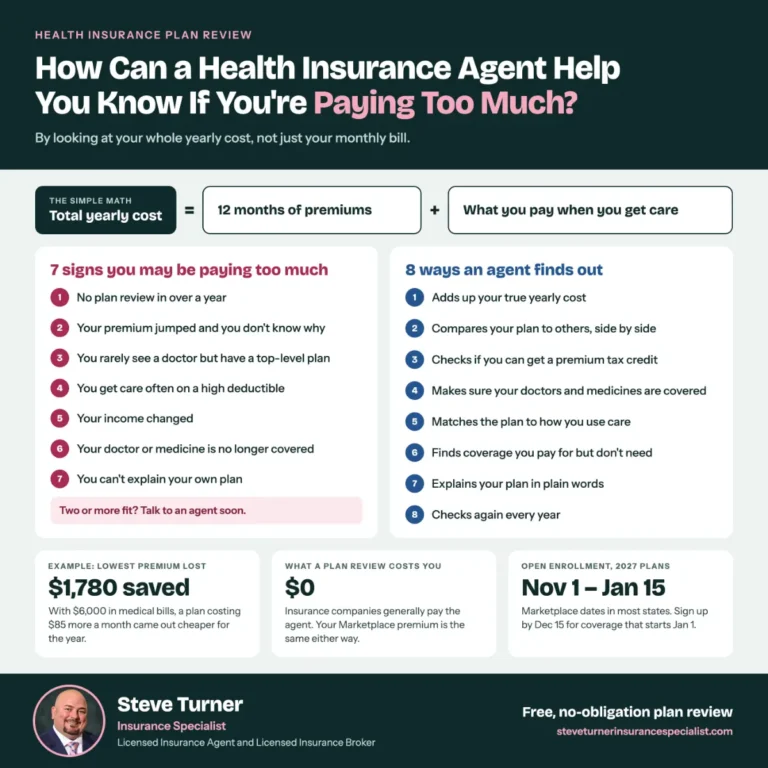
No. My premium is the same whether I use an agent, call the insurance company, or sign up on the Marketplace by myself.
This surprised me at first. Here is why it works that way.
- The cost is already built in. Insurance companies plan for commissions when they set their rates. They file those rates with the state.
- The price is the same for everyone. There is no “agent price” and “no-agent price” for the same plan.
- A federal rule limits overhead. For plans people buy on their own and small group plans, at least 80 cents of every premium dollar must go to medical care. Agent pay has to fit inside the other 20 cents.
I think of it like a grocery store. The shelf price is the same whether I use a cashier or self-checkout. The cashier’s pay is already part of the price.
One thing to watch for: A small number of agents charge their own fee on top. That is why I always ask about fees before I start.
What Do Agents Do to Earn Their Pay?
A commission can look like easy money. It isn’t. Here is what a good agent does for me before and after I sign up.
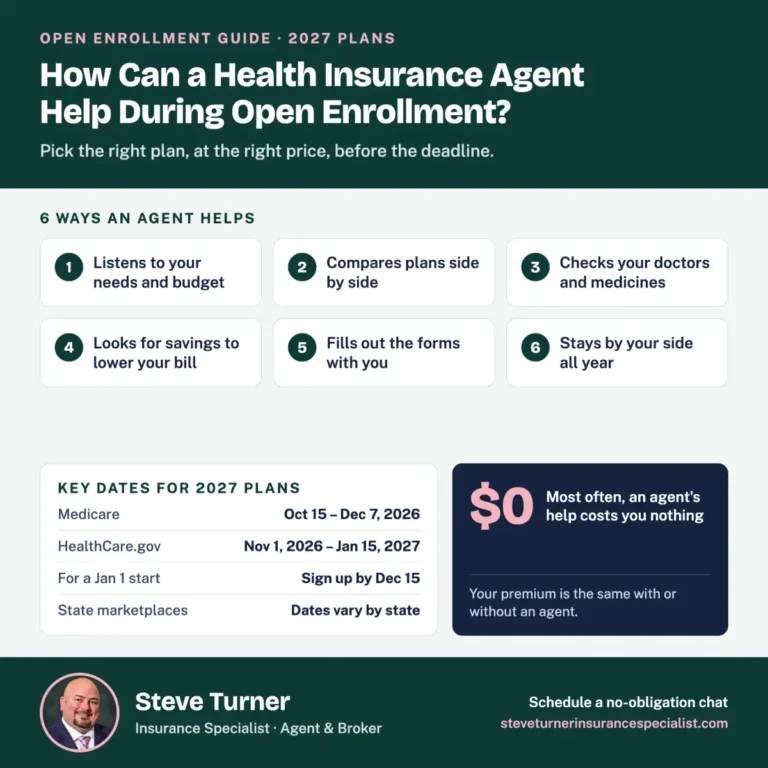
- Asks about my needs. They learn about my doctors, my medicines, and my budget.
- Compares plans. They line up costs and benefits, so I don’t have to.
- Checks for savings. They see if I can get help paying, like a tax credit.
- Fills out the forms. They help me enroll without mistakes.
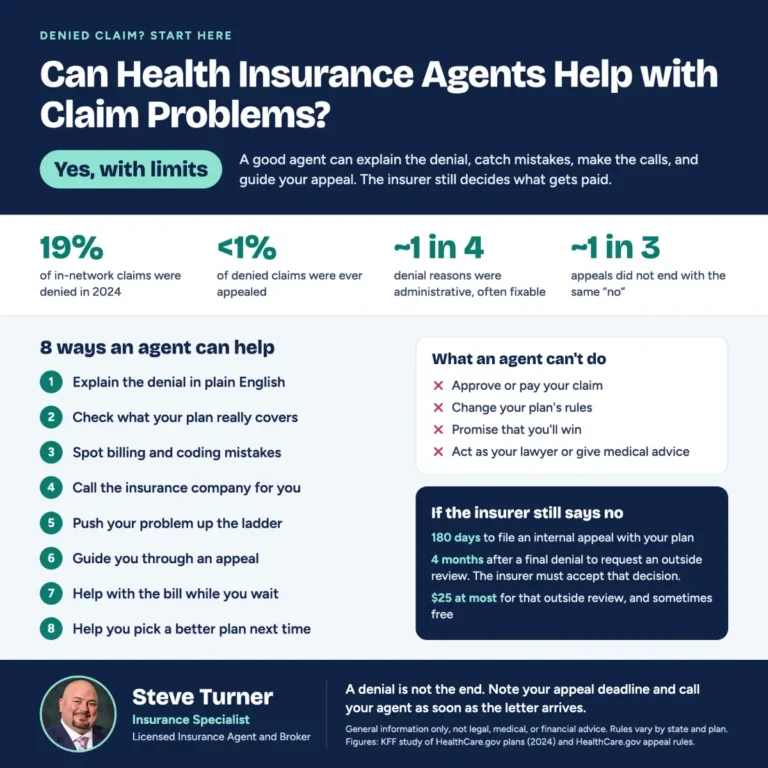
- Fixes problems later. They step in when a bill looks wrong, or a claim gets denied.
- Reviews my plan each year. Plans change, and so does my health.
The renewal commission pays for those last two jobs. I think of it as a service fee that the insurance company covers for me.
When Do Health Insurance Agents Get Paid?
Agents don’t get paid the minute I say yes. The timing depends on the plan and the company. There are two common setups.
- Paid as earned. The agent gets a little each month as I pay my bill. Most ACA plans work this way.
- Paid in advance. The company pays the agent for the whole year up front. This is common with Medicare Advantage plans.
What Is a Chargeback?
A chargeback happens when an agent has to refund money. It comes up when someone cancels a plan soon after signing up.
Here is how that can look:
- I join a Medicare Advantage plan, then switch out of it a few weeks later. My agent may have to return the commission.
- I cancel a regular health plan in the first 90 days. Some contracts require the agent to return all pay.
I like this rule as a buyer. It gives my agent a strong reason to find a plan I’ll want to keep. A rushed sale that falls apart earns them nothing.
Do Agents Push Plans That Pay Them More?
This is the question I cared about most. The fair answer is that it can happen. Pay is not the same at every company. Some plans pay agents nothing. An agent who only sells for a few companies may never mention the rest.
The good news is that most agents want happy clients who stay for years. Renewals and chargebacks both reward that. Rules also protect me.
5 Rules That Protect Me
- Medicare pay limits. The top commission is the same for every Medicare Advantage plan in my area. That leaves less reason to favor one plan over another.
- The 80/20 rule. Insurance companies must spend most of my premium on care. They can’t pile on sales costs.
- No Medicare fees. An agent can’t bill me for help choosing a Medicare Advantage plan.
- Written pay reports for group plans. Since late 2021, an agent who expects to earn $1,000 or more from a job-based health plan must tell the employer in writing. The report has to list what they will do and what they will be paid.
- State licenses. Every agent must hold a license in my state. The state can take it away for bad behavior.
A New Change for 2027
The government is also watching ACA agents more closely. Some agents were caught signing people up for plans without asking them first.
In response, the federal government paused new agent sign-ups on HealthCare.gov for 2027 plans. The pause started on September 22, 2026. It is expected to last until February 1, 2027.
Agents who were already signed up for 2026 can still help me. State-run websites are not part of the pause.
How Much Do Health Insurance Agents Make in a Year?
It varies a lot. A new agent may earn very little. An agent with hundreds of loyal clients can earn a great living.
Here is what the Bureau of Labor Statistics reported for all insurance sales agents in May 2025:
- Middle pay: $62,280 a year
- Lowest 10%: less than $37,330
- Highest 10%: more than $138,140
Those numbers cover every kind of insurance, not just health. They also leave out self-employed agents.
A Simple Example
Let me make up an agent named Sam. Sam lives in a state with the standard Medicare limits.
- Year one. Sam helps 100 people join Medicare Advantage plans in 2027. At the top rate, that is 100 x $725 = $72,500.
- Year two. Ninety of those people stay. At the 2027 renewal rate, that is 90 x $363 = $32,670. Sam earns this before making a single new sale.
This is how agents build income over time. Each year of happy clients stacks on top of the last one.
Keep in mind that Sam has bills too. Independent agents pay for their own licenses, training, software, and ads. Commission isn’t all take-home pay.
Is Using a Health Insurance Agent Worth It?
For me, the answer is usually yes. The help costs me nothing, and health plans are confusing. Still, an agent is not the right choice for everyone.
An agent helps most when:
- I have a health problem or take costly medicines.
- I’m new to Medicare, or I’m buying my first plan.
- I run a small business and need a group plan.
- I don’t have hours to read the fine print.
I might skip the agent when:
- I already know the exact plan I want.
- I want to see every plan, not just the ones one agent sells.
- I feel pushed or rushed.
Either way, the plan price stays the same. The only thing that changes is how much help I get.
7 Questions I’d Ask an Agent About Pay
It can feel rude to ask how someone gets paid. It isn’t. A good agent hears these questions all the time. Here are the seven I would ask.
- How do you get paid when I sign up? I want to hear “commission,” “salary,” or both.
- Do you charge me any fees? The answer should almost always be no.
- How many insurance companies do you work with? More choices usually means a better fit.
- Are there plans in my area that you don’t sell? If so, I’ll look at those by myself.
- Do some plans pay you more than others? An honest agent will tell me.
- Will you help me after I enroll? I want help with bills, claims, and next year’s renewal.
- Are you licensed in my state? I can check this on my state insurance department’s website.
If an agent dodges these questions or gets upset, I take that as a sign. I thank them and find someone else.
Frequently Asked Questions
Q: Do I have to pay a health insurance agent?
A: Rarely. The insurance company pays the agent. A few agents charge their own fee, so I ask up front.
Q: Is it cheaper to buy health insurance without an agent?
A: No. The premium is the same either way. Skipping the agent does not give me a discount.
Q: How much do health insurance agents make per policy?
A: It depends on the plan. An ACA plan pays about $20 per person each month on average. A Medicare Advantage plan pays up to $725 for the first year in most states in 2027. A small group plan often pays 3% to 6% of the premium.
Q: Do agents get paid every year I keep my plan?
A: Yes, in most cases. This is the renewal commission. It is usually smaller than the first-year pay.
Q: Does HealthCare.gov pay agents?
A: No. The Marketplace does not pay agents or set their pay. The insurance company that sells the plan pays them.
Q: Do agents get paid if I ask questions but never sign up?
A: Usually not. Commission-only agents earn nothing until someone enrolls. That is one reason some agents follow up so often.
Q: Do health insurance agents get paid by the hour?
A: Some do. Agents who work as employees may earn hourly pay or a salary. Independent agents are paid mostly by commission.
Q: Can I switch agents and keep my plan?
A: Often, yes. I can ask my insurance company to change my “agent of record.” The new agent then gets the future commissions. Steps differ by company so that I would call and ask.
Q: Who can help me if I don’t want someone paid by commission?
A: I have a few free choices:
- For ACA plans: A navigator. Navigators are paid by grants, not by insurance companies.
- For Medicare: A SHIP counselor. SHIP stands for State Health Insurance Assistance Program.
- For either one: I can also call the plan or enroll online by myself.
The Bottom Line
So, how do health insurance agents get paid? In most cases, the insurance company pays them a commission when I enroll. Then it pays them a smaller amount each year I stay.
Here is what I want you to remember:
- I don’t pay extra for using an agent.
- Agent pay is built into every plan’s price.
- Medicare sets a top limit on what agents can earn.
- Renewals and chargebacks reward agents for keeping me happy.
- It’s always okay to ask an agent how they get paid.
A good agent can save me hours of work and help me dodge costly mistakes. Now that I know where their paycheck comes from, I can ask better questions. I can also choose my plan with much more confidence.
Why choose Steve Turner Insurance Specialist?
Because I’m an “Insurance Specialist.” An “insurance specialist” is a broad term that includes insurance agents and insurance brokers, but the key difference is who the agent represents versus who the broker represents.
An “insurance agent” works directly for an insurance company and sells its specific policies to clients.
An “insurance broker” acts as an independent intermediary, comparing policies from multiple companies to find the best fit for their client’s needs, essentially representing the client rather than the insurance company.
I am both a licensed Insurance Agent and a licensed Insurance Broker.
My number one goal in life is to help people and ensure, without a shadow of a doubt, that you and your family are secure and protected. I will always be by your side, helping you mitigate risk by providing the industry’s best and most affordable insurance solutions.
I will find insurance plans for the entire family to help cover whatever life throws at you. I can help you save on severe medical emergencies, find a health insurance plan with low- or no-cost doctor visits and affordable prescription medications, and protect your family in the event of an unexpected accident or illness.
Best of all, it doesn’t cost you anything extra to use an experienced Insurance Agent and Broker like me to help you find the Insurance Plans that fit your individual, family, or business needs.
The companies that sell the insurance plans “you choose“ pay me – you don’t pay me. Calling any big insurance company directly won’t get you a lower price, as they will forward your call to the next available insurance agent on their list. You won’t have had any opportunity to learn about the insurance agent you’re speaking with in advance, understand their qualifications or experience level, or make an informed choice about who you want to work with.
Tap the Contact Me text or icon and get in touch by phone or email, or schedule a “No Obligation” chat through my calendar. I look forward to speaking with you!
OUR CLIENT REVIEWS


CONTACT STEVE TURNER INSURANCE AGENT & BROKER
I’m here to take your calls and emails and answer your questions 7 Days a week from 7:00 a.m. to 8:00 p.m., excluding posted holidays.
Steve Turner is a licensed agent and broker and a longstanding member of the National Association of Benefits and Insurance Professionals®. Steve holds the prestigious Registered Employee Benefits Consultant® designation. NABIP® is the preeminent organization for health insurance and employee benefits professionals and works diligently to ensure all Americans have access to high-quality, affordable Healthcare and related services.
Steve Turner is a licensed agent appointed by Florida Blue.
EMAIL ME: 24×7
OFFICE LOCATION
Website: steveturnerinsurancespecialist.com
Email: [email protected]
Phone and Text: +1-813-388-8373
Business Hours:
Monday: 7 a.m. to 8 p.m.
Tuesday: 7 a.m. to 8 p.m.
Wednesday: 7 a.m. to 8 p.m.
Thursday: 7 a.m. to 8 p.m.
Friday: 7 a.m. to 8 p.m.
Saturday: 7 a.m. to 8 p.m.
Sunday: 7 a.m. to 8 p.m.
SOCIAL FOLLOW + SHARE
Insurance Agent
MEDICARE STATEMENT
The Medicare Annual Enrollment Period is October 15th to December 7th. Steve Turner is not connected with or endorsed by the United States Government or the Federal Medicare Program. Some plans may not be available in your area, and any information I provide is limited to those offered. Please contact Medicare.gov or 1-800-MEDICARE for information on all your options.
There’s no one-size-fits-all answer. Carefully evaluate your health status, anticipated medical needs, prescription drug usage, budget, preferred doctors and hospitals, and tolerance for network rules. During the Medicare Annual Enrollment Period (October 15th to December 7th), research the specific plans available in your Florida county using the Medicare Plan Finder on Medicare.gov, compare costs and benefits, and consider free, personalized counseling from Florida’s SHINE (Serving Health Insurance Needs of Elders) program.