

Group Health Insurance and Employee Benefits for Small Businesses
Reviewed by Steve Turner, CLU, REBC · Florida License W333468 · NPN 18030539 · November 2026
Key takeaways
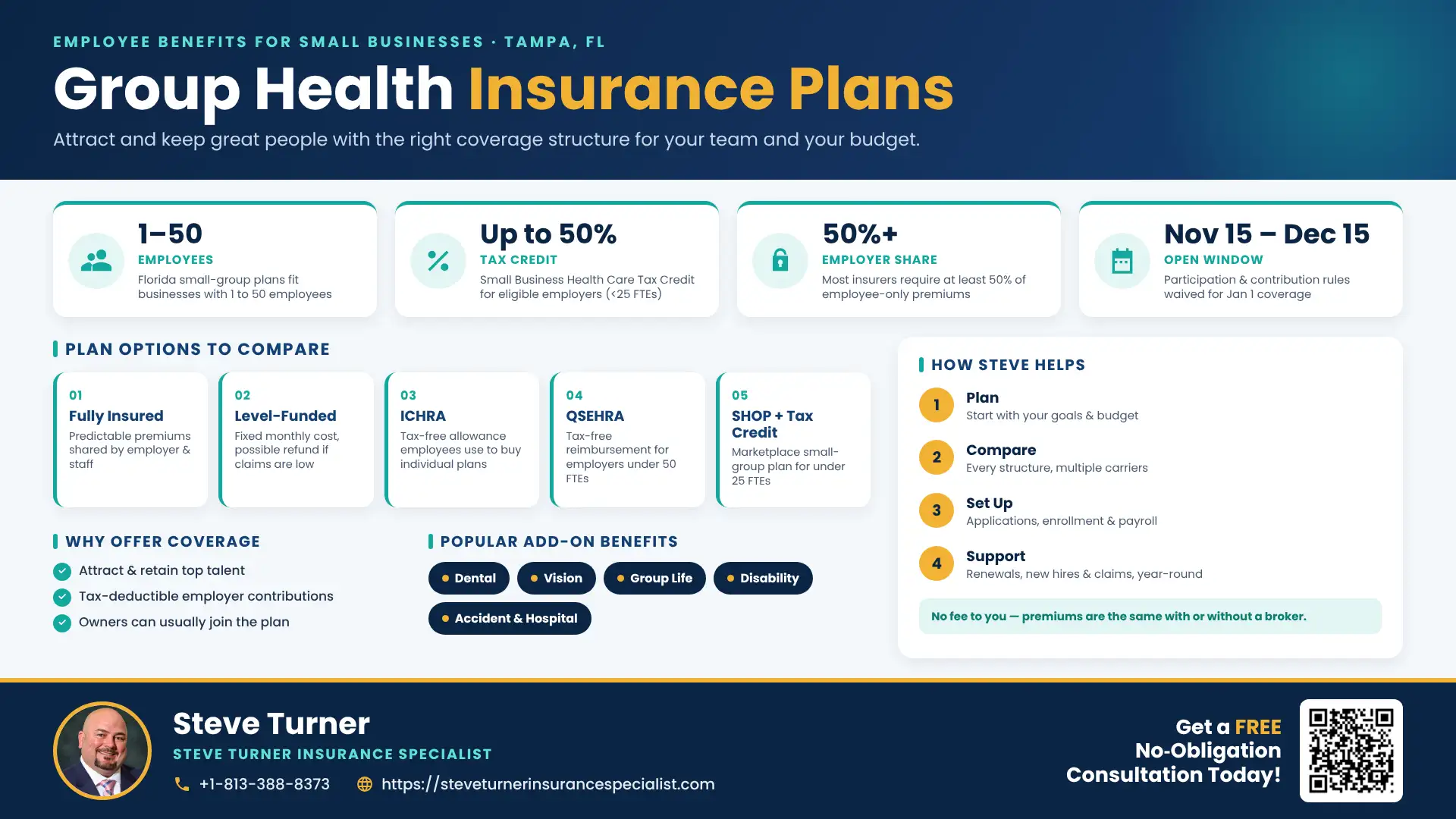
- In Florida, small group health plans are for businesses with 1 to 50 employees. Larger employers buy large-group or self-funded plans.
- You don’t have to offer a traditional group plan. ICHRA and QSEHRA let you give employees a tax-free allowance to buy their own coverage.
- Businesses with fewer than 25 full-time-equivalent employees and modest average wages may qualify for the Small Business Health Care Tax Credit, worth up to 50% of what you pay toward premiums.
- November 15 – December 15: insurers must accept small groups that don’t meet the usual participation or contribution rules, for January 1 coverage.
- Employers with 50 or more full-time-equivalent employees must offer affordable coverage or risk ACA penalties.
What group health insurance is
Group health insurance is a health plan an employer buys for its employees, and often their families. The employer pays part of the premium, usually at least half of employee-only coverage. Employees pay the rest through payroll deduction, often before taxes.
Why businesses offer it:
- Hiring and keeping people: health coverage is the first benefit employees ask about.
- Tax advantages: employer contributions are generally tax-deductible for the business and tax-free to employees.
- Coverage for the owner: owners can usually join the plan too.
Your options, compared
| Option | How it works | Good fit for | Watch out for |
|---|---|---|---|
| Fully insured small group plan | The insurance company sets a premium; you and employees share it | Businesses that want predictable costs and a traditional plan | Participation and contribution minimums; yearly renewals |
| Level-funded plan | Fixed monthly cost, with a possible refund if your group’s claims are low | Healthy groups, often 5 or more employees | Requires health information for underwriting; refunds aren’t guaranteed |
| ICHRA (individual coverage HRA) | You set a monthly allowance; employees buy individual plans and you reimburse them tax-free | Any size business, including employees spread across counties or states | Employees lose Marketplace subsidies if the ICHRA counts as “affordable” |
| QSEHRA (small business HRA) | Tax-free reimbursement up to the IRS limit | Fewer than 50 full-time-equivalent employees, with no group plan | 2026 limits: $6,450 self-only / $13,100 family. 2027: $6,700 / $13,500 |
| SHOP Marketplace plan + tax credit | Small group plan bought through HealthCare.gov’s SHOP | Fewer than 25 full-time-equivalent employees with lower average wages | Limited plan choices in some counties |
What group health insurance costs
Premiums depend on your employees’ ages, plan design, ZIP code, and how much you contribute. Under the ACA, small group premiums can’t be based on employees’ health. Things that move the cost:
- The plan type: HMO, PPO, EPO, or a high-deductible plan paired with an HSA.
- Your contribution: a percentage of employee-only coverage, of family coverage, or a fixed dollar amount.
- Participation: many insurers want about 70–75% of eligible employees enrolled (not counting those with other coverage). This is waived during the November 15 – December 15 window.
2026 limits worth knowing:
| Limit | 2026 |
|---|---|
| HSA contribution, self-only | $4,400 |
| High-deductible plan minimum deductible | $1,700 self-only / $3,400 family |
| ACA out-of-pocket maximum | $10,600 self-only / $21,200 family |
| Health FSA employee contribution | $3,400 |
More: How much does group health insurance cost? · How do I compare group health insurance quotes?
The Small Business Health Care Tax Credit
You may qualify if:
- You have fewer than 25 full-time-equivalent employees.
- Your average annual wages are low enough. For 2026, the credit begins phasing out when average wages exceed $34,100.
- You pay at least 50% of employee-only premiums.
- You buy coverage through the SHOP Marketplace.
The credit can be worth up to 50% of what you contribute toward premiums, for two consecutive years. Ask your tax advisor to confirm your eligibility (IRS Form 8941).
Employees turning 65 and Medicare
- 20 or more employees: your group plan pays first. Employees can usually delay Part B without a penalty while they’re covered through active work.
- Fewer than 20 employees: Medicare usually pays first, so employees who are 65 or older generally need Part B to avoid gaps.
I help both businesses and employees get the timing right. More: Medicare Part B · Can I delay Part B if I’m still working?
Benefits you can add
| Benefit | What it does | More |
|---|---|---|
| Dental | Cleanings, fillings and major work | Dental insurance |
| Vision | Eye exams, glasses and contacts | |
| Group life | Death benefit, often 1–2× salary | Life insurance |
| Short- and long-term disability | Replaces income when an employee can’t work | Disability insurance |
| Accident and hospital indemnity | Cash benefits that help with deductibles | Hospital indemnity · Accident insurance |
Many of these can be voluntary: employees pay through payroll deduction, at little or no cost to the business.
Group health insurance in Tampa: what to check
- Networks: many Tampa employees want access to Tampa General, BayCare (St. Joseph’s), AdventHealth, HCA Florida or Moffitt. Networks differ by plan, so check them before you choose.
- Employees in other counties or states: an ICHRA or a broad PPO network may work better than a local HMO.
- Renewal timing: most small group renewals arrive 60–90 days ahead. Start comparing as soon as you get yours.
- Industries: I work with professional offices, contractors, restaurants, medical and dental practices, and nonprofits around Hillsborough County.
I work with businesses in Carrollwood, Northdale, Westchase, Citrus Park, Lutz, Westshore, downtown Tampa, Ybor, Brandon, Riverview, and across Hillsborough County. My office is on North Dale Mabry Highway, and I also meet by phone or video.
Where I can help
I’m licensed to help with group and individual health insurance in 8 states: Alabama · Colorado · Florida · Georgia · North Carolina · South Carolina · Tennessee · Texas
How I help
- Start with your goals and budget: how much you want to contribute, who’s eligible, and what employees value most.
- Compare every structure: traditional, level-funded, ICHRA, and QSEHRA, from multiple insurance companies.
- Handle the setup: applications, employee enrollment, and payroll-deduction details.
- Stay with you year-round: renewals, new hires, employees turning 65, and claims or billing problems.
As a Registered Employee Benefits Consultant (REBC), I’m trained in group benefits design and compliance. There’s no cost to work with me: the insurance company pays me, and your premium is the same whether you use a broker or not.
Group health insurance FAQs
How many employees do I need for group health insurance in Florida?
Florida small group plans are for businesses with 1 to 50 employees. Some insurers have their own minimums or require at least one W-2 employee who isn’t the owner or the owner’s spouse, so ask before you apply.
How much does an employer have to pay?
Most insurers require the employer to pay at least 50% of employee-only premiums. During the November 15 – December 15 window, insurers must accept groups that don’t meet their contribution or participation rules.
What is an ICHRA?
An individual coverage HRA lets you give employees a tax-free monthly allowance to buy their own individual health plans. There’s no IRS dollar cap, and you can set different amounts for different employee classes.
What is a QSEHRA?
A small business HRA for employers with fewer than 50 full-time-equivalent employees and no group plan. For 2026, you can reimburse up to $6,450 for self-only coverage and $13,100 for family coverage.
Do I have to offer health insurance?
Only if you have 50 or more full-time-equivalent employees. Smaller businesses offer it by choice, usually to hire and keep people.
How quickly can coverage start?
Often on the first of the next month if you complete the application by the insurer’s deadline. More: How quickly can employees get group health insurance coverage?
Does it cost more to use a broker?
No. Premiums are the same with or without a broker. I’m paid by the insurance company you choose.
Talk with Steve
Want to compare group plans, ICHRA, and QSEHRA for your business, and see what you’d actually pay per employee? Call me at (813) 388-8373 or book time on my calendar. I’ll walk you through your options in plain English.
Related: Health insurance · Dental insurance · Disability insurance · Life insurance · What group health plans should I offer employees?
OUR CLIENT REVIEWS


CONTACT STEVE TURNER, LICENSED INSURANCE AGENT & BROKER
Questions? Call, text, or book a time below; I answer calls and emails 7 Days a week from 7:00 a.m. to 8:00 p.m., excluding posted holidays.
EMAIL STEVE
OFFICE LOCATION
Address: 14502 N Dale Mabry Hwy, Suite 200, Tampa, FL 33618
Website: steveturnerinsurancespecialist.com
Email: [email protected]
Phone and Text: +1-813-388-8373
Business Hours:
Monday: 7:00 a.m. / 8:00 p.m.
Tuesday: 7:00 a.m. / 8:00 p.m.
Wednesday: 7:00 a.m. / 8:00 p.m.
Thursday: 7:00 a.m. / 8:00 p.m.
Friday: 7:00 a.m. / 8:00 p.m.
Saturday: 7:00 a.m. / 8:00 p.m.
Sunday: 7:00 a.m. / 8:00 p.m.
Medicare plan availability differs by state and county. Steve Turner is licensed in AL, CO, FL, GA, NC, SC, TN, and TX.
Steve Turner is a licensed insurance agent and is not connected with or endorsed by the United States Government or the Federal Medicare Program. The Medicare Annual Enrollment Period is October 15 to December 7.
MEDICARE DISCLAIMER
We do not offer every plan available in your area. Any information we provide is limited to those plans we do offer in your area. Please contact Medicare.gov or 1-800-MEDICARE to get information on all of your options.
Steve Turner

Steve Turner, CLU®, REBC® is licensed in AL, CO, FL, GA, NC, SC, TN, and TX · NPN 18030539 · Florida License W333468
Steve Turner is a licensed agent and broker and a long-standing member of the National Association of Benefits and Insurance Professionals NABIP®. Steve holds the Registered Employee Benefits Consultant® (REBC®) designation. Steve also holds the “Chartered Life Underwriter” designation (CLU®), a professional credential for individuals specializing in life insurance and estate planning, conferred by the American College of Financial Services. Since 2016 (over 10 years), Steve has helped individuals, families, Medicare beneficiaries, and small businesses find the right coverage to meet their needs. Steve has earned 180+ Google reviews from happy clients.
Steve Turner is a licensed agent appointed by Florida Blue in Florida.