

What Does Medicare Supplement Insurance Cover for 2027?

What Does Medicare Supplement Insurance Cover for 2027? Understanding What Gaps a Supplement Fills in Original Medicare
Medicare Supplement Insurance helps pay the bills that Original Medicare leaves behind. That includes deductibles, copays, and the 20% you owe on most doctor visits. In this guide, I’ll walk you through what these plans cover in 2027, plan by plan, plus the new 2027 numbers you need to know.
Why I Wrote This Guide
When I first looked at Medicare, I was surprised. I thought Medicare paid for everything. It doesn’t. Original Medicare (Part A and Part B) pays a big chunk of your health care costs. But it leaves gaps. Those gaps can add up fast, and there is no yearly cap on what you might owe.
That’s where Medicare Supplement Insurance comes in. Most people call it Medigap because it fills the “gaps” in Original Medicare. You buy it from a private insurance company. You pay a monthly premium. In return, the plan pays some or all of the costs Medicare doesn’t.
Here’s what makes 2027 worth a fresh look:
- New high-deductible amount. The high-deductible versions of Plan G and Plan F now have a $3,050 deductible in 2027.
- Higher caps on Plans K and L. Their yearly out-of-pocket limits went up to $8,360 and $4,180.
- Medicare’s own costs are rising. The Part B deductible is expected to rise in 2027, too.
I’ll explain each of these in plain words. By the end, you’ll know what Medigap covers, what it doesn’t, and how to pick a plan that fits your life and budget.
Quick note: I’m not a licensed insurance agent or a lawyer. This guide is to help you learn. Always check with Medicare.gov, your State Health Insurance Assistance Program (SHIP), or a licensed agent before you buy.
What Does Medicare Supplement Insurance Cover in 2027?
In 2027, Medigap plans can cover up to nine main benefits. Every plan covers some of them. Only a few plans cover all of them.
The good news is that Medigap plans are standardized. That means a Plan G from one company covers the same things as a Plan G from another company. The only big difference is the price. (Massachusetts, Minnesota, and Wisconsin set up their plans a little differently, so check your state rules if you live there.)
Here are the nine benefits I look for when I compare plans:
- Part A coinsurance and hospital costs. This covers your share of a long hospital stay, plus 365 extra hospital days after Medicare’s days run out. Every Medigap plan covers this.
- Part B coinsurance or copays. This is the 20% you usually owe for doctor visits, tests, and outpatient care. Most plans pay all of it.
- Blood (first 3 pints). If you need a blood transfusion, Medicare doesn’t pay for the first 3 pints. Medigap helps here.
- Hospice care coinsurance. This covers small copays for hospice care and short-term respite care.
- Skilled nursing facility coinsurance. After a hospital stay, you may need care in a nursing facility. Starting on day 21, you owe a daily copay. Many plans pay it.
- Part A deductible. This is what you pay before Medicare covers a hospital stay. It can cost well over $1,700 each time you have a new benefit period.
- Part B deductible. This is the yearly amount you pay before Part B starts paying. Only Plans C and F cover it, and only for people who were eligible for Medicare before 2020.
- Part B excess charges. Some doctors can charge up to 15% more than Medicare’s approved amount. Plans F and G cover this extra cost.
- Foreign travel emergencies. If you get sick or hurt outside the U.S., some plans pay 80% of emergency care, up to plan limits.
Think of these nine benefits like a menu. Each plan letter picks a different set of items from that menu. Next, I’ll show you which plan covers what.
Medigap Plans Compared: What Each Plan Covers in 2027
You can still buy 10 Medigap plans, named with letters: A, B, C, D, F, G, K, L, M, and N. Plan G is the most comprehensive plan most new members can buy in 2027, and Plan N is a popular lower-cost option.
In this chart, “Yes” means the plan pays 100% of that cost. A percent means it pays only part.
| Plan | Part A coinsurance | Part B coinsurance | Blood (3 pints) | Hospice | Skilled nursing | Part A deductible | Part B deductible | Part B excess | Foreign travel |
|---|---|---|---|---|---|---|---|---|---|
| A | Yes | Yes | Yes | Yes | No | No | No | No | No |
| B | Yes | Yes | Yes | Yes | No | Yes | No | No | No |
| C* | Yes | Yes | Yes | Yes | Yes | Yes | Yes | No | 80% |
| D | Yes | Yes | Yes | Yes | Yes | Yes | No | No | 80% |
| F* | Yes | Yes | Yes | Yes | Yes | Yes | Yes | Yes | 80% |
| G | Yes | Yes | Yes | Yes | Yes | Yes | No | Yes | 80% |
| K | Yes | 50% | 50% | 50% | 50% | 50% | No | No | No |
| L | Yes | 75% | 75% | 75% | 75% | 75% | No | No | No |
| M | Yes | Yes | Yes | Yes | Yes | 50% | No | No | 80% |
| N | Yes | Yes** | Yes | Yes | Yes | Yes | No | No | 80% |
*Plans C and F are only for people who became eligible for Medicare before January 1, 2020.
**Plan N has small copays: up to $20 for some office visits and up to $50 for some ER visits that don’t lead to a hospital stay.
The Plans I Hear About Most
Here’s my quick take on the most common plans:
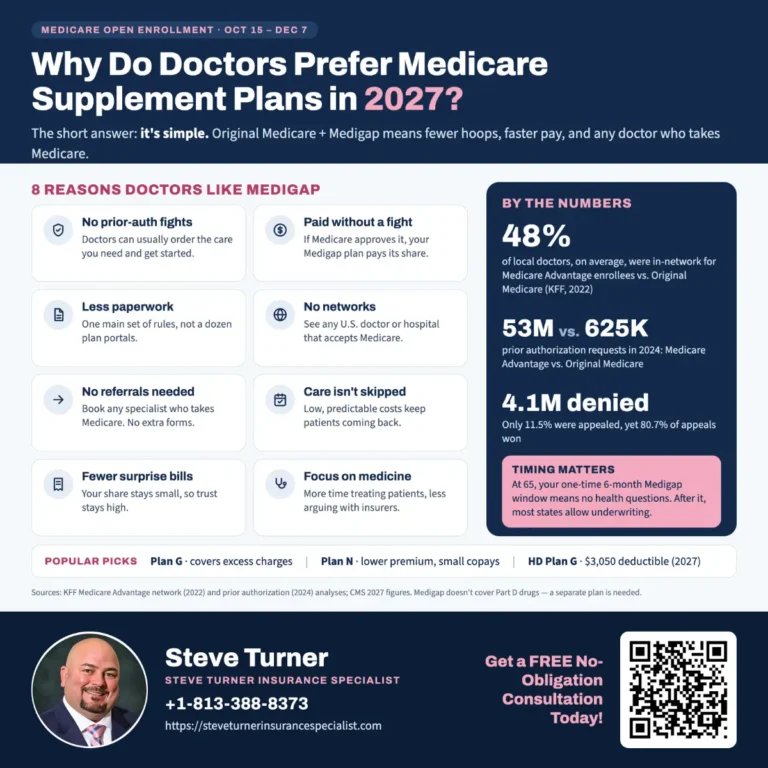
- Plan G. This is the top pick for many people new to Medicare. It covers everything on the menu except the Part B deductible. Once you pay that one deductible each year, you usually owe nothing else for Medicare-approved care.
- High-Deductible Plan G. Same coverage as Plan G, but you pay the first $3,050 of costs in 2027 before the plan pays. In return, the monthly premium is usually much lower.
- Plan N. This plan costs less each month than Plan G. The trade-off is small copays at the doctor and ER, and no coverage for excess charges.
- Plan F. It covers all nine benefits. But you can only buy it if you were eligible for Medicare before 2020. If you already have it, you can keep it.
- Plans K and L. These plans pay only part of your costs, so premiums are lower. They are the only plans with a yearly out-of-pocket cap. In 2027, that cap is $8,360 for Plan K and $4,180 for Plan L.
One tip I always share: since the coverage is the same for each letter, shop around on price. Two companies can charge very different premiums for the same plan.
Key 2027 Medicare Numbers That Affect Your Medigap Coverage
Two big 2027 Medigap numbers are official, and the rest are still projections. Here’s where things stand as of mid-October 2026.
| Cost | 2026 | 2027 | Status |
|---|---|---|---|
| High-deductible Plan G and F deductible | $2,950 | $3,050 | Official (CMS) |
| Plan K out-of-pocket limit | $8,000 | $8,360 | Official (CMS) |
| Plan L out-of-pocket limit | $4,000 | $4,180 | Official (CMS) |
| Part B deductible | $283 | About $292 | Projected (AARP) |
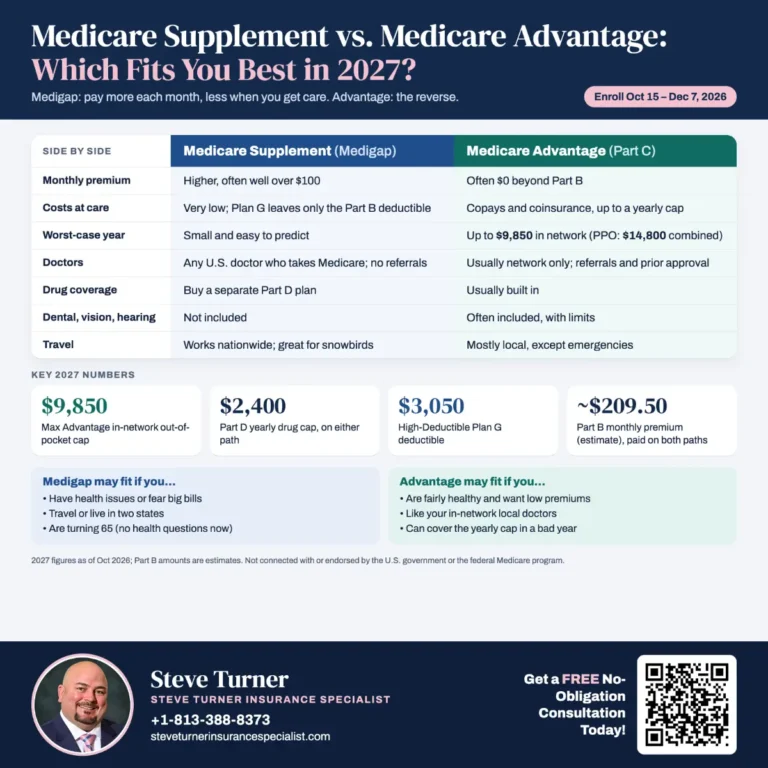
| Part B monthly premium | $202.90 | About $209.50 | Projected (MedicareFAQ) |
| Part A deductible (per benefit period) | $1,736 | Not yet announced | Expected in fall 2026 |
What These Numbers Mean for You
Let me break it down:
- If you pick High-Deductible Plan G, you could pay up to $3,050 in Medicare-covered costs in 2027 before the plan kicks in. That’s $100 more than in 2026—the Part B deductible counts toward that $3,050.
- If you pick regular Plan G, your main yearly cost (besides the premium) is the Part B deductible. That’s expected to be about $292 in 2027.
- If you pick Plan K or L, you pay your share of costs until you hit the cap. After that, the plan pays 100% of covered costs for the rest of the year.
- If you have Plan F or C, the plan pays your Part B deductible, so a rise in that deductible doesn’t hit your wallet.
CMS usually confirms the final Part A and Part B numbers for the next year in late October or November. I’d check Medicare.gov again before you lock in a plan.
What Medicare Supplement Insurance Does NOT Cover
Medigap only helps with costs for care that Original Medicare already covers. If Medicare doesn’t cover a service, your Medigap plan won’t either. This is what trips up a lot of people I talk to.
Here’s what Medigap does not pay for:
- Prescription drugs. Medigap plans sold today don’t cover drugs you get at the pharmacy. You need a separate Part D drug plan. In 2027, Part D has a $700 maximum deductible and a $2,400 yearly cap on drug costs.
- Routine dental care. Cleanings, fillings, and dentures aren’t covered.
- Routine vision care. Eye exams for glasses and the glasses themselves aren’t covered.
- Hearing aids. Hearing aids and exams to fit them aren’t covered.
- Long-term care. Help with daily tasks like bathing or dressing, often in a nursing home, isn’t covered.
- Private-duty nursing. A nurse who comes to your home full-time isn’t covered.
- Your monthly premiums. Medigap doesn’t pay your Part B premium or its own premium.
So what can you do about these gaps? Here are a few ideas I’ve seen people use:
- Buy a Part D plan for your medicines.
- Look at a stand-alone dental, vision, or hearing plan.
- Think about long-term care insurance if you’re worried about nursing home costs.
- Ask your local SHIP office if you qualify for help paying Medicare costs.
When Should You Sign Up for a Medigap Plan?
The best time to buy Medigap is during your Medigap Open Enrollment Period. It lasts six months. It starts the first month you are both 65 or older and enrolled in Part B.
I can’t stress this enough. During those six months, insurance companies must sell you any Medigap plan they offer in your state. They can’t turn you down or charge you more because of health problems.
After that window closes, things can get harder. In most states, a company can ask health questions. It can charge you more or even say no. Some states have extra rules that give you more chances to switch, so check with your state.
Here are a few more rules I want you to know:
- You must have Part A and Part B to buy a Medigap plan.
- Medigap doesn’t work with Medicare Advantage. You can’t use both at the same time. Medigap only works with Original Medicare.
- Each policy covers one person. If you and your spouse both want coverage, you each need your own plan.
- You can’t cancel your plan for health reasons. As long as you pay your premium, your plan is guaranteed renewable.
- Fall Open Enrollment is different. The October 15 to December 7 window is for Medicare Advantage and Part D changes. It does not give you special rights to switch Medigap plans.
Medigap Questions People Ask Me All the Time
Q: Is Medicare Supplement Insurance the same as Medicare Advantage?
A: No. They are very different. Medigap works alongside Original Medicare and helps pay your share of costs. Medicare Advantage (Part C) replaces Original Medicare with a private plan. Advantage plans often have networks, so you may need to use certain doctors. With Medigap, you can see any doctor in the U.S. who accepts Medicare.
Q: Which Medigap plan covers the most in 2027?
A: Plan F covers all nine benefits. But only people who were eligible for Medicare before January 1, 2020, can buy it. For everyone else, Plan G covers the most. Plan G is the only plan that leaves out the Part B deductible.
Q: Did Medigap coverage change for 2027?
A: The benefits each plan covers stayed the same. What changed are the dollar amounts. The high-deductible Plan G and F deductibles rose to $3,050. The Plan K and Plan L caps rose to $8,360 and $4,180. Your premium may also change, since each insurance company sets its own prices.
Q: Does Medigap cover care when I travel?
A: Inside the U.S., yes. You can use any provider that takes Medicare, in any state. Outside the U.S., Plans C, D, F, G, M, and N pay 80% of emergency care after a $250 deductible. This benefit has a $50,000 lifetime limit. If you travel a lot, you may want extra travel insurance too.
Q: How much does a Medigap plan cost in 2027?
A: It depends. Prices change based on where you live, your age, the plan letter, and the company. Some companies also look at whether you use tobacco. The only way to know for sure is to get quotes. I’d compare at least three companies for the same plan letter.
Q: What are Part B excess charges, and do I need to worry about them?
A: Some doctors don’t accept Medicare’s approved amount as full payment. They can charge you up to 15% more. That extra amount is called an excess charge. Plans F and G cover it. Most doctors do accept Medicare’s approved amount, so many people never face these charges. But it’s nice to be covered.
Q: Can I switch Medigap plans later?
A: You can apply to switch any time. But outside your open enrollment period, the company may ask health questions and could say no. Some states give you yearly chances to switch without health questions. Check your state’s rules before you drop your current plan.
Q: Do I still need a Part D plan if I have Medigap?
A: Most likely, yes. Medigap plans sold today don’t cover pharmacy drugs. If you skip Part D when you’re first eligible and don’t have other drug coverage, you may pay a late penalty later.
My Final Thoughts on Medigap Coverage for 2027
Medicare Supplement Insurance can turn surprise medical bills into costs you can plan for. In 2027, the benefits stay the same, but some key dollar amounts went up.
If I had to sum it all up, here’s what I’d want you to remember:
- Medigap fills the gaps in Original Medicare, like deductibles, coinsurance, and copays.
- Plans are standardized, so the same letter means the same coverage at any company.
- Plan G is the fullest plan most new members can buy. Plan N is a solid lower-cost choice.
- High-Deductible Plan G has a $3,050 deductible in 2027.
- Plans K and L have yearly caps of $8,360 and $4,180 in 2027.
- Medigap doesn’t cover drugs, dental, vision, hearing, or long-term care. Plan for those separately.
- Your six-month open enrollment window is the best time to buy. Don’t let it slip by.
My best advice is simple. Think about your health, your budget, and how much risk you’re okay with. Then compare prices for the plan letter you want from a few companies. If you get stuck, your local SHIP offers free, unbiased help. You can also look up plans in your area at Medicare.gov.
Picking the right plan now can save you a lot of money and stress in 2027 and beyond.
Why choose Steve Turner Insurance Specialist?
Because I’m an “Insurance Specialist.” An “insurance specialist” is a broad term that includes insurance agents and insurance brokers, but the key difference is who the agent represents versus who the broker represents.
An “insurance agent” works directly for an insurance company and sells its specific policies to clients.
An “insurance broker” acts as an independent intermediary, comparing policies from multiple companies to find the best fit for their client’s needs, essentially representing the client rather than the insurance company.
I am both a licensed Insurance Agent and a licensed Insurance Broker.
My number one goal in life is to help people and ensure, without a shadow of a doubt, that you and your family are secure and protected. I will always be by your side, helping you mitigate risk by providing the industry’s best and most affordable insurance solutions.
I will find insurance plans for the entire family to help cover whatever life throws at you. I can help you save on severe medical emergencies, find a health insurance plan with low- or no-cost doctor visits and affordable prescription medications, and protect your family in the event of an unexpected accident or illness.
Best of all, it doesn’t cost you anything extra to use an experienced Insurance Agent and Broker like me to help you find the Insurance Plans that fit your individual, family, or business needs.
The companies that sell the insurance plans “you choose“ pay me – you don’t pay me. Calling any big insurance company directly won’t get you a lower price, as they will forward your call to the next available insurance agent on their list. You won’t have had any opportunity to learn about the insurance agent you’re speaking with in advance, understand their qualifications or experience level, or make an informed choice about who you want to work with.
Tap the Contact Me text or icon and get in touch by phone or email, or schedule a “No Obligation” chat through my calendar. I look forward to speaking with you!
OUR CLIENT REVIEWS


CONTACT STEVE TURNER, LICENSED INSURANCE AGENT & BROKER
Questions? Call, text, or book a time below; I answer calls and emails 7 Days a week from 7:00 a.m. to 8:00 p.m., excluding posted holidays.
EMAIL ME: 24×7
OFFICE LOCATION
Address: 14502 N Dale Mabry Hwy, Suite 200, Tampa, FL 33618
Website: steveturnerinsurancespecialist.com
Email: [email protected]
Phone and Text: +1-813-388-8373
Business Hours:
Monday: 7:00 a.m. / 8:00 p.m.
Tuesday: 7:00 a.m. / 8:00 p.m.
Wednesday: 7:00 a.m. / 8:00 p.m.
Thursday: 7:00 a.m. / 8:00 p.m.
Friday: 7:00 a.m. / 8:00 p.m.
Saturday: 7:00 a.m. / 8:00 p.m.
Sunday: 7:00 a.m. / 8:00 p.m.
MEDICARE SUPPLEMENT POSTS

INSURANCE OFFERINGS
What Does Medicare Supplement Insurance Cover for 2027?
HEALTH INSURANCE

MEDICARE ADVANTAGE

MEDICARE SUPPLEMENT

PRESCRIPTION DRUGS

LIFE INSURANCE

DISABILITY INSURANCE

DENTAL INSURANCE

GROUP HEALTH INSURANCE

ACCIDENT INSURANCE

LONG TERM CARE INSURANCE

MEDICAID INSURANCE

MEDICARE INSURANCE

MEDICARE PART A INSURANCE

MEDICARE PART B INSURANCE

MEDICARE PART C INSURANCE

MEDICARE PART D INSURANCE

MEDICARE PLAN G INSURANCE

MEDICARE PLAN N INSURANCE

SERVICE AREA
Medicare plan availability differs by state and county. Steve Turner is licensed in AL, CO, FL, GA, NC, SC, TN, and TX.
Steve Turner is a licensed insurance agent and is not connected with or endorsed by the United States Government or the Federal Medicare Program. The Medicare Annual Enrollment Period is October 15 to December 7.
MEDICARE DISCLAIMER
We do not offer every plan available in your area. Any information we provide is limited to those plans we do offer in your area. Please contact Medicare.gov or 1-800-MEDICARE to get information on all of your options.
Steve Turner

Steve Turner, CLU®, REBC® is licensed in AL, CO, FL, GA, NC, SC, TN, and TX · NPN 18030539 · Florida License W333468
Steve Turner is a licensed agent and broker and a long-standing member of the National Association of Benefits and Insurance Professionals NABIP®. Steve holds the Registered Employee Benefits Consultant® (REBC®) designation. Steve also holds the “Chartered Life Underwriter” designation (CLU®), a professional credential for individuals specializing in life insurance and estate planning, conferred by the American College of Financial Services. Since 2016 (over 10 years), Steve has helped individuals, families, Medicare beneficiaries, and small businesses find the right coverage to meet their needs. Steve has earned 180+ Google reviews from happy clients.
Steve Turner is a licensed agent appointed by Florida Blue in Florida.