

Does Prescription Drugs Insurance Cover Seasonal Workers?

Does Prescription Drugs Insurance Cover Seasonal Workers? Customer in Seasonal Employment Looking for Coverage
Quick answer: Yes, seasonal workers can get prescription drug coverage. But it rarely comes from the job itself. Most seasonal workers get coverage through a Marketplace plan, Medicaid, a family member’s plan, or COBRA. Some lucky ones get it from an employer who offers health benefits to seasonal staff.
I wrote this guide because I know how confusing it can get. When you work a summer job at a beach resort, pick crops in the fall, or work retail during the holidays, your paycheck comes and goes with the season. Your need for medicine does not. If you take an inhaler, insulin, blood pressure pills, or anything else every day, you can’t stop just because the season ends.
So in this article, I’ll walk you through how prescription drug coverage works for seasonal workers. I’ll explain the rules in plain words. I’ll also cover the big changes coming in 2027, because some of them hit seasonal workers hard. By the end, you’ll know where to look and what to do next.
Why Prescription Coverage Matters So Much
Most people think of health insurance as “doctor and hospital” coverage. But for many of us, the pharmacy is where we spend money most often. A single brand-name drug can cost hundreds of dollars a month without insurance.
Here’s the good news. Almost every real health insurance plan includes prescription drugs. Under the Affordable Care Act (ACA), prescription drugs are one of the ten “essential health benefits.” That means Marketplace plans and most job-based plans have to cover them. Medicaid covers them too.
So the real question isn’t “Does insurance cover my pills?” It’s “How do I, as a seasonal worker, get a plan in the first place?” Let’s dig in.
Who Counts as a Seasonal Worker?
A seasonal worker is someone hired for a job that happens at the same time each year and lasts only part of the year. Under the ACA’s employer rules, a seasonal job usually lasts six months or less.
Here are some common seasonal jobs:
- Farm and harvest work – picking fruit, packing produce, or working in fields.
- Holiday retail – store, warehouse, and delivery jobs from November to January.
- Summer tourism – lifeguards, camp counselors, park staff, and hotel workers.
- Winter sports – ski instructors, lift operators, and lodge staff.
- Tax season help – tax preparers who work from January to April.
- Landscaping and construction – jobs that slow down when the weather turns cold.
- Fishing and canning – work that follows the fishing season.
Some seasonal workers come back to the same employer year after year. Others jump between two or three seasonal jobs to stay busy all year. Some come to the U.S. on a work visa, like the H-2A visa for farm work or the H-2B visa for other seasonal jobs.
Why does this matter? Because the type of worker you are changes which coverage options you can use. A U.S. citizen working a summer job has different choices than a visa worker. Someone who works 40 hours a week has different choices than someone who works 15.
Does My Seasonal Employer Have to Give Me Prescription Coverage?
Usually, no. This is the part that surprises most people, so I want to explain it clearly.
The ACA has a rule called the “employer mandate.” It says larger employers (generally those with 50 or more full-time workers) must offer health insurance to full-time employees or pay a penalty. Full-time means about 30 hours a week, or 130 hours a month.
But there are a few catches that often leave seasonal workers out:
- Small employers are not required to offer coverage at all. Many farms, shops, and summer camps have fewer than 50 full-time workers.
- A special seasonal worker exception applies. When an employer counts workers to determine whether it’s “large,” it can exclude seasonal workers who work 120 days or less in a year. So a business can look big in summer but still count as small.
- Employers can use a “look-back” period. For seasonal workers, an employer can watch your hours for up to 12 months before deciding if you’re full-time. If your job ends before that, you may never be offered a plan.
- Part-time workers don’t have to be offered coverage. If you work under 30 hours a week, the mandate doesn’t apply.
When You Might Get Coverage Through Work
That said, some employers do offer health plans to seasonal staff. Big ski resorts, large retailers, theme parks, and some farm operations offer benefits to attract good workers. If you get a job-based plan, it almost always includes prescription drugs.
Here’s what I’d ask your employer on day one:
- Do seasonal workers get health insurance here?
- How many hours do I need to work to qualify?
- Is there a waiting period before coverage starts? (By law, it can’t be longer than 90 days once you’re eligible.)
- What does the plan charge for prescriptions? Is there a list of covered drugs (called a “formulary”)?
- What happens to my coverage when the season ends?
That last question is a big one. When your seasonal job ends, your job-based coverage usually ends too. Often it stops at the end of the month you leave. So plan, especially if you need refills.
6 Ways Seasonal Workers Can Get Prescription Drug Coverage
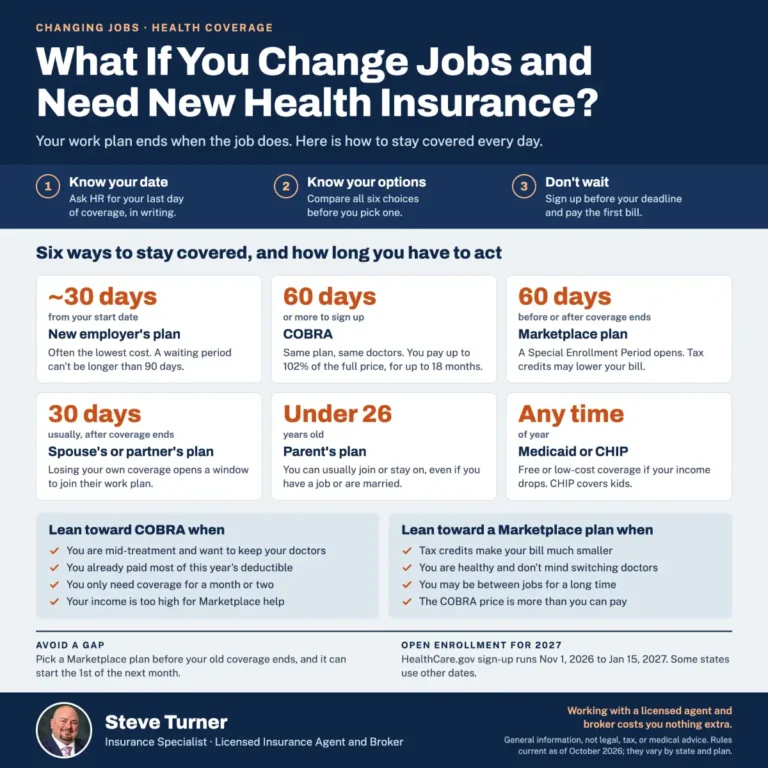
If your job doesn’t give you a plan, don’t worry. You still have options. Here are the six I’d look at first.
1. A Health Insurance Marketplace Plan
The Marketplace (HealthCare.gov or your state’s site) lets you buy your own health plan. Every Marketplace plan covers prescription drugs.
You can sign up during Open Enrollment. For 2027 coverage, Open Enrollment runs November 1, 2026, through January 15, 2027, in most states. Some state-run marketplaces use different dates, so check your state’s site.
You can also sign up outside Open Enrollment if you have a “qualifying life event.” Losing job-based coverage when your season ends is one of those events. You usually have 60 days to pick a new plan.
The Marketplace may also give you a tax credit to lower your monthly cost. It’s based on your expected income for the whole year, not just your busy season. That’s great for seasonal workers, because a few big months don’t count against you as much.
2. Medicaid
Medicaid is free or very low-cost health coverage for people with low incomes. It covers prescriptions, often for just a few dollars per fill. If your income drops in the off-season, you might qualify. Each state sets its own rules, and you can apply year-round.
3. CHIP for Your Kids
The Children’s Health Insurance Program (CHIP) covers kids in families who earn too much for Medicaid but can’t afford private insurance. It includes prescriptions.
4. A Spouse’s or Parent’s Plan
If your spouse has a job-based plan, you can usually join it. If you’re under 26, you can stay on a parent’s plan, even if you don’t live with them.
5. COBRA
COBRA lets you keep your old job-based plan after you leave your job. It generally applies to employers with 20 or more workers, and it can last up to 18 months. The catch? You pay the full cost plus a small fee, so it’s often expensive. It can still make sense for a short gap if you’re in the middle of treatment.
6. Medicare (If You’re 65 or Older)
Many seasonal workers are retirees who take a summer or holiday job. If you’re 65 or older, Medicare Part D covers prescription drugs. It doesn’t matter what your job is.
Side-by-Side Look
| Option | Covers prescriptions? | When you can sign up | Best for |
|---|---|---|---|
| Job-based plan | Yes | When your employer offers it | Full-time seasonal workers at large companies |
| Marketplace | Yes | Open Enrollment or within 60 days of losing coverage | Most seasonal workers without a job plan |
| Medicaid | Yes | Any time | People with low or no off-season income |
| CHIP | Yes | Any time | Children in working families |
| Family member’s plan | Yes | Their Open Enrollment or a life event | Spouses and people under 26 |
| COBRA | Yes | Within 60 days after job-based coverage ends | Short gaps during ongoing treatment |
| Medicare Part D | Yes | Your Medicare enrollment periods | Workers 65 and older |
Big Changes in 2027 That Seasonal Workers Need to Know
A federal law passed in July 2025 (often called the One Big Beautiful Bill Act, or H.R. 1) changes several health programs. Some of these changes start on January 1, 2027. Here’s what seasonal workers should watch for.
Medicaid Work Rules Start January 1, 2027
Starting January 1, 2027, most adults ages 19 through 64 will need to work, go to school, volunteer, or earn a certain amount each month to keep Medicaid. This mainly applies to adults who got Medicaid through their state’s Medicaid expansion. Some states, like Nebraska, started even earlier.
The basic rule is 80 hours of activity a month, or earning at least $580 a month (80 hours times the federal minimum wage).
Now here’s the part that matters for you. Seasonal workers have a special rule. Seasonal workers can meet the requirement if their average monthly work income over the past six months reaches that same $580 level. For example, Colorado explains that it adds up all earned income from the last 6 months and divides by 6.
So if you earn $3,500 during a busy summer and almost nothing in the fall, your six-month average could still pass. That’s a big help. But you’ll need proof, so keep your pay stubs.
Also, in many states, adults in the Medicaid expansion group must renew every six months instead of once a year. Watch your mail closely so you don’t accidentally lose coverage.
Marketplace Tax Credits Got Smaller
The extra-large “enhanced” tax credits that many people used from 2021 to 2025 ended. The enhanced premium tax credits ended in December 2025, and premium help went back to older, smaller levels. Tax credits are still available, but many people now pay more each month. Shop carefully during Open Enrollment, because last year’s cheapest plan may not be the best deal this year.
Visa Workers May Lose Tax Credits
This matters for H-2A and H-2B workers. Starting in 2027, premium tax credit eligibility will be limited to lawful permanent residents (green card holders), certain Cuban and Haitian entrants, and certain COFA migrants. Groups losing tax credits in 2027 include refugees, people granted asylum, valid visa holders, and people with Temporary Protected Status.
That means many seasonal visa workers will have to pay full price for a Marketplace plan, which is often too expensive. If that’s you, the money-saving tips in the next section and community health centers become extra important.
My advice: These rules are new, and states are still implementing them. Call your state Medicaid office or a free Marketplace helper (called a “navigator”) to check how they apply to you.
8 Ways to Save on Prescriptions (With or Without Insurance)
Even with a plan, medicine can get pricey. And if you’re between plans, every dollar counts. Here are my favorite ways to cut costs.
- Ask for the generic. Generic drugs work the same way as brand names but often cost far less. Ask your doctor or pharmacist if one is available.
- Use a free discount card or app. Programs like GoodRx and SingleCare show coupon prices at nearby pharmacies. They’re free, and sometimes they beat your insurance price.
- Check low-cost online pharmacies. Some online pharmacies, like Mark Cuban Cost Plus Drug Company, sell many generics close to what they cost to make.
- Visit a community health center. Federally funded health centers charge on a sliding scale based on income. Many also have low-cost pharmacies. Some, called migrant health centers, focus on farm and seasonal workers. You can find one at findahealthcenter.hrsa.gov.
- Apply for a patient assistance program. Many drug companies give free or cheap medicine to people with low incomes. Ask your doctor’s office or search the drug maker’s website.
- Get a 90-day supply before your job ends. If you know your coverage is ending, ask your doctor if you can fill a three-month supply while you’re still insured. Your plan has to allow it, so call first.
- Shop around. Prices for the same drug can vary widely from one pharmacy to the next. Big-box stores and warehouse clubs often have lower prices on common generics.
- Ask your doctor about cheaper options. Sometimes there’s an older drug that works just as well for much less money. Your doctor won’t know cost matters to you unless you say so.
Frequently Asked Questions
Q: Do seasonal workers get health insurance through their job?
A: Sometimes, but not usually. Employers with fewer than 50 full-time workers don’t have to offer it. Larger employers can also leave out many seasonal and part-time workers. Always ask during hiring.
Q: If I have a health plan, will it cover my prescriptions?
A: Almost always, yes. Marketplace plans, Medicaid, and most job-based plans cover prescriptions. But each plan has its own list of covered drugs, called a formulary. Check that your medicine is on the list before you pick a plan.
Q: What happens to my prescription coverage when the season ends?
A: If you had a job-based plan, it usually ends when the job ends, often at the end of that month. You then have 60 days to sign up for a Marketplace plan or choose COBRA. You can apply for Medicaid any time.
Q: Can I sign up for a Marketplace plan in the middle of the year?
A: Only if you have a qualifying life event, like losing other coverage, moving, having a baby, or getting married. Otherwise, you’ll need to wait for Open Enrollment.
Q: How does the Marketplace count income that goes up and down?
A: It looks at your expected income for the whole year. Make your best guess, then update it if things change. If you guess too low, you may have to pay back some of your tax credit at tax time. Starting in 2026, there’s no cap on how much you might have to pay back, so report changes quickly.
Q: Do H-2A farm workers get health insurance?
A: H-2A employers must provide workers’ compensation for on-the-job injuries. But they generally don’t have to offer health insurance. Starting in 2027, many visa holders also lose Marketplace tax credits. Migrant health centers can be a lifesaver here.
Q: Will Medicaid’s new work rules kick me off during my off-season?
A: Not necessarily. The seasonal worker rule lets you use your six-month average income. If that average is at least $580 a month, you can meet the rule even in slow months. Keep your pay records handy.
Q: Is a short-term health plan a good idea for seasonal workers?
A: Be careful. Short-term plans are cheaper, but they don’t have to follow ACA rules. Many don’t cover prescriptions well, or at all. They may also refuse to cover pre-existing conditions. Read the fine print first.
My Final Thoughts
So, does prescription drug insurance cover seasonal workers? Yes, it can. But you usually have to find it. Your seasonal job probably won’t hand you a plan. The good news is that the Marketplace, Medicaid, CHIP, family plans, COBRA, and Medicare all cover prescriptions.
The key is timing. Seasonal work starts and stops, and coverage can start and stop with it. If you plan a few weeks, you can avoid a gap when you can’t afford your medicine.
Your Seasonal Worker Prescription Checklist
- Ask your employer if seasonal workers can get health insurance.
- Make a list of every medicine you take and how much you need.
- Mark November 1, 2026, on your calendar for Open Enrollment.
- Check if your medicines are on a plan’s covered drug list before you sign up.
- Save your pay stubs for Medicaid’s six-month income rule.
- Fill a 90-day supply before your job-based coverage ends, if your plan allows it.
- Find your nearest community health center, just in case.
- Report income changes to the Marketplace right away.
Health rules change often, and they’re changing a lot right now. Before you make a final choice, talk to a free navigator at HealthCare.gov or your state Medicaid office. They can look at your exact situation. Your health is worth that one phone call.
Why choose Steve Turner Insurance Specialist?
Because I’m an “Insurance Specialist.” An “insurance specialist” is a broad term that includes insurance agents and insurance brokers, but the key difference is who the agent represents versus who the broker represents.
An “insurance agent” works directly for an insurance company and sells its specific policies to clients.
An “insurance broker” acts as an independent intermediary, comparing policies from multiple companies to find the best fit for their client’s needs, essentially representing the client rather than the insurance company.
I am both a licensed Insurance Agent and a licensed Insurance Broker.
My number one goal in life is to help people and ensure, without a shadow of a doubt, that you and your family are secure and protected. I will always be by your side, helping you mitigate risk by providing the industry’s best and most affordable insurance solutions.
I will find insurance plans for the entire family to help cover whatever life throws at you. I can help you save on severe medical emergencies, find a health insurance plan with low- or no-cost doctor visits and affordable prescription medications, and protect your family in the event of an unexpected accident or illness.
Best of all, it doesn’t cost you anything extra to use an experienced Insurance Agent and Broker like me to help you find the Insurance Plans that fit your individual, family, or business needs.
The companies that sell the insurance plans “you choose“ pay me – you don’t pay me. Calling any big insurance company directly won’t get you a lower price, as they will forward your call to the next available insurance agent on their list. You won’t have had any opportunity to learn about the insurance agent you’re speaking with in advance, understand their qualifications or experience level, or make an informed choice about who you want to work with.
Tap the Contact Me text or icon and get in touch by phone or email, or schedule a “No Obligation” chat through my calendar. I look forward to speaking with you!
OUR CLIENT REVIEWS


CONTACT STEVE TURNER INSURANCE AGENT & BROKER
I’m here to take your calls and emails and answer your questions 7 Days a week from 7:00 a.m. to 8:00 p.m., excluding posted holidays.
Steve Turner is a licensed agent and broker and a longstanding member of the National Association of Benefits and Insurance Professionals®. Steve holds the prestigious Registered Employee Benefits Consultant® designation. NABIP® is the preeminent organization for health insurance and employee benefits professionals and works diligently to ensure all Americans have access to high-quality, affordable Healthcare and related services.
Steve Turner is a licensed agent appointed by Florida Blue.
EMAIL ME: 24×7
OFFICE LOCATION
Website: steveturnerinsurancespecialist.com
Email: [email protected]
Phone and Text: +1-813-388-8373
Business Hours:
Monday: 7 a.m. to 8 p.m.
Tuesday: 7 a.m. to 8 p.m.
Wednesday: 7 a.m. to 8 p.m.
Thursday: 7 a.m. to 8 p.m.
Friday: 7 a.m. to 8 p.m.
Saturday: 7 a.m. to 8 p.m.
Sunday: 7 a.m. to 8 p.m.
SOCIAL FOLLOW + SHARE
Insurance Agent
MEDICARE STATEMENT
The Medicare Annual Enrollment Period is October 15th to December 7th. Steve Turner is not connected with or endorsed by the United States Government or the Federal Medicare Program. Some plans may not be available in your area, and any information I provide is limited to those offered. Please contact Medicare.gov or 1-800-MEDICARE for information on all your options.
There’s no one-size-fits-all answer. Carefully evaluate your health status, anticipated medical needs, prescription drug usage, budget, preferred doctors and hospitals, and tolerance for network rules. During the Medicare Annual Enrollment Period (October 15th to December 7th), research the specific plans available in your Florida county using the Medicare Plan Finder on Medicare.gov, compare costs and benefits, and consider free, personalized counseling from Florida’s SHINE (Serving Health Insurance Needs of Elders) program.